

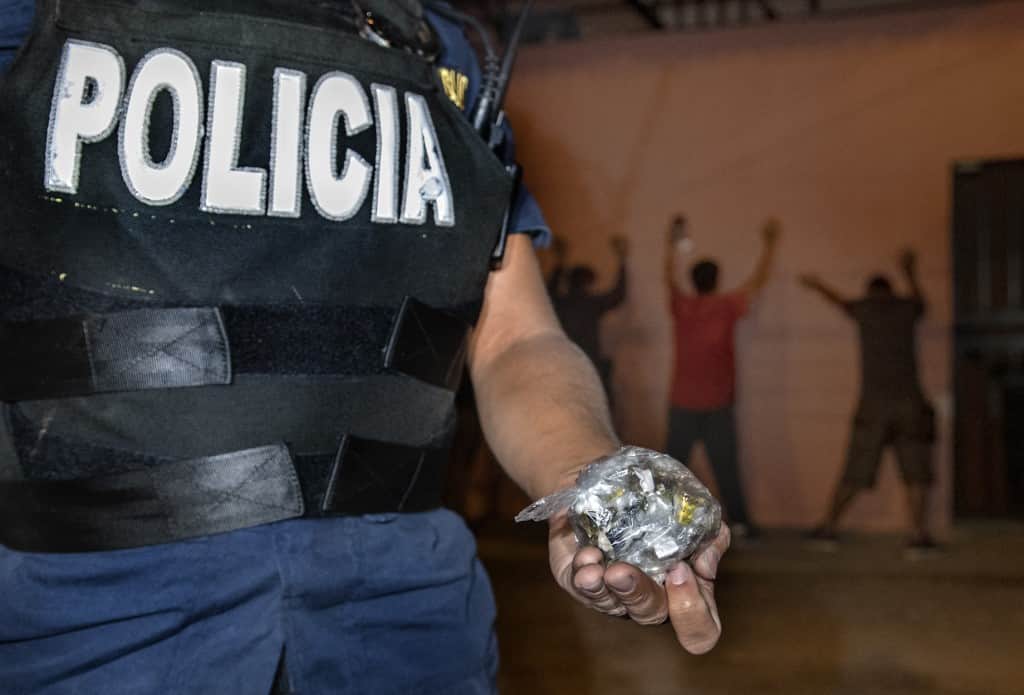
As we wrote about in an earlier article, authorities struck a significant blow against organized crime today, as they dismantled the South Caribbean Cartel in what officials called the largest police operation in the nation’s history.
The raid targeted a transnational group responsible for trafficking cocaine and marijuana to the United States and Europe, seizing millions in assets and arresting dozens. Among the connections uncovered, former INCOPESCA director Anita McDonald stands out due to her family ties and prior associations with key figures in the network.
The operation, dubbed “Traición,” involved 1,200 agents from the Judicial Investigation Agency (OIJ), the Public Prosecutor’s Office, and other security forces. They conducted 64 simultaneous raids across provinces including Limón, San José, Alajuela, Cartago, Puntarenas, and Isla Chira.
By midday, 33 suspects faced detention, with assets valued at over 2 billion colones confiscated, including luxury condos, vehicles, boats, and cash. Over the course of the investigation, which began in 2022 after a massacre in Dondonia, Limón, agents seized 13.7 tons of drugs and 68 firearms.
OIJ subdirector Michael Soto described the cartel as a full-fledged transnational entity with divisions for armed enforcement, finances, logistics, legal support, and technology. The group-controlled drug routes along both the Pacific and Caribbean coasts, receiving shipments from Colombia and distributing them domestically while exporting to international markets. Soto noted the cartel’s role as the primary supplier of cocaine and marijuana in Costa Rica, fueling local violence through sales to smaller gangs.
Leading the organization were brothers Luis Manuel Picado Grijalba, alias “Shock,” and Jordie Picado Grijalba, alias “Noni.” Shock remains detained in the United Kingdom following his arrest in December 2024 at a London airport, where he awaits extradition to the United States on drug trafficking charges. Noni sits in a Costa Rican prison, also pending extradition.
The cartel’s armed branch fell under Tony Peña Russell, linked to 78 homicides and known for training assassins in Limón. Other prominent members included figures like “Macho Coca” and “Pecho Rata,” who oversaw operations in the region.
Anita McDonald, a lawyer from Limón and former board member of the Costa Rican Institute of Fisheries and Aquaculture (INCOPESCA), connects to this network through family and historical associations. McDonald is the mother-in-law of Shock, whose wife, Estefanía McDonald Rodriguez, played an unwitting role in his capture.
Rodriguez posted photos of their European vacation on social media, allowing U.S. Drug Enforcement Administration (DEA) agents to track the couple’s movements from Costa Rica to Paris, Rome, and London. The posts, which included landmarks like the Eiffel Tower and Trevi Fountain, provided the location data needed for Shock’s arrest.
McDonald’s ties extend beyond family. In 2015, during the administration of President Luis Guillermo Solís, she faced dismissal from INCOPESCA’s board after recommending Gílbert Bell, alias “Macho Coca,” as an advisor. Bell, accused of drug trafficking at the time, later emerged as a key player in the South Caribbean Cartel.
Authorities investigated McDonald for her contacts with Bell, including a meeting in Portete de Limón alongside Ann McKinley, then-executive president of the Atlantic Port Authority (JAPDEVA). While McKinley received exoneration due to lack of evidence, the incident highlighted McDonald’s proximity to criminal elements. Weeks after the meeting, prosecutors raided the area over an illegal pier construction tied to Bell’s activities.
The 2015 probe also revealed McDonald’s interactions with members of rival group “La H,” drawing further scrutiny. Bell himself now faces detention for fuel theft, but his role in the cartel underscores the long-standing networks in Limón, a hotspot for drug shipments due to its ports and coastal access.
This latest crackdown involved international collaboration with agencies from Colombia, Panama, Spain, the UK, France, and the DEA. Soto warned that the cartel’s fall might create power vacuums, potentially sparking more violence in the Caribbean as released criminals vie for control. Public Prosecutor Carlo Díaz emphasized the operation’s importance for Limón, calling it a debt owed to the province long plagued by gang turf wars.
Costa Rica has seen a surge in drug-related homicides, with 905 in 2023, 880 in 2024, and projections nearing 900 for 2025. The South Caribbean Cartel’s operations contributed to this trend, using sophisticated laundering schemes and armed enforcers modeled after Mexican groups like the Zetas.
As extradition proceedings for the Picado brothers continue, the focus shifts to asset forfeiture and preventing regrouping. For residents in Limón, the raids offer hope, but the intertwined personal and criminal connections, like those involving McDonald, remind us of the deep roots of these networks in our society.





