

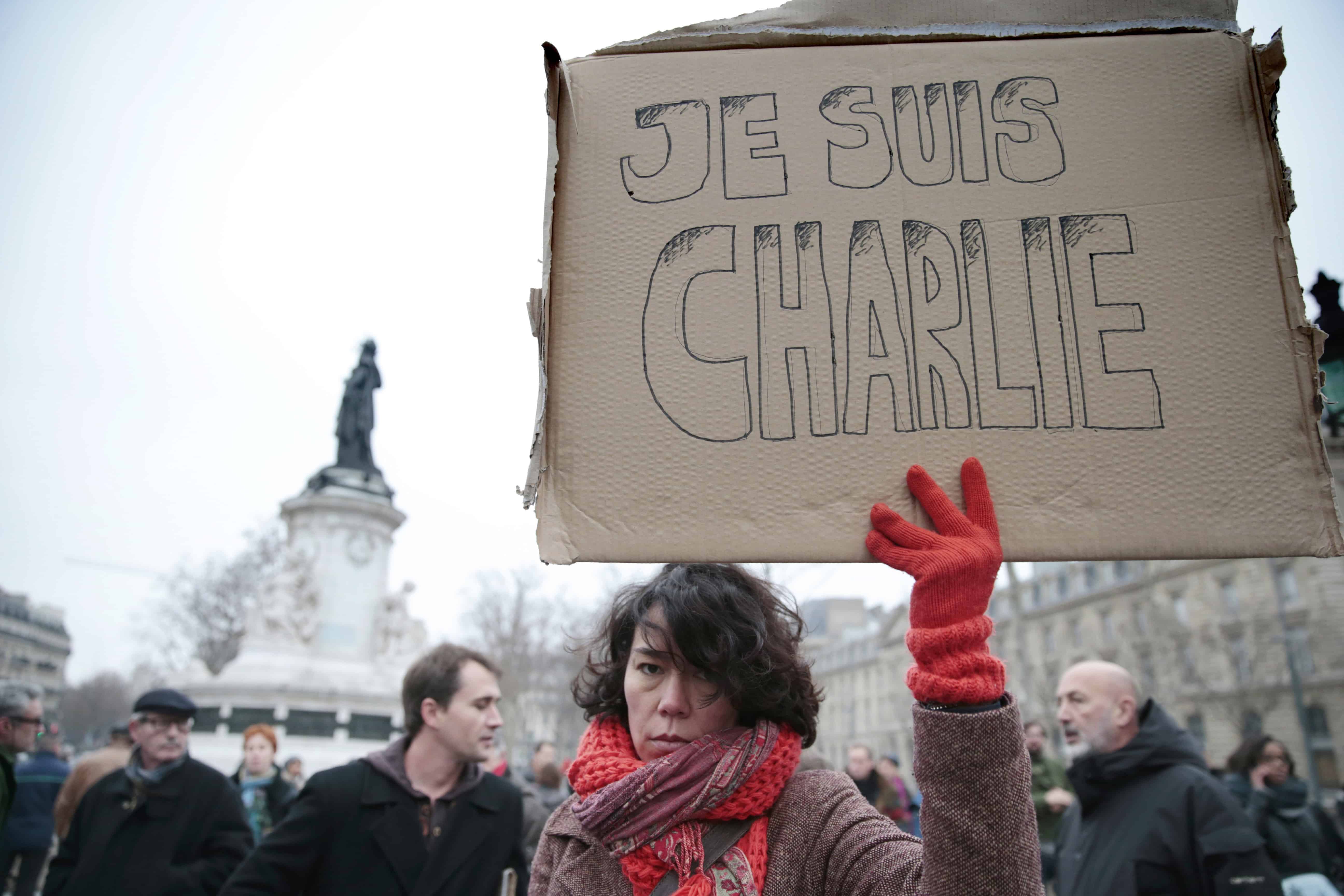
In the aftermath of a deadly attack on the satirical newspaper Charlie Hebdo in Paris, many took to social media to rally and mourn — changing their profile pictures to “Je suis Charlie” after the name of the paper, and making the terms #CharlieHebdo, Bernard Maris, Cabu and Wolinski trend worldwide on Twitter.
But in murkier, quieter corners of the Internet, other hashtags are also trending: While it’s not entirely clear, at this point, who is responsible for the attack, a number of self-proclaimed jihadis have been celebrating it on a hashtag that Al-Hayat’s Joyce Karam translates as #ParisInvasion.
“Mock the Prophet of Islam and pay with your life,” reads a rough translation of one tweet. “This is a deterrent for every coward.”
“God is great,” wrote another, next to a graphic picture from the attacks. Another tweeted a picture of a man on a stretcher with a reference to a Quranic passage about jihad.
https://twitter.com/olasalah5569/status/552869352949960704
The tweets are, if nothing else, a fairly predictable illustration of extremist vitriol. But they’re also examples of a relatively new danger for mainstream social platforms like Twitter: infiltration by extremists who use the sites to recruit and spread their views.
One would think that kind of thing has been going on for a while — after all, sites like YouTube, Facebook and Twitter were born at the height of the war on terror. But representatives for several major U.S. networks say it’s a problem that’s become particularly pressing since the rise of the Islamic State, with its sophisticated messaging and propaganda strategies.
The group has, for instance, used the anonymous question-and-answer site Ask.fm to recruit a number of Westerners to its cause, including three American teenagers who tried to travel to a Syrian camp three months ago. They’re active on Twitter, Facebook, Kik and even Tumblr, where a number of fighters and their wives have started personal blogs. (Sample post from the blog Al-Khansaa: “Are there decent hair driers and straighteners in Syria?”)
In September, an Islamic State-affiliated account even took to Twitter to threaten employees of the site, warning that “every Twitter employee in San Francisco … (should) watch over himself, because on his doorstep there might be a lone assassin waiting.” The account was quickly suspended, and Twitter promised a full investigation into the tweets.
Unfortunately, weeding out extremists and their sympathizers is more difficult than it looks. For one thing, many extremists don’t use language that would catch the attention of keyword filters or other automated moderation tools; the jihadists who have recruited Westerners to join them in Syria, for instance, often speak more generally of religion or “travel.”
“It’s a really tough issue,” Catherine Teitelbaum, chief of trust & safety at Ask.fm, told The Washington Post last month. “The language itself is benign — the tone of the conversations is actually very casual. There’s very little reference to violence. It’s not like other areas of abuse.”
Even when social networks do find terrorists in their midst, they often leave the accounts up at the behest of law enforcement, who hope to glean some intelligence from them — or even tweet back.
That’s an awkward, and complicated, position for networks: On one hand, they’re cooperating with law enforcement; on the other, they necessarily open themselves up to incidents like these — and accusations that they serve as some kind of mouthpiece through which extremists reach the moderate masses.
Still, the opposite is true, too. On Wednesday morning, one of the more popular tweets on the #ParisInvasion hashtag was from the U.S.-based Arabic-language blogger Naseem Alomari.
“No to terrorism, yes to dialogue,” it says, in part.
French Internet users start using this image "I am charlie" as profiles. pic.twitter.com/dkUPqQRBCA
— Julien Pain (@JulienPain) January 7, 2015
Dewey writes The Post’s The Intersect web channel covering digital and Internet culture.
© 2015, The Washington Post





