

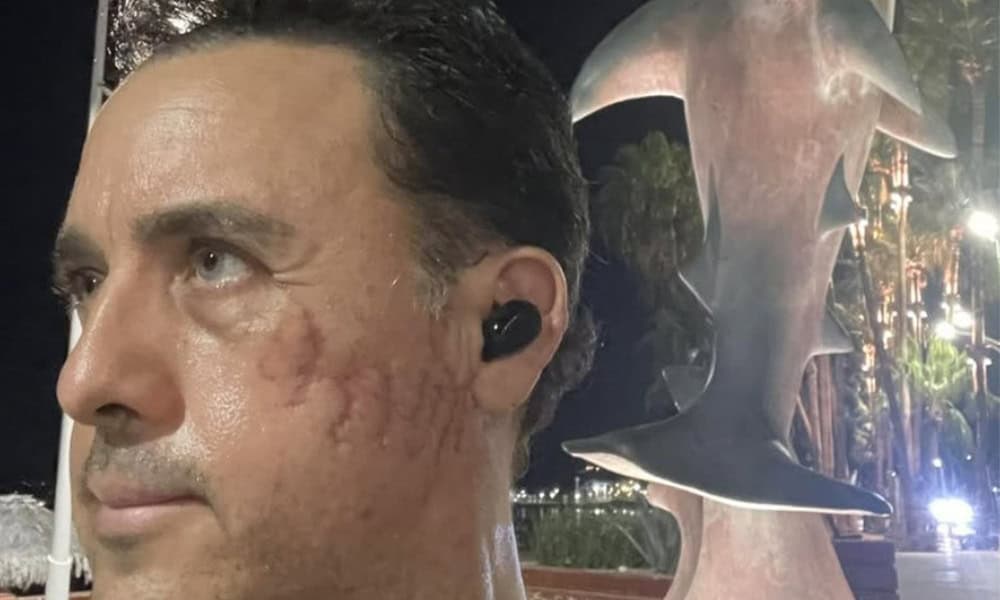
A Mexican marine biologist with decades of experience studying sharks faced a life-threatening encounter in September when a Galapagos shark clamped down on his head during a tagging operation near Cocos Island. Mauricio Hoyos, 48, emerged from the ordeal with serious injuries but a firm resolve to continue his work—and even a desire to cross paths with the same animal again.
Hoyos led a scientific team from the One Ocean Worldwide Coalition on a mission to track shark migration patterns around the remote island, located over 500 kilometers off Costa Rica’s Pacific coast. The group aimed to gather data on breeding and feeding grounds to support conservation efforts against overfishing. On the day of the incident, Hoyos descended to a depth of about 37 meters to tag a female Galapagos shark measuring more than three meters long.
He fired a pole spear to attach an acoustic tag to the shark’s dorsal fin. Moments later, the animal turned and bit him. “My whole head was inside her mouth,” Hoyos recalled from his recovery bed. He felt the immense pressure of the jaws but noted that the shark released him after a brief moment, swimming away without further pursuit.
The attack left Hoyos with 27 puncture wounds matching the shark’s teeth, deep lacerations on his scalp, and damage to his jaw that required surgical repair. Blood clouded the water, and his scuba gear sustained damage, forcing a rapid ascent. Fellow divers and park rangers on Cocos Island provided immediate aid, stemming the bleeding and stabilizing him before a grueling 36-hour boat journey back to the mainland.
Upon arrival in Puntarenas, rescuers transferred Hoyos to a hospital in San José, where doctors performed two surgeries to mend his injuries. He spent weeks recovering, first in Costa Rica and then at home in La Paz, Baja California, Mexico. Despite the trauma, Hoyos expressed gratitude for the swift response from Costa Rican authorities and medical teams. “They treated me like one of their own,” he said.
Hoyos, who has dedicated over 30 years to marine research, views the incident not as an act of aggression but as a defensive response from a startled animal. “She spared my life,” he stated, emphasizing that humans do not form part of sharks’ natural diet.
He pointed out that such events remain rare, even for those who work closely with these predators. In fact, Hoyos has encountered similar situations before, including a previous bite from another Galapagos shark that cost him part of a finger.
His passion for sharks began in childhood, inspired by films that often portray them as threats. Instead, those stories drove him to study and protect the species. Hoyos has earned awards for his conservation work, including recognition from groups like Fins Attached and Shark Project International. He stresses the need to dispel misconceptions: “We kill hundreds of thousands of sharks daily through fishing, yet they rarely harm us.”
Now back in Mexico, Hoyos reports steady progress in his healing. He plans to dive again as early as mid-November and return to Cocos Island in January. Remarkably, he hopes to locate the shark that bit him, thanks to the tag he placed just before the attack. “I marked her, so I can track if she’s still there,” he explained. For Hoyos, the encounter serves as a reminder of the respect owed to marine life, not a reason to fear it.
Cocos Island, a UNESCO World Heritage site and national park, draws researchers and divers for its rich biodiversity, including hammerhead, tiger, and whale sharks. The area supports vital ecosystems but faces pressures from illegal fishing. Hoyos’s work contributes to broader efforts to safeguard these waters, highlighting the balance between human activity and wildlife preservation.
As our country continues to promote ocean conservation, stories like Hoyos’s underscore the risks scientists take to protect vulnerable species. His determination to return reflects a commitment shared by many in the field: understanding sharks means coexisting with them, not avoiding them.





