
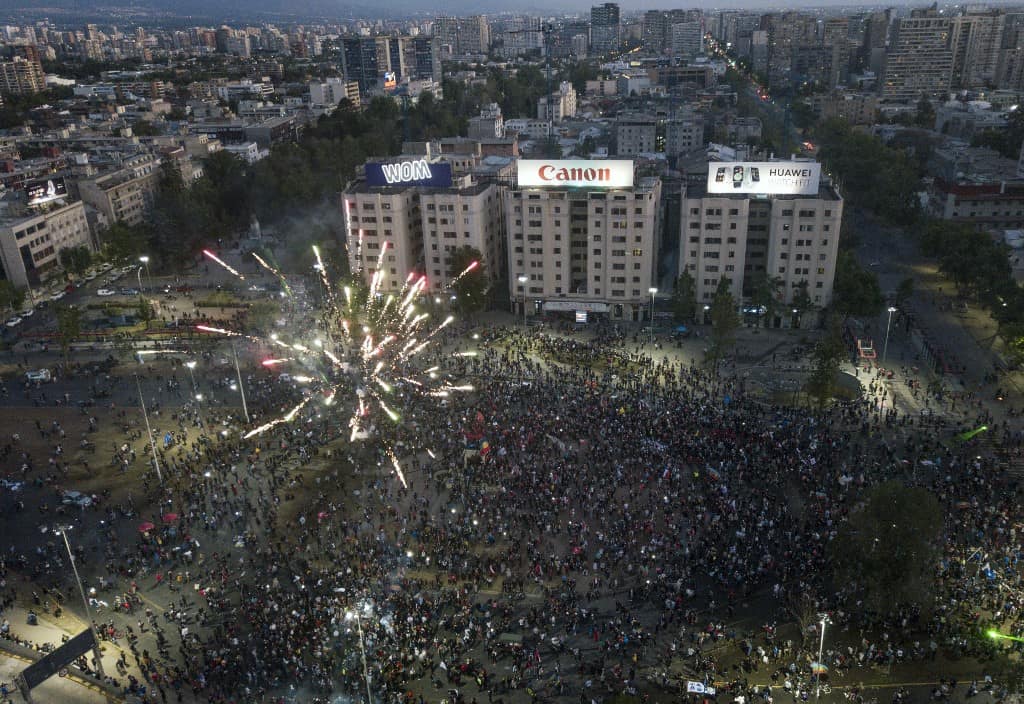
Chileans gleefully ripped up their Pinochet-era constitution in a weekend referendum, but the focus turned Monday to the next chapter, as the country begins the tricky task of forging its replacement.
Citizens of the South American country voted overwhelmingly on Sunday to consign the last vestiges of General Augusto Pinochet’s brutal dictatorship to history.
The result set off wild celebrations by jubilant crowds singing “Adios General.”
“I’m so happy to feel that the people have finally made their voice heard,” said 58-year-old secretary Carolina Martinez as she walked to work Monday in Santiago.
A key upshot of the result is that the state is now likely to play a greater role in the economy, reducing inequality and providing greater social welfare spending on health, education, public housing and pensions.
However, “the road ahead is full of uncertainties and rewriting the constitution will be a complex process,” warned Capital Economics in a note.
The process is fraught with risk for the conservative government of President Sebastian Pinera, badly bruised by the referendum result and with elections approaching next year, analysts said.
The 70-year-old billionaire acknowledged in a speech late Sunday that the country had been “divided” by the constitution, and called for unity in the search for “a new constitution for Chile.”
“From today we must all work together,” he said.
The appeal may come too late for many in Chile who believe Pinera and his conservative coalition grudgingly agreed to hold a referendum only after months of deadly protests.
‘Extremely fragile’ government
In the end, the resounding 78 percent majority “should be read as a rejection of the political parties, which to a large extent have been administrators of Pinochet’s constitution, of the regime we inherited from him,” said political scientist Marcelo Mella from the University of Santiago.
Mella said the vote marks a new beginning for Chile and “means abandoning once and for all the shadow of the dictatorship in institutional terms and resolving the debts to our democracy.”
“There is uncertainty about what’s going to happen,” said Andres Castro, 33, an unemployed former company manager.
“Because despite the great victory of the ‘Approve’ campaign that most people were hoping for, it doesn’t mean that the problems we have are going to be solved right away.”
Chileans also chose to establish a Constituent Convention to be tasked with drafting a new constitution. In doing so they rejected the option of including lawmakers in a mixed convention.
The new 155-member body will be elected April 11 and have a year to draft a new constitution. Each article of the new text needs a two-thirds majority of members.
The new constitution would then be put to the electorate in another referendum in 2022 — a campaign that will overlap with Chile’s general election, due in November 2021.
“During the next two years, we have an intense electoral process,” said Mauricio Morales, a constitutional expert at the University of Talca.
Morales told AFP the plebiscite result is unlikely to quell Chile’s violent anti-government protests, heaping pressure on Pinera’s “extremely fragile” government.
“We will probably have outbreaks of violence in the belief that Pinera’s government has about 15 percent support and was clearly defeated in this plebiscite,” said Morales.
“If these demonstrations have already resulted in a constitutional change, it is perfectly possible that this same demonstration will put pressure on President Pinera to resign from office.”
The police reported 260 people were arrested around the country in disturbances after the vote, including 62 in Santiago for public disorder and looting.