

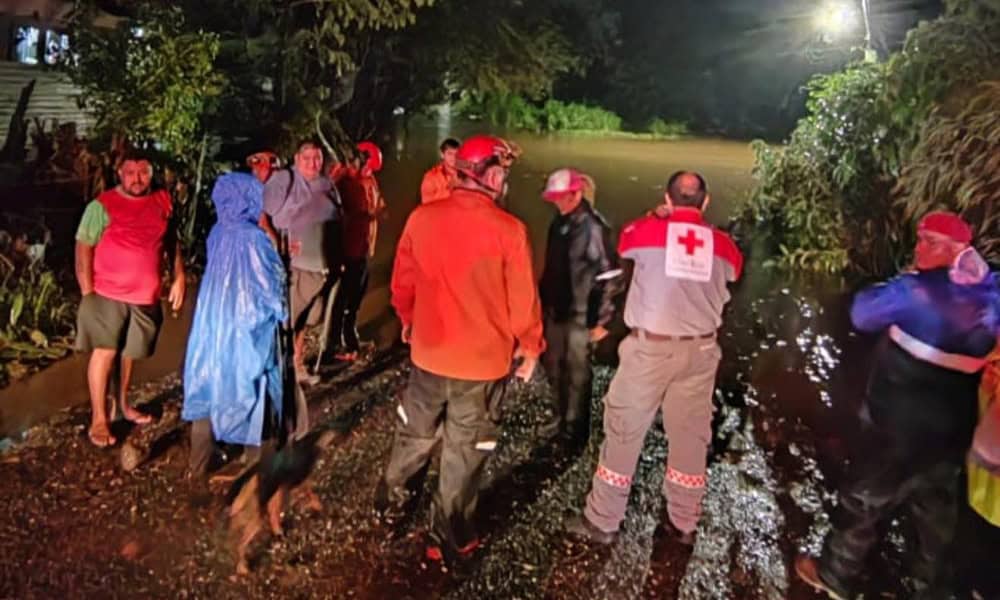
Costa Rica faces another tough week as persistent heavy rains pound our country, leading to widespread flooding, landslides, and disrupted lives. This October, the rainy season hits hard, with communities in Guanacaste and the Central Valley bearing the brunt.
Families scramble to safety, roads turn impassable, and officials urge caution amid rising waters. The situation underscores the challenges of a wetter-than-usual month, driven by atmospheric patterns that show no quick end.
In Guanacaste, Nicoya stands out as one of the hardest-hit areas. Flooding swamped areas like Curime, San Martín, Fortuna, Sámara, and Qiriman, where the Potrero River overflowed and cut off dozens of families. Vehicles got swept away in the currents, and access roads collapsed under the strain.
Nearby in Carrillo, Filadelfia saw sewer systems fail, while Cuajiniquil in La Cruz dealt with overflowing rivers and streams that blocked routes. Reports from Nosara and Hojancha show similar chaos, with rainfall totals reaching 151 mm and 96 mm in just hours yesterday. Landslides knocked down trees, and streams burst their banks, leaving homes isolated and communities on edge.
The Central Valley hasn’t escaped the deluge. Barrio Dent in Montes de Oca, San José, woke to a nightmare, covered in mud, trash, and debris after one of the worst floods in decades. Torrential downpours the night before caused the Los Negritos stream to overflow, transforming streets into raging rivers.
Water levels hit over two meters in places, trapping residents and forcing evacuations through rooftops. Pilar Orellana, a local resident, described the ordeal: “I had to get into the house from the other street, through the roof… it was an avalanche.”
Aysha Bouzid shared her fear: “I was asleep. Suddenly I woke up, felt the mattress shift. When I looked, my house was flooded. I barely got out, everything overturned by the water, my door wouldn’t open. Neighbors pulled me to safety.”
This isn’t a new fight for Barrio Dent residents. They’ve dealt with floods since the 1970s, with partial relief from a 1995 diversion project by the Costa Rican Institute of Aqueducts and Sewers. But problems linger, tied to urban growth that sealed over 80% of the 2.2 km² micro-watershed with impermeable surfaces.
An old alcantarilla, past its lifespan, collapsed further, worsening the flow. Now, a new alliance brings hope: the University of Costa Rica (UCR), the Montes de Oca Municipality, and neighbors joined forces in a forum to tackle the issue.
They plan a system of early warnings using micro-weather stations that track rainfall in real time—alerting via group chats when 40 mm falls in an hour, signaling imminent overflow. Experts map hydrology and push for structural fixes, like recovering the natural riverbed or building tunnels, though costs top $8 million and funding remains a hurdle.
Mayor Domingo Argüello of Montes de Oca calls it a national issue: “This is no longer just a problem for Montes de Oca; it affects two areas families, homes. We need central government support.” The municipality installed a relief pipe in 2024 that eased some pressure, sparing worse damage to UCR facilities like the Faculty of Economic Sciences.
Still, yesterday, floods hit the UCR underground parking, reaching the second level and affecting the student cafeteria, offices, and nearby faculties. Circunvalación Norte flooded again, along with Barrio Escalante streets, snarling traffic and stranding drivers.
Elsewhere in the valley, Desamparados saw the Chilamate stream burst, flooding roads and homes. San Pedro recorded 111 mm of rain in five hours yesterday, pushing saturation levels high and raising risks of sudden slides and overflows. The National Emergency Commission reminds people to heed warnings and steer clear of rivers, streams, or landslide-prone spots.
Beyond these hotspots, the rains struck broader areas. In Alajuela, a landslide in San Ramón buried a home, killing a couple and their daughter. Puntarenas reported over 213 incidents nationwide, with Barranca, El Roble, and Quepos seeing streets turn to rivers and evacuations of over 350 people to shelters.
Guanacaste’s roads and bridges washed out, halting events like local football matches. Zona Norte areas like Santa Clara and Ciudad Quesada logged 56 mm and 61 mm, respectively, adding to the strain.
These conditions stem from the Intertropical Convergence Zone hovering near Costa Rica, pulling in moisture from the Pacific and Caribbean. Combined with sea breezes and high-level troughs, it fuels intense clouds, steady rains, and thunderstorms. October typically ranks as one of the wettest months, peaking in the Central Pacific, South Pacific, and Central Valley.
A tropical wave earlier in the month amplified the downpours, leading to orange alerts—the second-highest level—across much of the country. Soil saturation heightens dangers, with forecasts predicting 30-60 mm more in the Pacific North, Zona Norte, and Valle Central through this evening, possibly peaking at 80 mm in spots. The Pacific South expects 25-50 mm with isolated showers.
Authorities handled 33 emergency calls on the 10th of this month alone, mostly for floods from swollen rivers and failed sewers in places like Pérez Zeledón, Corredores, Buenos Aires, Alajuela, and Atenas. A landslide in La Carpio destroyed a house, injuring one adult, though residents escaped collapse. Red Cross and fire teams responded, but some refused evacuation despite unstable ground threatening more homes.
As the week wraps, the forecast holds steady: unstable weather lingers into today, with rains and storms in the Valle Central, Zona Norte, Pacific coasts, and Caribbean mountains, easing slightly by night but focused on Zona Norte and Pacific shores.
People should watch for electrical storms, gusts up to 80 km/h, and fog banks in urban zones. Staying informed through official channels remains key to navigating these days safely.





