

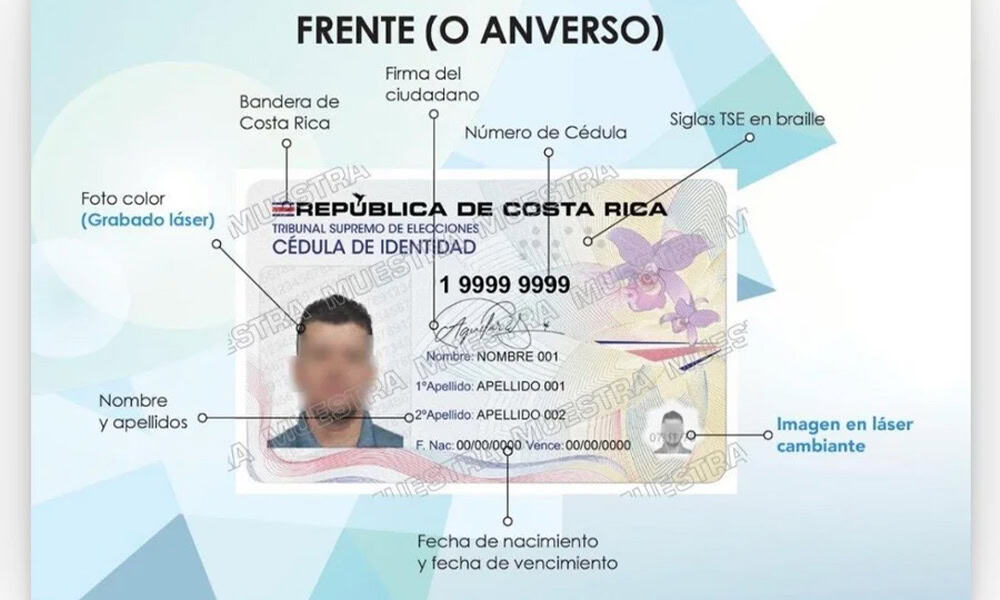
Costa Rica’s Supreme Electoral Tribunal (TSE) rolled out a redesigned physical identity card today. The update focuses on better protection against fraud while keeping the card practical for everyday use. The new card keeps its 10-year validity and standard size of 85.60 millimeters by 53.98 millimeters, matching international norms.
It drops some older details, like parents’ names and the holder’s electoral address, to cut down on unnecessary personal information. One key change replaces the old barcode with Machine Readable Zone (MRZ) technology.
This allows machines to scan and verify identities quickly across systems. The card also adds a smaller secondary photo next to the main one, following rules from the International Civil Aviation Organization (ICAO) for travel documents.
Security gets a boost with features like raised text, interrupted lines, and elements that show up under ultraviolet light. Microtext—tiny letters, numbers, or images—appears only when magnified, making forgery harder. The materials used now hold up better over time.
People with current valid cards do not need to swap them out. The TSE issues new physical cards at no cost, as long as holders stay within the one-replacement-per-year rule.
In September, the TSE introduced the Costa Rican Digital Identity (IDC) as a mobile option. This digital version carries the same legal weight as the physical card for official tasks. It fits into the TSE’s push to update services, starting from plans laid out about three years ago.
Xenia Guerrero, the TSE’s General Director of Technology Strategy, said the IDC gives people another way to identify themselves securely. It uses strong safeguards and biometric checks to protect user information.
To get the IDC, applicants need a valid physical ID, no ongoing legal issues, and a mobile device with an email address. The process happens online at www.tse.go.cr/idc. It costs ₡2,600 and lasts four years. Once paid, users receive a QR code by email to activate it on their phone app. Activation involves accepting terms, scanning the code, taking a selfie for biometrics, and setting a PIN.
The IDC works for both in-person and online dealings with public and private groups. Verification relies on secure biometric methods to confirm identities without hassle.
This shift reflects Costa Rica’s move toward more efficient identification tools. The physical redesign and digital addition aim to make daily interactions safer and simpler for residents.