

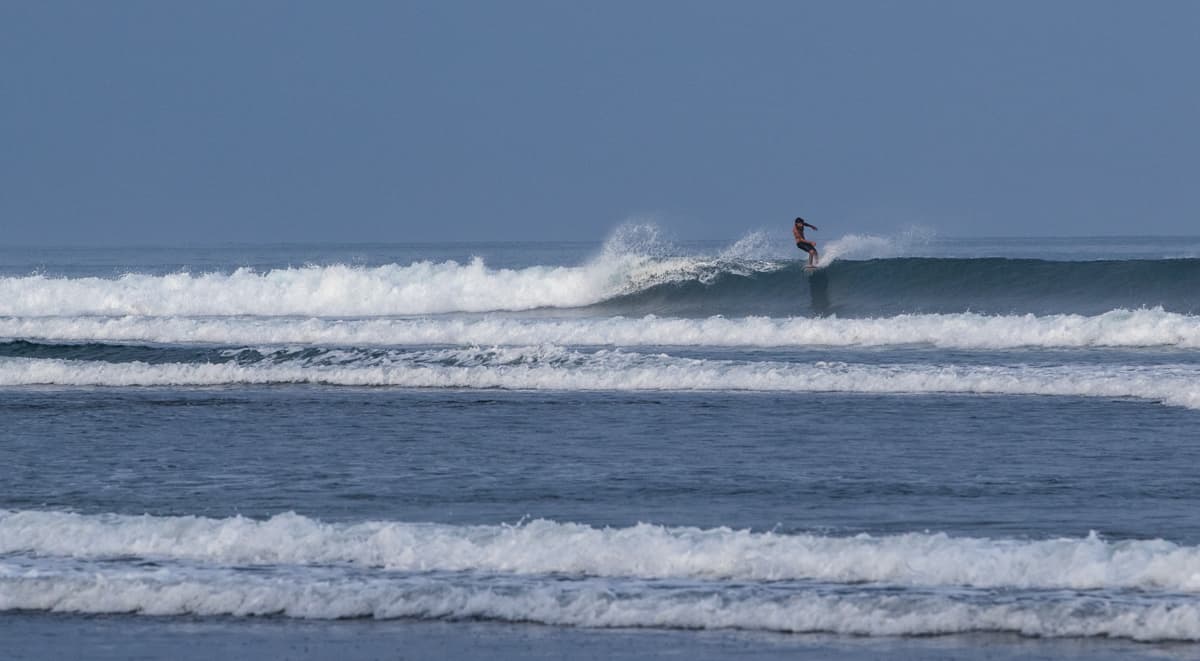
A Brazilian surfer survived a rare and severe ocean injury in Costa Rica after a needlefish leapt from the water at Playa Pavones and struck him in the chest, puncturing his heart. Fabiano Duarte da Costa, a 42-year-old physical educator from Itajaí, Brazil, was surfing at Playa Pavones, one of Costa Rica’s best-known surf breaks on the southern Pacific coast. He was sitting on his board waiting for a wave when the fish jumped from the water and hit him directly in the chest.
Duarte later said he felt the impact and a sharp pain before losing consciousness. The injury immediately turned a normal surf session into a life-threatening emergency.
The first critical break came on the beach. A doctor happened to be nearby and began first aid almost immediately. According to reports from Costa Rica and Brazil, Duarte suffered cardiac arrest after the strike, and the doctor performed resuscitation on the sand before emergency responders took over.
Duarte was first treated in the southern zone, with later reports identifying Hospital de Ciudad Neily as part of the emergency response. Dr. Carlos Bolaños, one of the doctors who treated him, later said the patient arrived with a hole in the heart and heavy bleeding. During the emergency treatment, Duarte’s heart stopped for roughly two minutes before resuscitation efforts restored a pulse.
After he was stabilized, Costa Rica’s Ministry of Public Security assisted with an air ambulance transfer from Coto 47 to Juan Santamaría International Airport. From there, the Red Cross transported him by ambulance to San Juan de Dios Hospital in San José, where he continued treatment in intensive care.
His recovery has been closely followed in Brazil and Costa Rica. By late May, Duarte had left the most critical stage and was recovering outside the hospital while waiting for final medical clearance. He thanked the Red Cross, Costa Rica’s public health system, the Ministry of Public Security, and the medical teams at Ciudad Neily and San Juan de Dios for helping save his life.
His family and friends also launched an online fundraiser to help cover medical and travel costs. The campaign sought about 40,000 Brazilian reals, roughly 3.5 million Costa Rican colones.
Needlefish are long, fast-moving fish with narrow, pointed jaws. They are not usually considered a routine threat to surfers, but medical literature has documented serious injuries when the fish jump from the water and strike people at speed. Their sharp beaks can cause deep puncture wounds, especially when the impact hits the chest, neck, face, or head.
The Pavones case is not the only recent needlefish injury reported in Costa Rica. In December 2025, a surfer at Playa Hermosa de Osa was struck in the neck by part of a needlefish jaw. Lifeguards stabilized the object and did not attempt to remove it on the beach because it was lodged dangerously close to the carotid artery. The surfer later underwent surgery and was reported stable.
Internationally, needlefish strikes have also caused fatal injuries. In 2024, Italian surfer Giulia Manfrini died in Indonesia after being hit by a needlefish while surfing in the Mentawai Islands.
For Costa Rica’s surf community, Duarte’s survival has drawn attention not only because of the unusual nature of the accident, but because of the chain of quick decisions that followed: immediate first aid on the beach, emergency stabilization in the southern zone, air transport to San José, and hospital care in the capital.
The incident remains an extremely rare type of surf injury. But it is also a reminder that remote beaches, even famous surf spots, can turn dangerous in seconds when a medical emergency happens far from a major hospital.





