
I should have a near zero percent chance of recording freshwater eels with my camera traps. Not only are they found underwater, but they’re found in the type of water that isn’t easy to see through. Most eels prefer still, stagnant water with lots of detritus and tangled roots.
I do have the only underwater camera trap in Costa Rica (shout out to Dr. Christopher Bunt, fisheries research scientist and developer of underwater camera equipment), but that camera needs water with decent visibility to work properly. The only way I could record eels is if some other creature reached into the goopy water, grabbed an eel, pulled it out of the water, and showed it to one of my terrestrial camera traps. Luckily enough, that’s exactly what happened four times over the last few months.
My first camera trap video featuring a creature with an eel in its mouth was recorded on a drying cattle pond. An American crocodile emerged from the water and slid by the camera with a large eel in its jaws. After that, I recorded a wood stork with a big old eel in its beak, quickly followed by two different bare-throated tiger herons dispatching eels of their own on two different properties.
After one video of something with an eel in its mouth, I think to myself, ‘That’s cool.’ After four videos of eel-meals, it’s time to start searching for more information so I know more about what’s going on. I have no Costa Rica freshwater fish books, so I cruised the internet for more information.
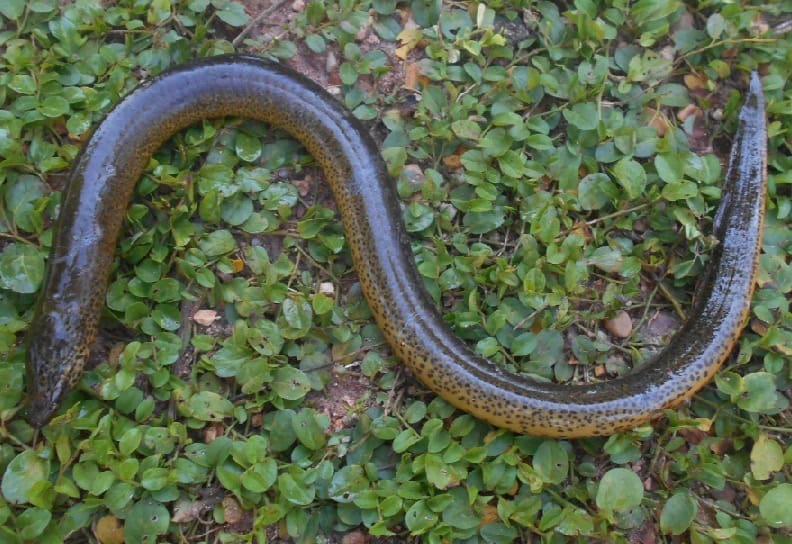
I couldn’t find enough info to quench my thirst for eel-knowledge, so I turned to WhatsApp. A message to a group of biologists gave me my answer. The crocodile and waterbirds were enjoying a meal of marbled swamp eel (Synbranchus marmoratus). Now that I knew the name, I could do a proper internet search, and I found all kinds of good stuff including – they’re not even eels, they can breathe air outside of the water, and they’re sequential hermaphrodites. Here’s a little more about each of those tidbits.
Marbled swamp eels are not true eels. They’re freshwater fish that have evolved long, cylindrical bodies independently from eels. There are a bunch of physical distinctions between eels and swamp eels, but the general idea is that they look like eels but they’re not.
Marbled swamp eels have gills and can breathe underwater like we all imagine that fish do, but they also can breathe out of the water. The linings of their mouths are highly vascularized, meaning they have a lot of blood vessels, which allows them to act as primitive lungs. This is a super important adaptation that allows them to move over land or hide in tunnels under the mud if their stagnant water home dries up for a while.
This final fact is a doozy. Marbled swamp eels are sequential hermaphrodites. This means that the same individual can be both male and female during its life cycle. Some individuals are born male and stay male, but the majority begin life as females and change to males around four years of age.
I’d like to take this time to thank that crocodile and those three birds for showing me their dinners, without them I wouldn’t know a thing about the marbled swamp eel. If you’d like to get a good look at some swamp eels, take a look at the video below.
About the Author
Vincent Losasso, founder of Guanacaste Wildlife Monitoring, is a biologist who works with camera traps throughout Costa Rica.