

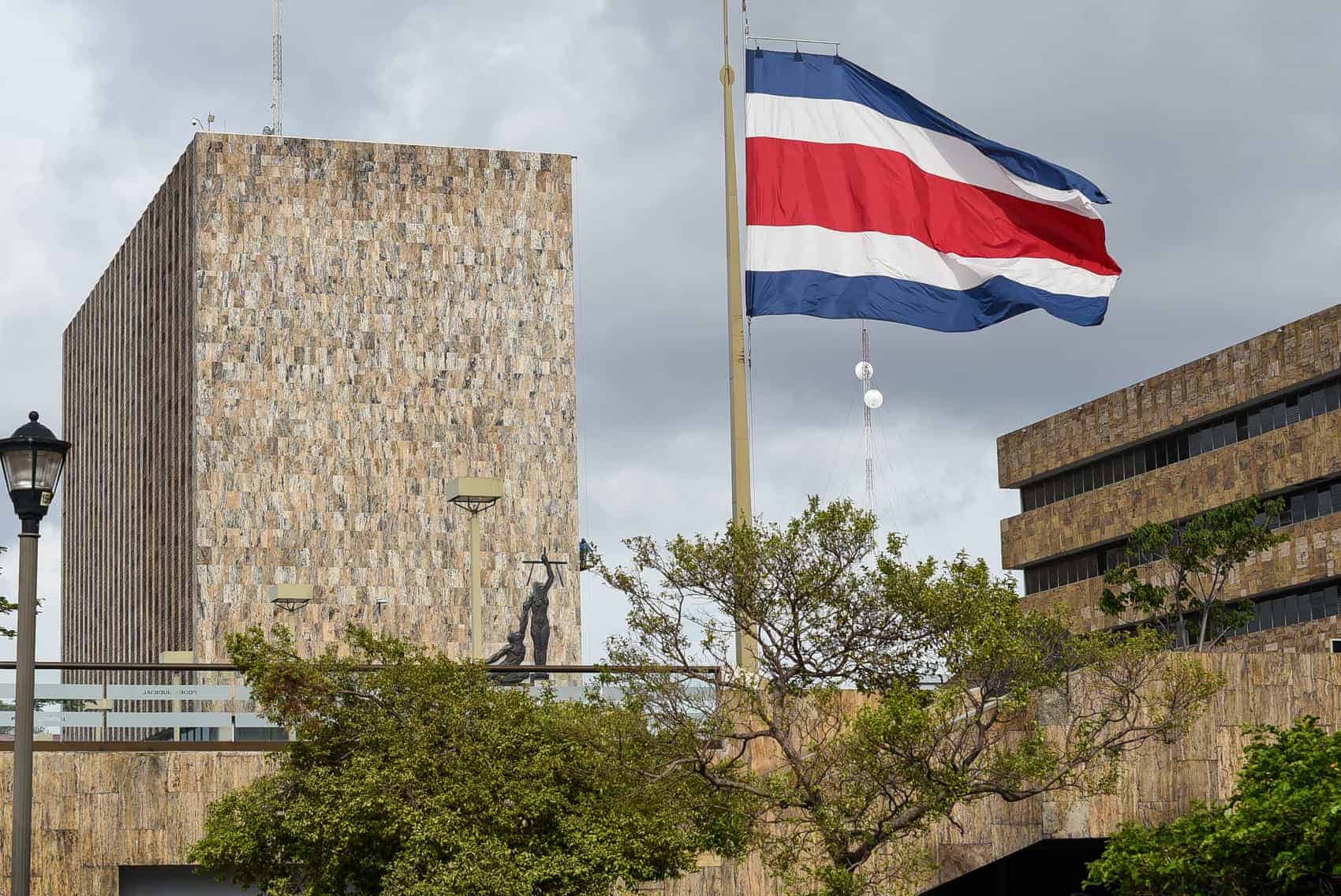
One of the oldest and largest bar associations in the United States has asked two international bodies to keep watch over Costa Rica’s judiciary, citing budget reductions imposed by the Executive Branch and the Legislative Assembly’s failure to appoint enough substitute justices to the Constitutional Chamber.
The New York City Bar Association published the statement on Monday, August 10. It calls on the Inter-American Commission on Human Rights and the United Nations Special Rapporteur on the Independence of Judges and Lawyers to monitor developments here.
Founded in 1870, the association counts more than 20,000 members across the United States and in over 50 countries, among them judges, prosecutors, defense attorneys, government lawyers and academics. The statement was prepared by its Cyrus R. Vance Center for International Justice, with Jaime Chávez Alor and Cuitlahuac Castillo Camarena named as authors alongside Christopher Ferguson of the association’s Task Force on the Independence of Lawyers and Judges.
The document addresses two matters that have run in parallel since May. The first is the announced reduction of roughly ₡27 billion (about $59.5 million) to the judiciary’s budget, which Finance and Presidency Minister Rodrigo Chaves Robles set out as part of a 5% cut applied across public institutions for the second half of the year.
The Costa Rican Association of the Judiciary, known as ACOJUD, has said the measure “compromises every citizen’s right to receive a timely, impartial, and effective response” and would reach criminal investigations, victim assistance, public defense and court operations nationwide. The association’s statement quotes that warning and treats the reduction as a matter of judicial independence rather than ordinary fiscal policy.
On that point the arithmetic deserves a closer look than the statement gives it. The ₡27 billion figure was an announced modification that required budgetary processing and could not be applied unilaterally by the Executive Branch. On June 29 the Corte Plena, the full 22-member Supreme Court, agreed to make ₡13.242 billion (about $29.2 million) available and rejected the remainder.
The Ministry of Finance subsequently applied a retention of roughly ₡3.053 billion (about $6.7 million), bringing the total the judiciary says it will not receive or execute to approximately ₡16.3 billion (about $35.9 million). The judiciary has calculated that retention as close to 42% of the operating spending it had planned for the remainder of 2026, a category covering fuel, per diems, forensic examinations, maintenance, technology licenses, translation, transport and victim services.
The second matter concerns the Constitutional Chamber, the branch of the Supreme Court that decides constitutional questions including habeas corpus and amparo actions. Sitting justices must step aside from certain cases for disqualification, incapacity or conflict of interest, and without substitutes available the panel required to decide those cases cannot be assembled.
The association states the Chamber requires 12 substitutes to function normally and that only three have been appointed. It notes that 123 case files were left unresolved as a result, involving pensions, health, public employment, tax reform and municipal questions. Among the matters stalled by the lack of quorum is the request to lift the immunity of former President Rodrigo Chaves over allegations of irregular financing of the 2022 electoral campaign.
The judiciary submitted a slate of 18 candidates for the substitute positions on June 15. The governing party declined to endorse it, citing a lack of consensus, after initially indicating it would review the list. The operational picture has since shifted. On July 23 the Constitutional Chamber provisionally extended the appointments of substitute justices whose terms had expired, until the Legislative Assembly names replacements.
President Laura Fernández described that ruling as a coup d’état against the Assembly, and on August 3 Assembly President Yara Jiménez and governing-party lawmakers filed a criminal complaint against the four justices in the majority. The Chamber rejected the characterization, saying its decision fell within its authority to protect access to constitutional justice.
The association measures both matters against the United Nations Basic Principles on the Independence of the Judiciary, adopted in 1985 and recognized within Costa Rican law. It points in particular to Principle 7, which requires states to provide the judiciary adequate resources, and Principle 10, which requires that judicial appointment methods guard against improper motives.
The statement is careful on one point. It does not dispute a state’s authority to set budget priorities, and it says a finding of improper effect does not depend on proving an intent to weaken the courts. Costa Rica is not the first country to draw the association’s attention this year. It issued a similar statement in May on reprisals and attacks against judges across Latin America, and a July statement in support of the bar associations of Morocco.
Concern from outside of here had already been voiced before Monday. The UN Special Rapporteur on the independence of judges and lawyers, Margaret Satterthwaite, raised the budget question publicly on July 23, and the Latin American Federation of Women Judges issued its own statement the same day urging that budgetary decisions affecting the courts be adopted through transparent, technical dialogue.
Inside Costa Rica, the tension between the Executive Branch and the courts has been building for months, and last week thousands filled the plaza in San José in support of the judiciary. Fernández and Chaves have rejected the suggestion that their administration intends to close, control or dismantle the judiciary, arguing that spending reductions follow from the government’s fiscal position and that the justice system requires significant reform.
Over the weekend Fernández announced she intends to resume periodic meetings among the heads of the three branches of government, and Supreme Court President Orlando Aguirre Gómez welcomed the proposal while asking for a clear agenda and respect for each institution’s competencies.
The association makes four requests of the Executive Branch and the Legislative Assembly. It asks them to refrain from using budget allocation as a mechanism of pressure, to open technical dialogue with the judiciary on its actual needs, to establish legal mechanisms guaranteeing a stable minimum allocation subject to accountability, and to approve enough suitable substitute justices to restore the Constitutional Chamber’s full operation.
Whether either body responds is now the open question, and the answer will be visible in the Assembly’s appointment calendar and in the 2027 budget rather than in any statement issued abroad.





