

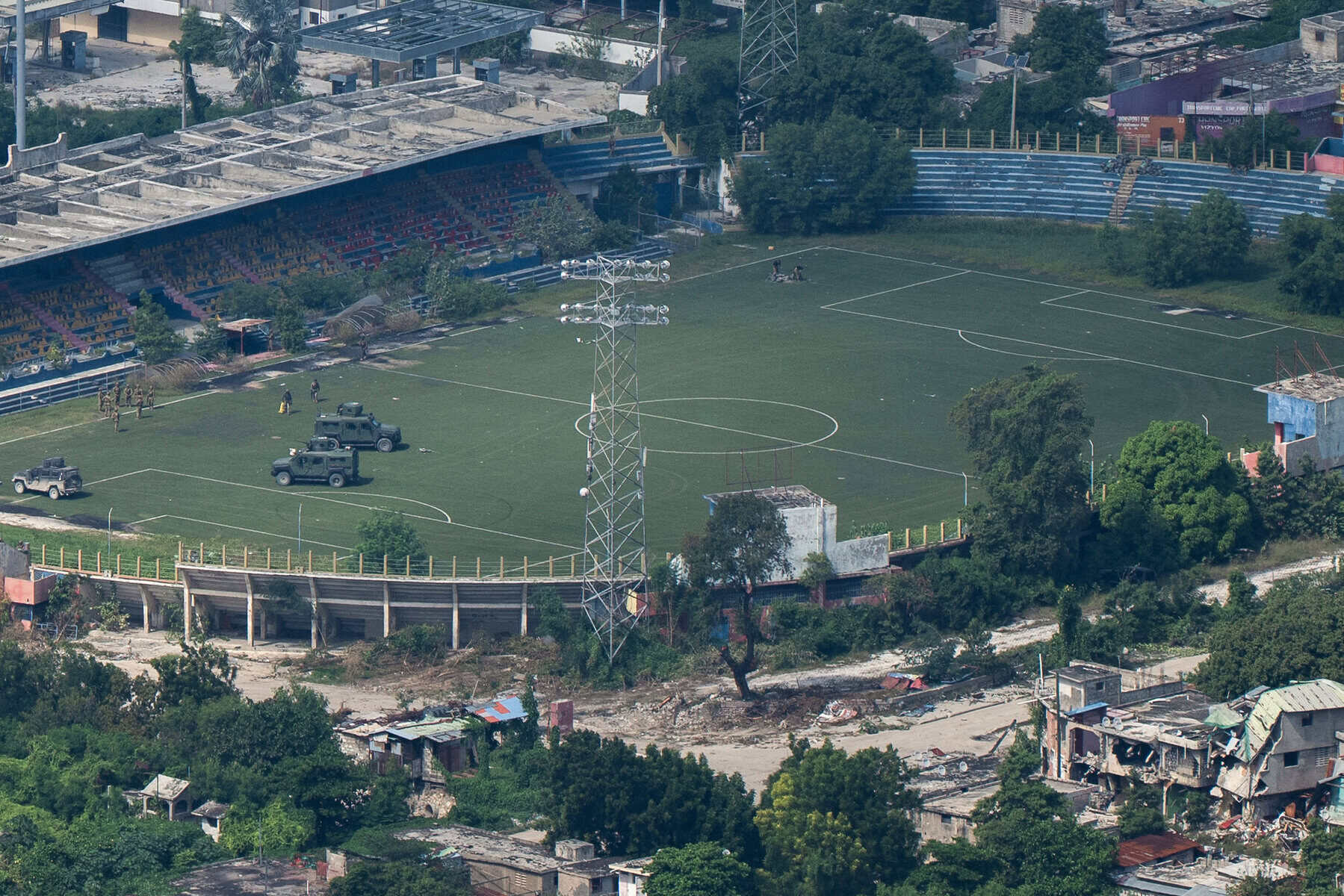
El Salvador will turn Haiti’s national soccer stadium into a forward base for its troops after Salvadoran and Haitian forces retook the Sylvio Cator stadium in Port-au-Prince from armed gangs on Thursday, President Nayib Bukele announced. The joint operation took place in the early hours yesterday and involved the Haitian National Police, the Armed Forces of Haiti, a government-contracted security unit known as the Task Force, and Salvadoran special forces, according to Bukele and Haitian police. Bukele said it was carried out under a bilateral agreement between the two governments.
The Haitian National Police said in a statement that its officers had taken full control of the stadium and its surroundings before handing security of the complex to the Salvadoran armed forces. More than 20 armored vehicles and trucks carrying Salvadoran military personnel were stationed inside the stadium after the operation, according to local media reports.
Bukele said troops found several human skulls inside the facility. Authorities have not announced any identification of the remains or said whether they will be examined. The Salvadoran president said his forces would use the stadium as a base to advance deeper into territory held by gangs, and that the allied forces now hold the advantage on the ground.
In a message addressed directly to gang members, he told them to leave the area before the next phase of operations begins and warned that those who stay to fight Salvadoran and Haitian forces will face the consequences. He did not give a start date. The stadium, home ground of Haiti’s national soccer team, had been held by gangs since early 2024. Its loss forced Haiti to play every one of its home qualifiers for the 2026 World Cup outside the country.
The recovery is the latest step in a rapidly expanding Salvadoran military presence in Haiti. El Salvador has deployed more than 2,000 troops since October 18, when gangs ambushed an armored vehicle carrying four Salvadoran Air Force aviation technicians in Croix-des-Bouquets, northeast of Port-au-Prince. The Salvadoran military said the vehicle was struck by gunfire and explosives and caught fire, and that the four men got out before going missing.
The technicians were serving with the Gang Suppression Force, a multinational mission authorized by the United Nations Security Council to support Haitian police against armed groups that control large parts of the capital and other areas. Salvadoran officials have described them as non-combat personnel whose main job was carrying out medical evacuations.
The Salvadoran government maintains that the four are alive, but their whereabouts remained unknown as of now. Bukele has previously offered to withdraw all Salvadoran forces from Haiti if the technicians are released unharmed. The Gang Suppression Force has distanced itself from the actions of the Salvadoran troops sent in after the ambush, which operate under the separate bilateral arrangement with the Haitian government. Bukele has said the contingent is focused on confronting the gangs responsible for the October attack and related violence.
The stadium operation came two days after Bukele said Salvadoran troops had destroyed the headquarters of the 400 Mawozo gang, an operation for which Haiti’s prime minister publicly praised the Salvadoran leader. Gang violence in Haiti has forced nearly 1.5 million people from their homes, and the international force sent to help contain it has so far deployed only a fraction of the 5,550 personnel the Security Council authorized.





