

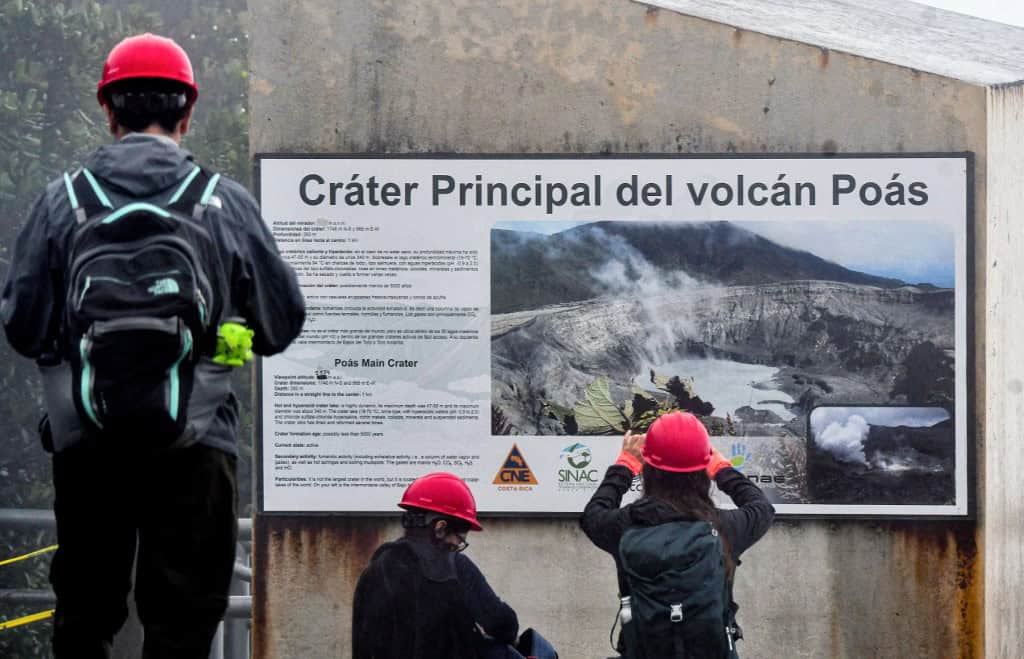
The Costa Rican Red Cross no longer runs the parking lot and restrooms at Poás Volcano National Park, one of the country’s main natural attractions, after the contract passed this month to a private consortium. The change takes a source of income from an organization that says it may have to stop mountain and water rescues to stay afloat.
The National System of Conservation Areas (SINAC) put the service out to tender in April. The award went to VolcAN Group, a consortium of three individuals, according to the public procurement filed. The contract covers 256 parking spaces for cars, motorcycles, buses and minibuses, along with the restrooms.
SINAC said, through the Environment Ministry’s press office, that the Red Cross was not selected because it did not submit all the required documentation. The Red Cross objected and appealed and SINAC said those challenges were reviewed and resolved by the Comptroller General’s Office, and the award stands.
The Red Cross had managed the Poás parking area for four years. It has not said publicly how much the contract brought in. It continues to provide similar services at the Barva Volcano section of Braulio Carrillo National Park and the Prusia section of Irazú Volcano National Park.
SINAC’s page for the park lists parking at 2,750 colones (about $6.17) for cars, 1,250 colones ($2.80) for motorcycles and 5,000 colones ($11.21) for buses and minibuses, paid by card at the entrance booth. The park sits on one of Costa Rica’s two most active volcanoes and is among several protected areas with new rules this high season.
The lost contract comes during the worst financial stretch in the organization’s recent history. Its financial statements show losses of 524 million colones (about $1.18 million) in 2022, 704 million colones ($1.58 million) in 2023, 865 million colones ($1.94 million) in 2024 and 936 million colones ($2.1 million) in 2025.
From January through July of this year it had already lost 943 million colones ($2.11 million). By June, 66 of its local committees and boards were operating at a loss. General manager Walter Fallas said in October that the scenarios under review include moving some local committees to daytime-only shifts, which would lengthen response times at night, and suspending water and mountain rescues. He said those operations tie up crews and equipment for long periods and generate overtime the organization cannot fund.
Fallas said the Red Cross is also considering ending its support for the Judicial Investigation Agency (OIJ) in recovering bodies and its emergency response in indigenous territories. Some stations could close, he said, though he ruled that out for the remainder of 2026. No date has been set for a decision on the rescue services.
The Red Cross responded to 537,919 incidents in 2025, roughly one every minute. During its mid-year vacation operation, from July 4 to 19, it handled 28 water emergencies and four mountain emergencies, by its own count. The organization says it needs about 30 billion colones ($67.3 million) a year to operate and took in about 24.6 billion colones ($55.3 million) in 2025.
The Finance Ministry announced a transfer of 1.5 billion colones ($3.36 million) in October, an amount the Red Cross says falls short of its needs. A bill that would exempt several of the organization’s funding sources from the fiscal spending cap is pending in a legislative committee.
For now, Red Cross crews continue to respond to emergencies nationwide, including on beaches and mountain trails and can be reached through 911.





