

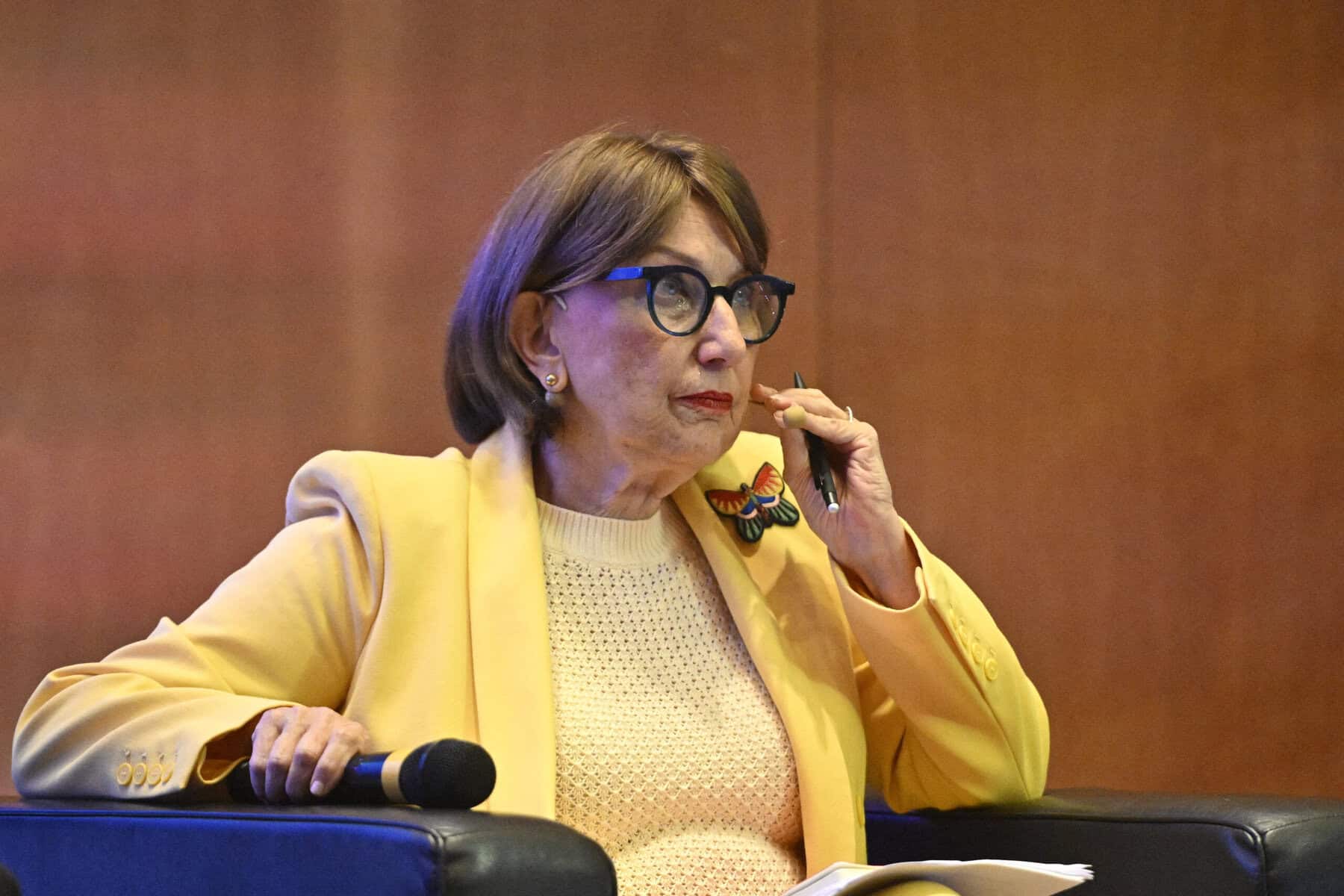
Costa Rican economist Rebeca Grynspan finished first again on Friday in the United Nations Security Council’s informal vote on the next Secretary-General, but the result made clear that two of the five permanent members still stand between her and the job. In the ninth closed-door straw poll since late July, Grynspan received 10 votes encouraging her candidacy, four discouraging it and one with no opinion, according to diplomats and a tally reported by the UN-focused outlet PassBlue. Two of the negative votes came from permanent members, each of which holds a veto.
The ballots were color-coded, the first time since Oct. 16 that the votes of the United States, China, Russia, France and the United Kingdom could be told apart from those of the 10 elected members. The ballots do not show which countries voted against her. The tally was a step back from early November, when Grynspan collected 12 encouraging votes and three discouraging ones on undifferentiated ballots. It also repeated the picture from the October color-coded round, when two permanent members likewise opposed her.
Even so, Grynspan remains the only candidate to reach the nine-vote threshold in every poll since September, and on Friday she was the only one backed by a majority of both the permanent and the elected members. Argentina’s Rafael Grossi, head of the International Atomic Energy Agency, came second with eight encouraging votes and six discouraging ones, three of them from permanent members. Lana Nusseibeh of the United Arab Emirates drew seven in favor and six against, also with three permanent-member objections.
Guyana’s Carolyn Rodrigues Birkett received six votes on each side. Türkiye’s Feridun Sinirlioğlu, who joined the race after the October color-coded round, received five encouraging votes and 10 discouraging ones, four of them from permanent members. PassBlue reported that every one of the eight candidates on the ballot drew at least two negative votes from permanent members.
Washington’s position remains the central question. US Ambassador Mike Waltz said Friday that the United States would welcome a Latin American candidate, in keeping with the informal practice of rotating the post among regions, while adding that Washington wants the best candidate to emerge and acknowledging there is no consensus yet. He also urged candidates with little support to withdraw so the Council can focus on a smaller field.
Diplomats cited by the development news outlet Devex said earlier this month that the United States and Russia had backed Nusseibeh, while China has signaled a preference for a Latin American without publicly endorsing anyone. Analysts have pointed to reports issued by UN Trade and Development under Grynspan that criticized the effect of Israeli policies on the Palestinian economy as a source of friction with the current US administration.
After the color-coded round in October, Grynspan said that because no formal vote had taken place, the results could not be described as vetoes, and that she would keep negotiating to broaden her support. To be recommended, a candidate needs at least nine votes on the Council and no veto from a permanent member. The 193-member General Assembly then makes the formal appointment.
Time is running short as António Guterres ends his second term on Dec. 31, and the UN Charter makes no provision for an interim leader. Reuters reported this week that UN officials are drafting contingency plans. Kirill Logvinov, a senior Russian Foreign Ministry official, said the options under discussion include temporarily extending Guterres’ term or naming another official to fill in. Daniel Safran-Hon, a former UN official, warned that senior appointments and the budget cannot move forward without a Secretary-General in place.
Grynspan, 70, served as Costa Rica’s vice president from 1994 to 1998 and later as UN Under-Secretary-General and associate administrator of the UN Development Programme. She led the Ibero-American General Secretariat from 2014 to 2021 before becoming the first woman to head UNCTAD, a post from which she took leave to campaign.
Costa Rica announced her candidacy in October 2025 and formally nominated her on March 3. If she clears the final hurdle, Grynspan would become the first woman and the first Central American to lead the United Nations.





