

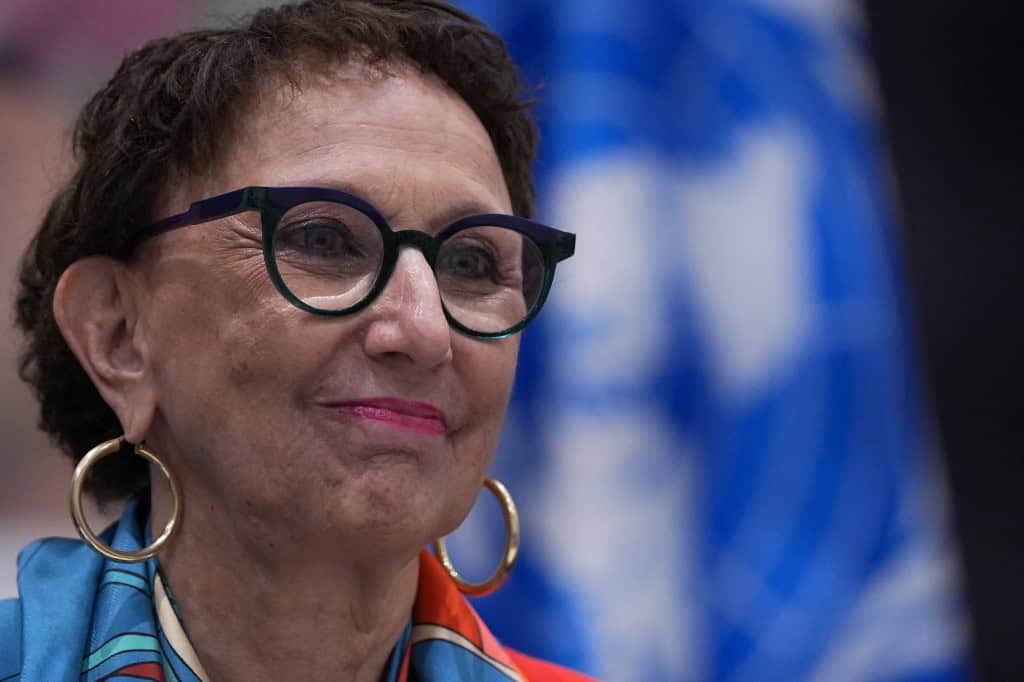
Costa Rican diplomat Rebeca Grynspan remains the leading candidate to become the next secretary-general of the United Nations, but a new round of voting has revealed a serious obstacle: two of the five countries with veto power currently oppose her candidacy. Grynspan received nine votes in favor, five against and one abstention in the sixth informal vote held yesterday by the 15-member UN Security Council.
That was enough to keep her ahead of the other candidates, but for the first time the voting system showed whether opposition came from one of the Security Council’s five permanent members: the United States, China, Russia, France and the United Kingdom. Two of those five countries voted to discourage Grynspan’s candidacy.
That does not mean she has been formally vetoed. Yesterday’s vote was an informal ballot used by Security Council members to measure support and determine which candidates may be able to move forward. A formal veto can only occur later, when the council votes on which candidate to recommend to the UN General Assembly.
Still, the two negative votes are important because any one of the five permanent members can ultimately block a candidate. Grynspan also received support from three of the five permanent members, meaning the Costa Rican candidate currently has backing from a majority of the countries with veto power.
The identities of the countries supporting and opposing her were not disclosed because the ballots remain secret. Grynspan said yesterday night that she remains confident about her position. She stressed that no formal veto had taken place and said her campaign would now focus on talks with Security Council members in an effort to build greater support.
She also noted that she continues to have the strongest overall numbers among the candidates. The former Costa Rican vice president received more positive votes than any other candidate in Yesterday’s round and fewer negative votes than most of her rivals. Her closest competitors include Guyana’s Carolyn Rodrigues-Birkett and Argentina’s Rafael Grossi, director general of the International Atomic Energy Agency.
Rodrigues-Birkett received eight votes in favor, while Grossi posted a similar result. Both also received negative votes from permanent members. In fact, none of the seven candidates currently in the race avoided opposition from countries with veto power. That means the contest remains wide open.
The Security Council has been conducting informal ballots since July in an effort to identify a candidate who can receive at least nine votes while avoiding opposition from any of the five permanent members. Yesterday’s vote was different from the previous rounds because permanent members used ballots of a different color from the council’s 10 rotating members.
That allowed officials to determine whether a negative vote came from a country with veto power without revealing which country cast it. Grynspan has led four of the six informal votes held so far. Costa Rica officially nominated her in March to succeed António Guterres, whose term as UN secretary-general ends December 31.
Grynspan is an economist and former vice president of Costa Rica who has spent much of her career in international organizations. She has served as secretary-general of the United Nations Conference on Trade and Development, known as UNCTAD, since 2021 and is currently on leave while campaigning for the UN’s top job.
She has also held senior positions with the United Nations Development Programme and served as secretary-general of the Ibero-American Conference. If selected, Grynspan would become the first woman to lead the United Nations since the organization was created in 1945. The next stage will likely involve intense diplomatic negotiations among the Security Council members.
The council must eventually agree on one candidate and formally recommend that person to the UN General Assembly. A successful candidate needs at least nine votes in the Security Council and cannot receive a veto from the United States, China, Russia, France or the United Kingdom.
Grynspan said yesterday that the latest results do not change her plans. All seven current candidates face opposition from permanent members, leaving diplomats with two possibilities: continue negotiating around the existing candidates or consider new names. For Costa Rica, the challenge is clear.
Grynspan remains in first place, but staying there will not be enough. Her campaign must now persuade at least two permanent Security Council members to change their position before the vote becomes formal.





