
President Laura Fernández Delgado has spent the days since Costa Rica’s most significant arrest in a decade making two arguments at once. She has praised the Judicial Investigation Agency for capturing Alejandro Arias Monge, known as Diablo, and she has defended her government’s reduction of the Judiciary’s budget, describing the cut as small and saying it does not touch substantive work. The agency that carried out the operation says otherwise, and on the morning of the raid its director learned of a further reduction he had not expected.
The capture came before dawn on Friday, July 24 surveillance and tracking unit and its tactical response team, known as SERT, moved in alongside prosecutors and exchanged fire with the occupants for roughly 45 to 50 minutes. Five officers were wounded, four of them SERT members.
At first light Arias Monge walked out of the house, sat down against a column and surrendered. He had been a fugitive since October 28, 2016, when he was released from preventive detention as a suspect in two homicides, a period of nine years and nine months. Also detained were Jonathan Pérez Méndez, alias Tan, described by investigators as Arias Monge’s successor, Jorge David Núñez Aguilar, alias Coco Pastilla, and a man identified by the surnames Matarrita Rodríguez, alias Coco Mono. A fourth man, Ríos Oconitrillo, alias Coco Guácimo, was killed by tactical officers at the scene.
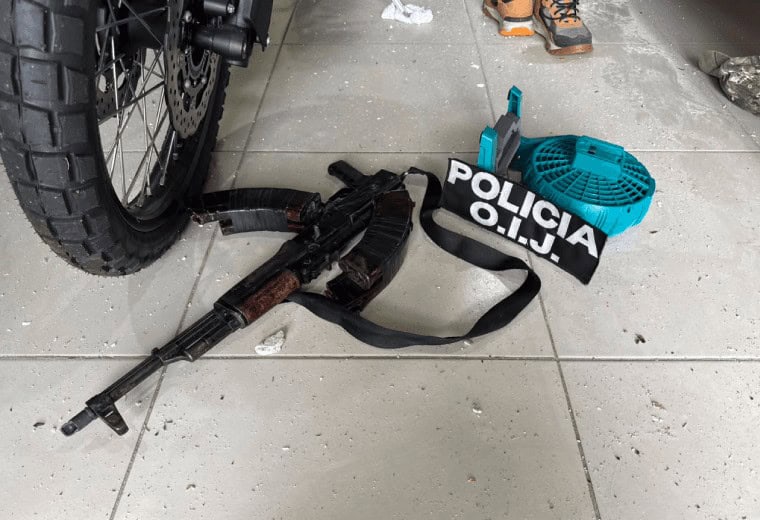
Agents seized five high-calibre rifles, including AK-47 pattern weapons, and three pistols. The United States government had offered a $500,000 reward for information leading to Arias Monge’s capture. He was taken to the courts of the First Judicial Circuit of San José and then to the maximum security module at La Reforma prison in Alajuela, where the Ministry of Justice and Peace says he is held in an isolation cell without yard access or visits. He has not been tried on any of the allegations that made him the country’s most wanted man.
Speaking to reporters during a tour of Guanacaste hours after the operation, Fernández congratulated the OIJ, the SERT team and the officers involved, saying she was grateful on behalf of Costa Rica and that credit belonged where credit was due. She described Arias Monge as a high-end criminal and said responsibility now fell to her government to ensure he remained imprisoned. She also said she hoped prosecutors and judges would not fail Costa Ricans and that Diablo would not go free.
According to the president, Arias Monge ended the lives of approximately 100 Costa Ricans during the years he spent as a fugitive. That figure is her characterization and has not been independently established; no court has attributed those deaths to him. Separately, OIJ interim director Michael Soto told reporters that the organizations run by Arias Monge, Ríos Oconitrillo and Pérez Méndez are believed to be connected to some 360 homicides in fights over drug trafficking territory, a count that covers three groups rather than one man.
In the same remarks in which she celebrated the operation, Fernández defended the budget adjustment her government has requested of the Judiciary, saying the reduction is small and does not affect substantive functions. The dispute behind that claim has been running since late June.
Rodrigo Chaves, who holds both the Ministry of Finance and the Ministry of the Presidency in her cabinet, asked the Judiciary to cut 5% of its budget for both 2026 and 2027, amounts equal to ₡27,076 million and ₡26,549 million, or roughly $59.8 million and $58.6 million at the Central Bank reference rate. On June 29 the Corte Plena, the full 22-member Supreme Court, agreed to a reduction of ₡13,242 million, about $29.2 million, and rejected the rest.
Of the amount it accepted, ₡8,687 million, some $19.2 million, consisted of funds the Legislative Assembly had already approved in the previous term to create new posts in the OIJ and the Public Ministry, open OIJ sub-delegations in La Cruz and Cabo Velas and establish a police office in Puerto Jiménez. Those funds were written into the Judiciary’s budget but Finance never authorized their execution, and the ministry subsequently removed them from the 2027 draft.
The remaining ₡4,555 million, about $10.1 million, came from exchange rate remainders, procurement processes that drew no bids and rescheduled construction. The Court declined to apply a comparable cut in 2027, saying it would damage the fight against organized crime, access to justice, programs to reduce case backlogs and services for victims.
The operational effect of the current year’s squeeze has narrowed to a specific number. The Judiciary has told the Corte Plena that Finance applied a retention of roughly ₡3,053 million, about $6.7 million, for the remainder of 2026, which the institution calculates as close to 42% of the operating spending it had planned to close out the year.
That category covers per diems, fuel, maintenance, forensic examinations, technology licences, translation, transport, victim services and territorial operations. Soto has said that if the reduction holds, the agency could face serious problems operating before the year ends, with the fuel budget for police units among the first lines affected, and that raids, surveillance and other proceedings central to dismantling criminal organizations would be exposed.
He confirmed the OIJ has already stopped buying firearms for the rest of the year to protect its year-end position, while saying ammunition supplies were adequate. He put the cost of the Riverside case at close to ₡230 million, roughly $508,000, in per diems, hydration, fuel and logistics for 1,500 officers, and a 37-raid operation earlier in the week at about ₡80 million, some $177,000.
Then came Friday. Soto told a press conference that he was informed that morning, in the middle of the operation, that a further ₡5,731 million, about $12.7 million, would not be transferred. The money is provided for under norma 10 of article 7 of the 2026 national budget law, which directs that savings from public sector posts left vacant in the first half of the year be split equally between the OIJ and the Ministry of Public Security.
Soto said the agency has traditionally received those funds at year end and used them for per diems, fuel, spare parts, bulletproof vests, pistols, helmets, scientific supplies and infrastructure, and that during the Diablo operation some officers positioned to the rear did not have protective helmets. He addressed Chaves directly, asking the minister to help with the norma 10 money.
Attorney General Carlo Díaz said the Public Ministry would keep working with what little it has. Orlando Aguirre, president of the Judiciary, said the institution cannot move funds between line items on its own initiative without risking irregularities, and that legislative approval is required to shift resources between programs.
Fernández responded to Soto at her first Council of Government session in Nicoya. She said she would believe him if the Judiciary did not have money set aside at Banco de Costa Rica, that the public no longer accepts the argument and that his statements were not acceptable to her, questioning judicial salaries and budget management. She also questioned how long Arias Monge had spent as a fugitive.
The 2027 request has not been settled and may not be the government’s to settle alone. Rodrigo Campos, the Judiciary’s legal director, has argued that a modification of this kind must be submitted to the Supreme Court under article 167 of the Constitution, and that if the Court finds the measure affects the organization or functioning of the Judiciary, the Legislative Assembly needs a two-thirds majority, or 38 of 84 votes, to approve it.
Judiciary planning director Allan Pow Hing and executive director Ana Eugenia Romero have said a ₡26,549 million cut in 2027 would mean closing judicial offices and contravention courts, largely because of building rent and utilities, pausing infrastructure projects and creating obstacles for criminal investigations and police operations. Roughly 80% of the Judiciary’s budget goes to payroll, which leaves the operating remainder carrying the full weight of any percentage reduction.
What sits unresolved is not the arithmetic but the argument. The government has presented a decade-long manhunt ending in a rented house in Sarapiquí as evidence that the justice system is capable of delivering results within its means. The people who ran that operation have presented the same morning as evidence of the opposite, describing officers without helmets and a fuel line they expect to strain before December. Whichever reading prevails will shape what the OIJ can put in the field next year, and the answer will arrive in the Legislative Assembly rather than in either side’s press conference.