

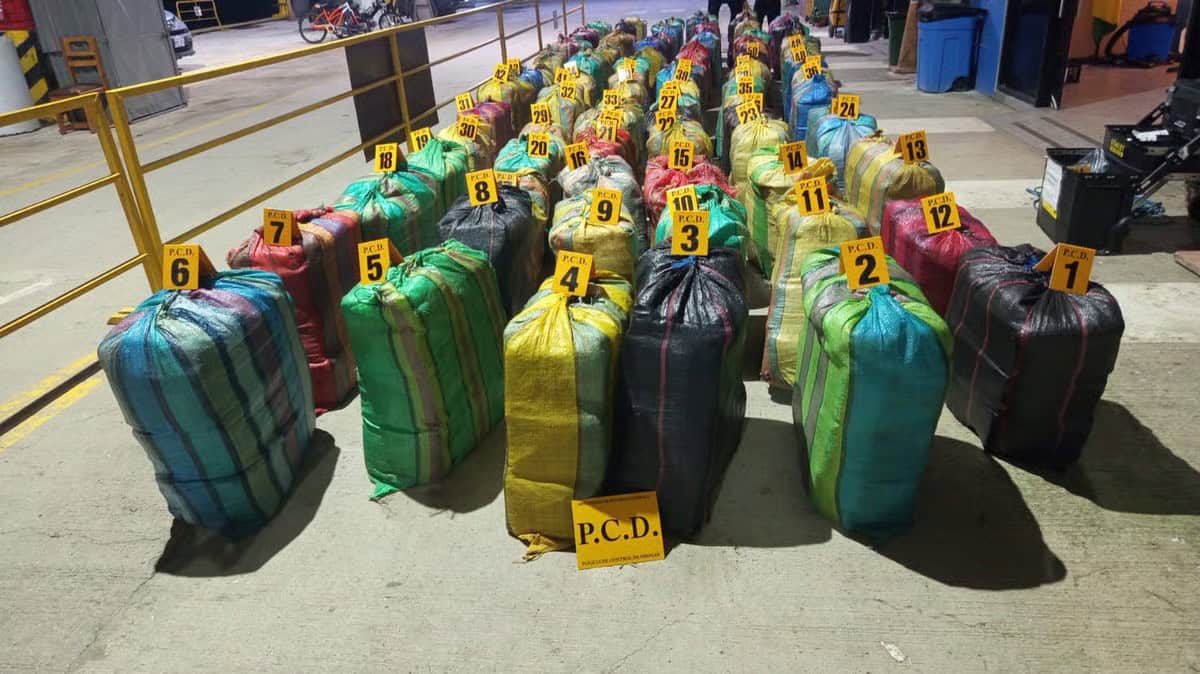
Costa Rica’s Coast Guard intercepted a speedboat carrying 2,648 packages of marijuana in the South Pacific this week in an operation coordinated with the US Drug Enforcement Administration, according to the Ministry of Public Security. Two Ecuadorian crew members were detained.
Public Security Minister Gerald Campos Valverde said the vessel was stopped about 52 nautical miles (96 kilometers, or 60 miles) southeast of Punta Burica, the peninsula that straddles the border with Panama. According to the minister, the operation began Tuesday and concluded Wednesday, Nov. 4.
The ministry said each package weighed roughly one kilogram (2.2 pounds), putting the load at more than 2.6 metric tons (about 5,800 pounds). Agents also seized 11 drums of fuel and other items that authorities consider relevant to the case.
The interception was carried out by the Coast Guard’s special operations group, known as GOPES, which stopped a 38-foot (11.6-meter) go-fast boat. The ministry said the DEA coordinated the operation, while the US Joint Interagency Task Force South and Panama’s National Aeronaval Service (SENAN) provided air and intelligence support.
Costa Rica’s Drug Control Police (PCD), the Special Support Unit (UEA) and the Directorate of Intelligence and Criminal Analysis (DIAC) also took part, according to the ministry.
The suspects were identified by their surnames as Trejos Domínguez, 25, who allegedly captained the vessel, and Flores Bawi, 49. Both were placed at the disposal of the Public Prosecutor’s Office, which will determine their legal situation. As of Thursday morning, authorities had not said whether prosecutors would request pretrial detention.
The boat was towed to the port of Golfito in Puntarenas province, where Drug Control Police agents inspected the cargo alongside prosecutors. The investigation continues into where the drugs came from and where they were headed, the ministry said. Authorities have not said whether the shipment is linked to other international cases or to any criminal group operating in Costa Rica.
The seizure adds to a run of maritime interceptions along Costa Rica’s southern Pacific coast, a stretch of water that has emerged as a prime drug route for shipments moving north from South America. Last month, a US surveillance plane helped authorities seize 1.5 tons of cocaine off Osa, a short distance up the same coastline.
Joint operations with US agencies have become a fixture of Costa Rica’s anti-drug strategy. Under a joint maritime patrol agreement in place since 1999, US aircraft and vessels regularly support Costa Rican interceptions at sea. The country authorized US Coast Guard vessels to take part in 2026 anti-drug operations, and in September a US military plane flew 45 tons of seized drugs out of Costa Rica. Seizures have climbed this year, with cocaine seizures up nearly 50% in 2026.
For a country that sits between South American producers and North American markets, the steady pace of seizures at sea reflects both the volume of drugs moving past its coastline and the growing reach of the international cooperation built to stop them before they land.





