

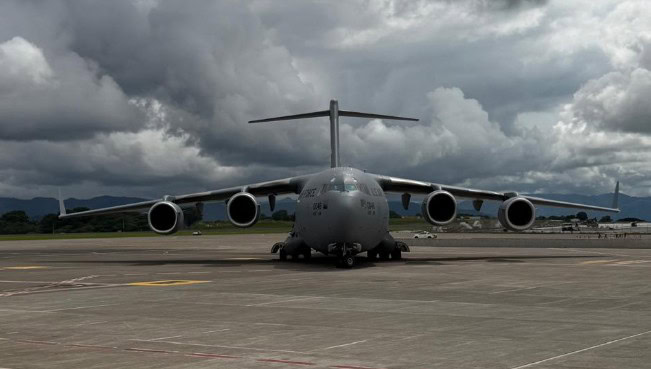
A US Air Force C-17 transport plane has flown 45 metric tons (about 49.6 US tons) of drugs seized in Costa Rica to the United States, where the cargo will be destroyed, Costa Rican prosecutors and the US Embassy said. The aircraft left this afternoon from Base 2 of the Public Security Ministry’s Air Surveillance Service at Juan Santamaría International Airport. The Public Ministry and the Judicial Investigation Agency (OIJ) coordinated the transfer with the US Drug Enforcement Administration (DEA).
Attorney General Carlo Díaz said budget limitations had prevented Costa Rica from carrying out the destruction itself. He said international cooperation made the transfer possible and that a Costa Rican judge will supervise the destruction. Díaz met with US Ambassador Melinda Hildebrand during the operation. He said the transfer reflected the importance of cooperation between institutions and countries in combating drug trafficking and keeping drugs from reaching communities.
Authorities said the cargo came from seizures made by Costa Rican agencies in several operations against drug trafficking. The Public Ministry referred to the shipment only as drugs, without specifying the substances. The US Embassy described the cargo as cocaine seized by Costa Rica with support from the United States and other partner countries in the Shield of the Americas security initiative and a regional coalition against drug cartels. The Embassy valued the shipment at more than $1.25 billion.
The Embassy linked the flight to joint efforts by Costa Rica, the United States and other countries against drug trafficking networks and transnational organized crime. The transfer comes weeks after the results of Operation Atlas Nexus, a joint action against organized crime involving countries in Latin America, the Caribbean and Europe. A European Union report on the operation said the OIJ seized more than 27.8 metric tons (30.6 US tons) of drugs, including 24.5 tons of cocaine and 3.2 tons of cannabis, along with 181 firearms. The report said 375 people were arrested in Costa Rica.
The same report highlighted two Costa Rican cases. One was the dismantling, through the Riverside case, of the organization allegedly led by Edwin López Vega, known as Pecho de Rata. The other was the arrest of Alejandro Arias Monge, known as Diablo, whom the report described as a fugitive of about a decade wanted on multiple warrants in Costa Rica and by the DEA.
Judicial authorities have said Costa Rica’s geographic position has made it a center for the transit, storage and re-export of cocaine. Shipments seized in the country come mainly from South America, particularly Colombia.





