
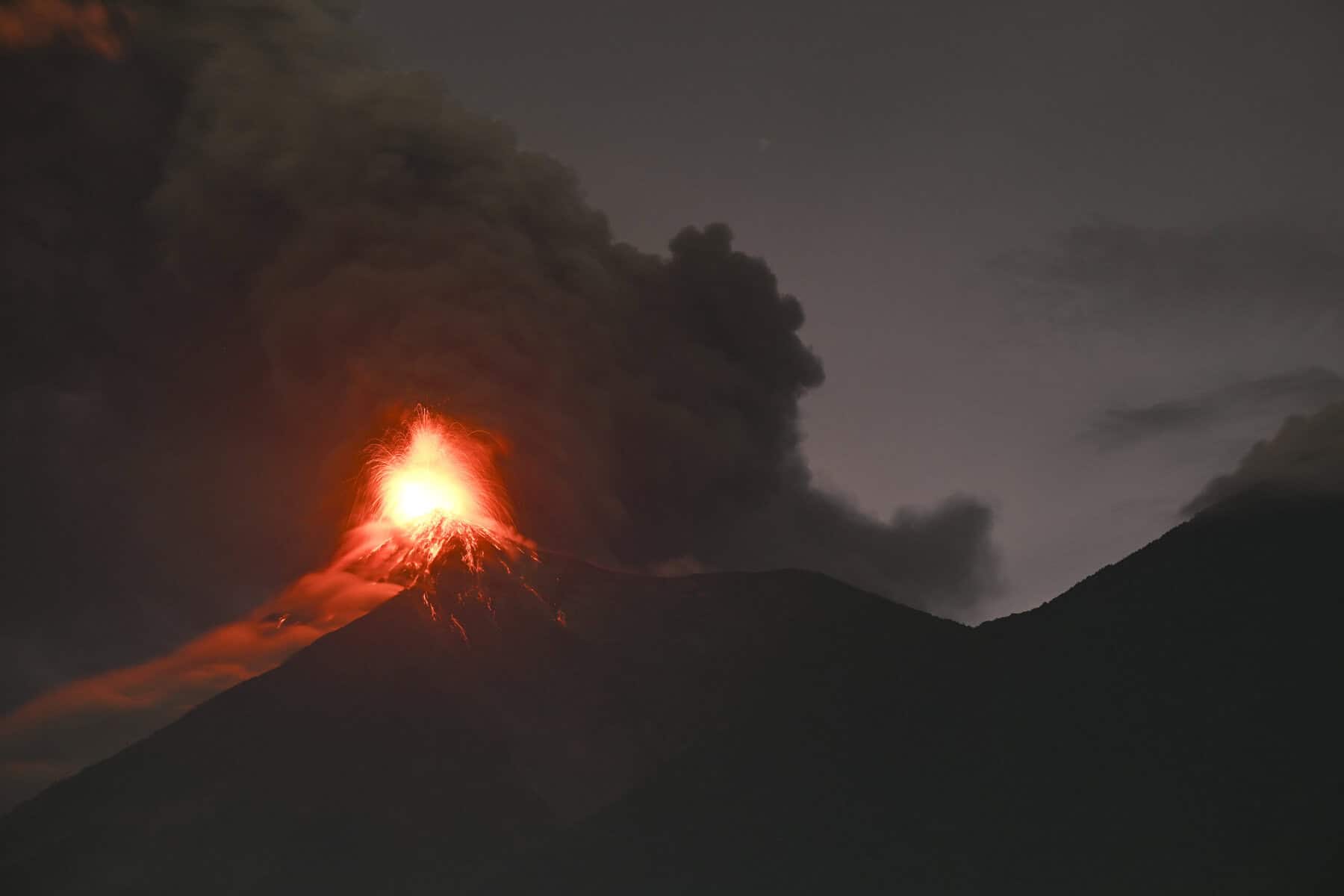
A powerful eruption of Guatemala’s Fuego Volcano has forced authorities to evacuate at least 1,700 residents from areas near the crater and declare the highest alert level Tuesday in zones exposed to falling ash. Fuego, considered the most active volcano in Central America and located near the capital, entered an eruptive phase Monday morning.
Its activity intensified overnight into Tuesday, with streams of lava flowing down its slopes and enormous columns of gas and ash rising into the sky. “The volcano is going through one of its most critical explosive phases,” producing mudflows, incandescent rocks, gases and ash, said Edwin Rojas, director of the Institute of Volcanology, known as Insivumeh.
Guatemala’s National Coordinator for Disaster Reduction, Conred, began evacuating communities near the volcano Monday evening and declared an orange danger alert nationwide. On Tuesday, the agency raised the alert to red in the departments of Sacatepéquez, Chimaltenango and Escuintla, which are home to 1.6 million people.
According to Conred Executive Secretary Claudinne Ogaldes, about 29,000 people are directly exposed to ashfall, making evacuations from the area essential. Ogaldes urged residents of nearby communities to wear masks and cover their water and food supplies. Conred said more than 1,700 people had been evacuated.
“We have become accustomed to living with a volcano that is always active, but this time it was simply too much,” said Sonia Vasquez, a 50-year-old resident of El Porvenir who spent the night in a shelter. Alejandro Garcia, another resident, also evacuated Monday evening after the alert was issued.
“We ran out, terrified,” he said, after seeing lava flowing down the volcano’s slopes. Despite the higher alert level, authorities reopened a road leading to the colonial city of Antigua, a UNESCO World Heritage Site and one of Guatemala’s main tourist destinations. Operations at Guatemala City’s international airport have not been affected so far.
Lava Fountain
The Ministry of Education suspended in-person classes at schools in three communities near the volcano. “It would be better if we could move somewhere else because we live with this fear, since the volcano gives no warning,” said Lidia Ortiz, another evacuee. According to Insivumeh experts, a lava fountain reaching between 200 and 300 meters above the crater formed Monday, while the ash column rose to more than 7,000 meters.
As the ash dispersed at altitudes between 5,000 and 6,000 meters, it traveled as far as 130 kilometers westward. The institute said 34 earthquakes were recorded in Guatemala during the previous 24 hours, most with epicenters in the Pacific Ocean. Guatemala is located along the Pacific Ring of Fire and experiences significant seismic and volcanic activity.
Several mass evacuations have taken place in recent years because of eruptions at Fuego, which rises 3,763 meters above sea level and is located about 35 kilometers from Guatemala City in a straight line. In June 2025, around 800 people were evacuated because of eruptions at Fuego.
In 2018, 215 people were killed and about 200 others were reported missing after volcanic flows devastated a village on the slopes of the volcano.