

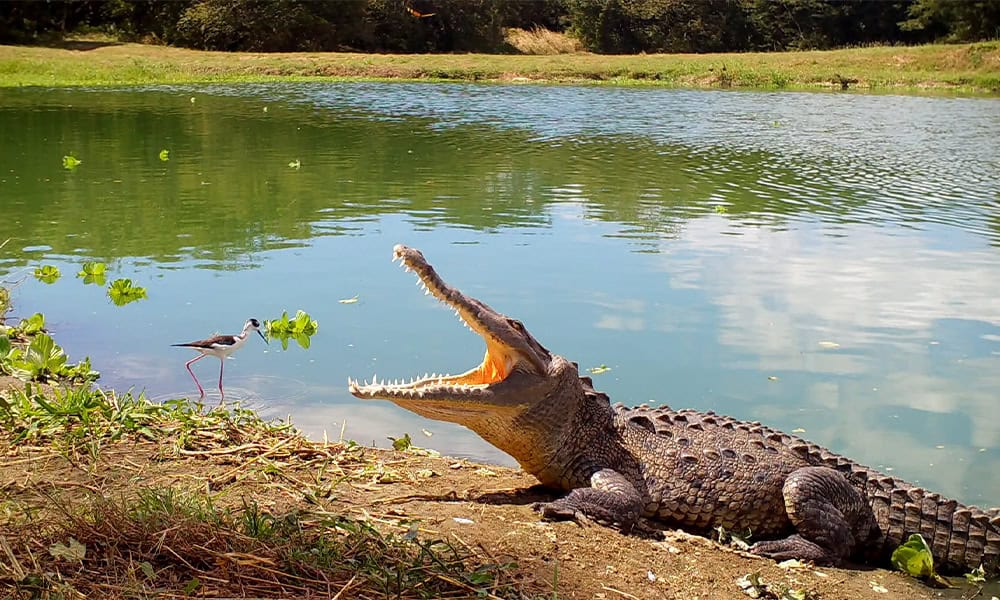
Today we meet the American crocodile (Crocodylus acutus), known as the cocodrilo in Spanish. These crocodilians have become a hot topic in Costa Rica as their population continues to rebound from hunting in years past. Scientists say we have not reached the point of overpopulation, but some members of the general public are nonetheless unhappy with increased sightings of crocodiles in recent years. Let’s set aside our feelings about the state of their population for a moment and learn more about their reptilian lives.
American crocodiles are one of two crocodilian species in Costa Rica with the other being the spectacled caiman. Of the two, crocodiles are significantly larger. At the top end, large male American crocodiles can reach lengths of twenty feet and can weigh over two thousand pounds, though that is far above the average size you would find in the wilds of Costa Rica.
These large predators are found in a variety of aquatic habitats including rivers, swamps, estuaries, and in coastal areas. They are highly tolerant of salt water and are regularly sighted in mangroves and on beaches. They are most frequently seen in these environments while sitting outside of the water basking in the sun, raising their body temperatures. At the slightest sign of trouble, they dash into the water where large individuals can stay submerged for over an hour.
The majority of their diet consists of aquatic creatures like fish, crabs, amphibians, reptiles like snakes and turtles, carrion, and small mammals. As they grow larger, they are able to prey upon larger species. Personally I’ve only witnessed them eating a variety of fish, a Halloween crab, and once I saw a crocodile swimming around with a white-tailed deer in its mouth. My camera traps have captured them eating or at least attempting to eat a much wider range of prey including a variety of herons and fish, bats, a frog, and a black spiny-tailed iguana. I know it’s a bit morbid but when I have the chance, I always set a camera trap where I find hoofprints of deer at the water’s edge, hoping for that National Geographic-style video of a crocodile leaping from the water and grabbing a deer.
Sometime around the end of dry season, females lay up to sixty eggs in a nest that they excavate near the water. The eggs incubate in the sun beneath a pile of plant material and soil. Since sex determination is temperature dependent, the temperature of the nest will determine the ratio of males to females. The female remains around the nest during incubation and will protect it against predators. I’ve found my share of crocodile nests while working along waterways. Once, I found a whole series of nests along the Tempisque River with shells strewn about, either the result of predation or successful hatching.
While working on a sugarcane plantation, I decided to eat my lunch along the edge of the Cañas River under a tree. It took a few moments to realize that I was sitting next to a crocodile nest and the female who made it was staring at me from across the small span of water. The most interesting nest I ever found was a in crocodile cave on the bank of a dried riverbed where I was able to record a series of videos of the female crocodile defending her newly hatched young against predators.
I am equal parts fascinated by and frightened of American crocodiles. I love seeing them in the wild and recording them with my camera traps, but at the same time the sight of these large, scaly creatures triggers some sort of fear response deep in my being. I’ve gone through my records and found some incredible crocodile videos to share with you in the video below. This is definitely one of the best compilation videos of any species that I’ve made. Enjoy.
About the Author
Vincent Losasso, founder of Guanacaste Wildlife Monitoring, is a biologist who works with camera traps throughout Costa Rica.