

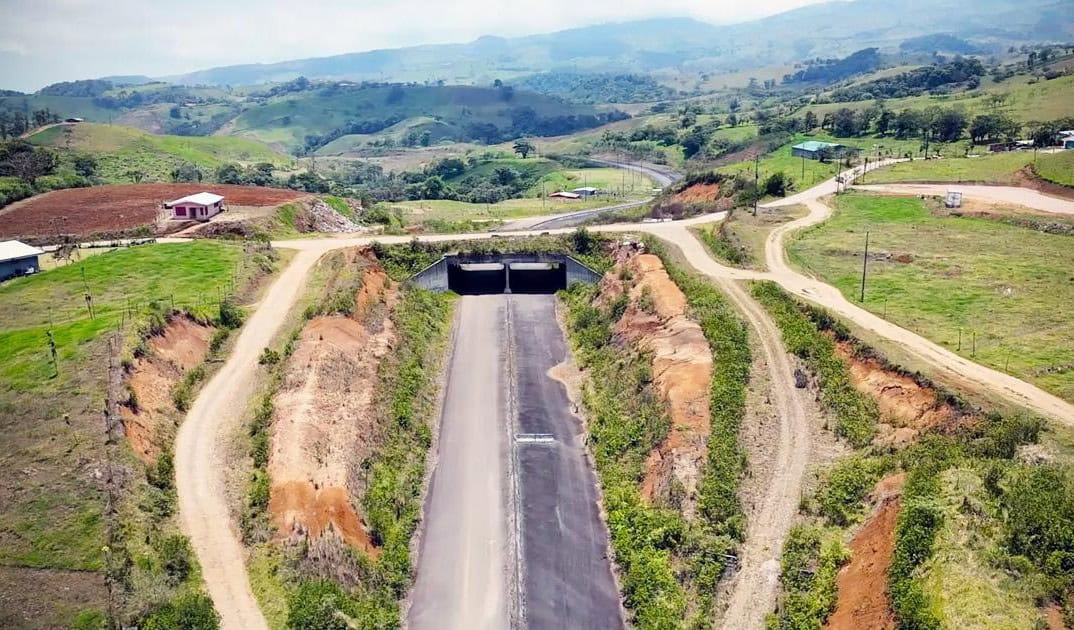
One of Costa Rica’s longest-delayed road projects has cleared a major hurdle after the Comptroller General’s Office approved a path forward for the central section of the new highway to San Carlos. The decision allows the government to move ahead with China Harbour Engineering Company, known as CHEC, for work on the central stretch of Route 35, a key piece of the long-promised road linking the Central Valley with San Carlos and the Northern Zone.
For travelers, the project matters because Route 35 is tied directly to access between San José and some of Costa Rica’s most visited inland destinations, including San Carlos, La Fortuna, Arenal and communities across the Northern Zone. The approval does not mean the road will open soon, but it removes one of the main legal and administrative barriers holding up the project.
The central section runs between Sifón de San Ramón and La Abundancia in Ciudad Quesada. The project covers nearly 30 kilometers and is planned as a four-lane highway, with two lanes in each direction, shoulders, a central divider and safety barriers. It also includes bridges, overpasses, improved existing structures, and crossings for wildlife and livestock.
According to project details previously released by the Ministry of Public Works and Transport, the central section is divided into two lots. The first runs from Sifón to Río Tapezco and covers about 13.9 kilometers. The second runs from Río Tapezco to La Abundancia and covers about 15.84 kilometers. The execution period is listed at 40 months for the first lot and 32 months for the second.
The Comptroller’s decision came after the government sought a way to proceed despite delays tied to the original financing and procurement process involving the Inter-American Development Bank. The issue centered on whether the government could shift the contracting process from multilateral rules to Costa Rica’s national public contracting system under exceptional conditions.
The Comptroller’s position gives the government room to advance, but it also places responsibility on the administration to justify the move, show that the process respected transparency and competition, and demonstrate that switching course serves the public interest better than restarting the bidding process.
President Laura Fernández, speaking during a visit to San Carlos, said the government expects construction to begin in the second half of the year. She asked the MOPT to accelerate the process so machinery can be seen on the ground this year.
The new San Carlos highway has been discussed for decades and has become a symbol of Costa Rica’s difficulty finishing major road projects. Parts of the corridor have advanced, including the northern section between Florencia and Ciudad Quesada, but the central section has remained one of the most complicated pieces because of technical, environmental, geological and contracting problems.
The project has also drawn scrutiny because CHEC was the only bidder still in position for the central section. The same Chinese company has been involved in the expansion of Route 32 to Limón, another major infrastructure project that has faced delays and criticism over its pace.
For San Carlos residents and businesses, the highway is seen as essential for moving people, agricultural goods and tourism more efficiently between the Northern Zone and the Central Valley. For visitors, the long-term benefit would be a more direct road option toward La Fortuna, Arenal and nearby tourism areas.
For now, drivers should not expect immediate changes to travel routes. The existing roads to San Carlos and La Fortuna remain in use, and the newly approved section still must move from paperwork to construction. But after years of stalled promises, the Comptroller’s approval gives the government its clearest opening yet to restart one of Costa Rica’s most important unfinished highway projects.





