
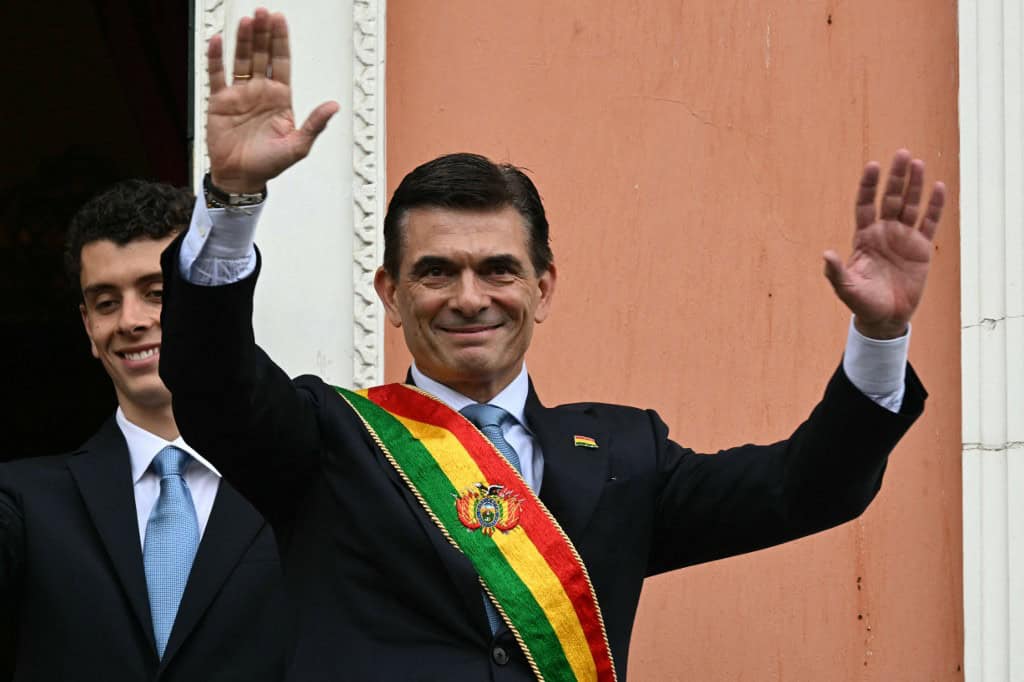
The center-right Rodrigo Paz was sworn in Saturday as president of Bolivia with a promise that the country would “never again” be “isolated” from the world, and he announced the restoration of diplomatic relations with the United States, a political shift after 20 years of left-wing governments.
Paz, 58, the son of former president Jaime Paz Zamora (1989–1993), outlined the pillars of his new government in a speech in which he showed openness to international capital and to relations with Western nations.
“Never again a Bolivia isolated, subjected to failed ideologies, much less a Bolivia turning its back on the world,” the president said as he greeted more than 70 international delegations that came to La Paz for the inauguration ceremony.
Among the main leaders present were the U.S. deputy secretary of state, Christopher Landau, and presidents Gabriel Boric (Chile), Javier Milei (Argentina), and Yamandú Orsi (Uruguay).
Paz’s election marks a political shift in the Andean country: it ends two decades of dominance by the Movement Toward Socialism (MAS), led for 26 years by Evo Morales, in power from 2006 to 2019, and then by his successor, outgoing president Luis Arce.
Diplomatic shift
In one of his first official acts, Paz announced the resumption of high-level diplomatic ties with the United States, which were broken in 2008. The rupture came after Morales expelled the U.S. envoy, accusing him of supporting a right-wing plot. Washington, in retaliation, did the same.
“We are going to establish those relations,” the new Bolivian leader said alongside the representative of Donald Trump’s government, who specified that it would be “at the ambassadorial level, as it always should have been.” “It has been very unusual that we have not had ambassadors in our capitals,” Landau said.
Paz, an economist and former senator, will govern a country that under Morales swung far to the left, with nationalization of energy resources and alliances with Hugo Chávez’s Venezuela, as well as with Cuba, China, Russia, and even Iran. The new president also held meetings with Milei and Boric.
“In whatever you think we can help you, we’re at your disposal,” the Argentine president offered. The Chilean leader, for his part, expressed his desire to continue “strengthening” relations, although the two countries have not maintained ambassadors since 1978 due to territorial disputes.
A total change
Paz was cheered as he entered La Paz’s legislative palace, where lawmakers and foreign guests attended, while heavy rain fell outside. The winner of the October 19 runoff inherits a country with a sharp economic crisis due to shortages of dollars and fuel.
Arce’s government exhausted almost all of its foreign-exchange reserves to sustain a policy of universal subsidies for gasoline and diesel. Year-over-year inflation in October was 19 percent, after peaking at 25 percent in July.
Yeni Murgía, a 55-year-old vendor, said she trusts that Paz’s government will halt rising living costs and ensure fuel supply. “We expect a total change. I am very happy,” she said amid thousands of the new president’s supporters who took to the center of the high-altitude city to celebrate with flags and music.
Green future
Paz vowed to reduce fuel subsidies and taxes, eliminate bureaucratic hurdles, and promote “capitalism for all” to bring the informal economy into the formal sector. He said “the country has to produce again, we are going to open the economy, attract investment” and proposed to “modernize the energy and digital systems.”
He also said that “economic development will go hand in hand with respect for the environment,” aiming for “a green future.” Bolivia lived for 20 years off the economic boom from its gas exports, now in decline due to a lack of exploration.
Arce, who ended his term with low popularity, did not attend the swearing-in. He was also expelled in recent days from MAS, accused of diverting party funds.