

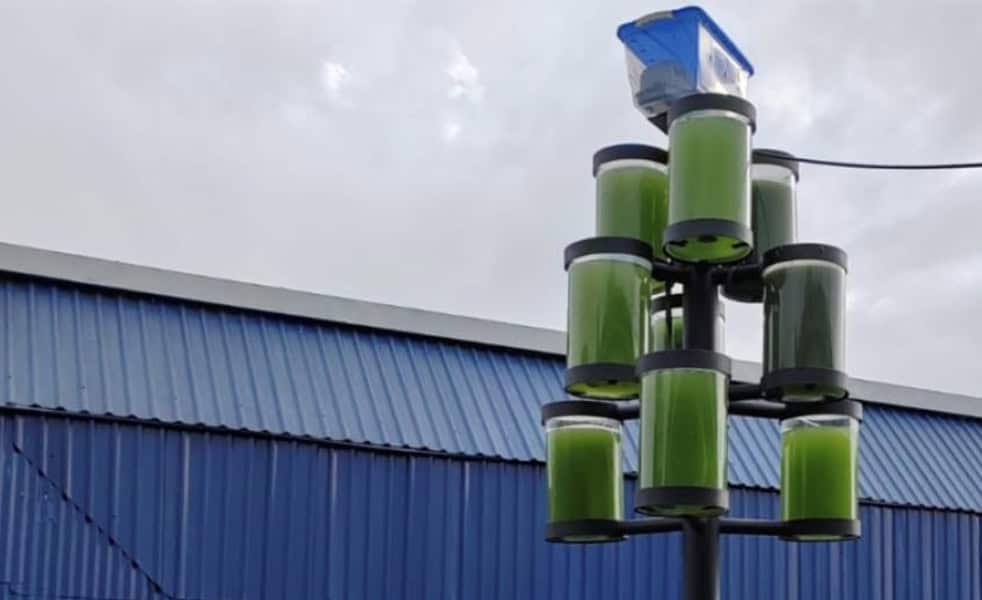
Under the banner of tackling climate change and reducing pollution, students from the Natural Resources Management program (MARENA) at the Universidad Estatal a Distancia (UNED) are spearheading an innovative project known as Liquid Trees. The research focuses on utilizing microalgae as an effective tool for carbon dioxide (CO₂) absorption.
According to Wilber Sácida González and María Martínez Delgado, the students behind this initiative, microalgae have proven to be more efficient than terrestrial trees in capturing CO₂ under certain conditions. However, they emphasize that Liquid Trees are not intended to replace traditional trees but to complement them. These microalgae can work in synergy with terrestrial trees, offering more efficient photosynthesis in controlled environments, absorbing carbon dioxide, and generating oxygen.
The project is supported by UNED’s Laboratory Program (PROLAB) and utilizes two key microalgae species: Nannochloropsis oculata, a saltwater microalgae, and Chlorella vulgaris, a freshwater species. Both are integral in addressing climate change and reducing the carbon footprint.
Liquid Trees rely on biophotoreactors—structures designed to cultivate microalgae—which provide a controlled environment to enhance the algae’s growth and carbon-absorbing capabilities. Since its inception as a pilot project at UNED’s San José campus in 2019, the initiative has expanded to other areas, exploring the potential of both freshwater and saltwater microalgae on a broader scale.
The urgency of this research is highlighted by recent findings from the Organization for Economic Cooperation and Development (OECD). According to the Ombudsman’s Office, San José’s air quality has deteriorated, with particulate matter (PM10) levels reaching 27.1 micrograms per cubic meter, making it one of the most polluted capitals in Latin America, surpassing Mexico City’s 21.7 micrograms.
International studies show that 240 liters of microalgae can absorb the same amount of carbon dioxide as 20 saplings, emphasizing the potential of this technology to be a game-changer in climate mitigation efforts.
In addition to environmental benefits, the Liquid Trees project also has significant social implications. It not only aims to reduce the carbon footprint but also to create jobs, support a circular economy, and promote the use of organic fertilizers. The project further contributes to sustainable practices in aquaculture and livestock farming, incorporating microalgae-based food to support these industries.





