

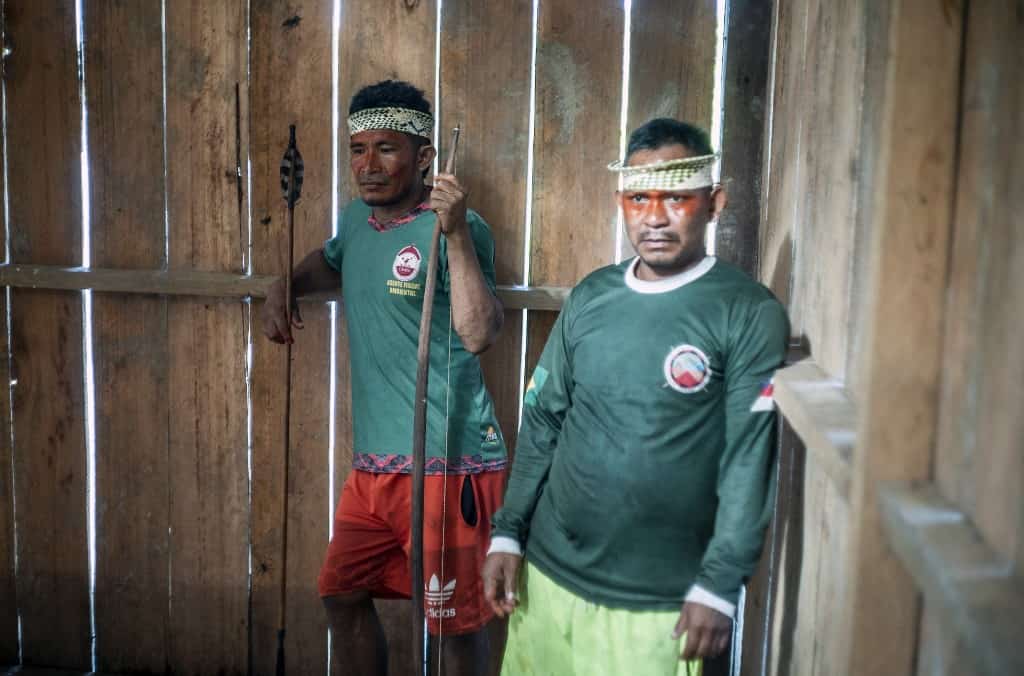
In a remote pocket of the Brazilian Amazon under siege from illegal fishermen, poachers, loggers and drug traffickers, Indigenous people have taken it upon themselves to defend the land and its resources.
With bows, arrows and spears, young men of the Sao Luis village patrol the Javari River by motorboat in the valley of the same name.
They call themselves the “Warriors of the Forest,” the self-styled heirs of Indigenous rights defender Bruno Pereira, who was murdered in the Javari Valley one year ago along with British journalist Dom Phillips.
“We must always be prepared for the worst. But we do not want violence,” said Lucinho Kanamari, his face painted red, insisting the traditional weapons are merely a “precaution.”
“When we spot intruders, one of us will talk to them. The others stay back, ready to react if things go wrong,” he said. “We are there to teach, to act as a peaceful deterrent. We talk, we explain.”
Lucinho is a member of the Kanamari Indigenous group, one of six in the Javari Valley which holds Brazil’s second largest protected Indigenous reservation.
Like many others who live here, he takes his surname from his tribe which lives in a part of the rainforest the size of Portugal that contains many of the world’s last uncontacted Indigenous groups.
Invasions exploded
The patrolling warriors particularly fear the illegal fishermen in search of pirarucu — one of the world’s largest freshwater fish, its flesh considered a delicacy worth a small fortune.
Such poachers are believed to have killed Pereira and Phillips on June 5, 2022, hacking up their bodies and hiding the remains in the jungle.
For a while, the crime brought international attention to this threatened corner of the planet long-abandoned under former far-right President Jair Bolsonaro and his pro-industrial agenda.
“With Bolsonaro, and then Covid, the invasions exploded,” said Varney Todah da Silva Kanamari, vice president of the Union of Indigenous Peoples of the Javari Valley (Univaja).
“As the state abandoned us, we had to assume our responsibilities… We defend what belongs to us: our lakes and forests,” he said. It is not only fishermen the watchmen fear. There are also narco groups growing coca crops on the Peruvian side of the river, and in April, loggers threatened to kill a Kanamari chief, forcing him into exile.
The warriors have built two floating wooden observation posts on the river near their village of Sao Luis. One of the structures has come under fire.
Their task is immense and dangerous, their means lacking. The team has only two motorboats and little fuel. The “warriors” avoid violent conflict, and in tense situations, withdraw back into the forest.
Under threat of death
With government forces absent from the area, the Sao Luis warriors work with another Amazon Indigenous group known by its acronym EVU — a sort of commando unit attached to Univaja.
Pereira helped set up the EVU before his death. EVU members — about 30 in total — are equipped with motorized barges, GPS, drones, phones and satellite internet, much of it made possible by private donors. They carry no weapons.
EVU volunteers from different Javari Valley communities undergo training by NGOs and security specialists in “how to intervene, make surveys, confiscate equipment or boats,” explained EVU co-founder Cristobal Negredo Espisango, known as Tatako.
According to Univaja coordinator Bushe Matis, the EVU does not “replace the state.” “We monitor, we collect information and evidence, and we pass it on to the relevant authorities. Then let the state do its job.”
EVU leader Orlando de Moraes Possuelo said a key goal is “to occupy terrain” in areas with an abundance of sought-after fish and animals.
“We arrive as soon as possible to catch the intruders in the act, before they disappear or return to Peru.” Legally, they cannot detain anyone.
Many of the group’s members have received threats. “I am under threat of death. I am afraid of course, but there is no other option,” said Tatako. “The EVU is the only organization that really fights organized crime in the Javari Valley,” he added.
With the return of leftist Luiz Inacio Lula da Silva to the presidency, many in the Amazon hope help will soon be coming. This week, as Brazil marked the anniversary of the murders of Pereira and Phillips, Lula vowed that “we will not abandon this struggle for the planet.”
“We are fighting to revive policies to protect Indigenous peoples and the Amazon,” he said in a statement to The Guardian newspaper, to which Phillips was a contributor.
But just last week, Brazil’s Congress passed bills cutting the powers of Lula’s environment and Indigenous affairs ministries and dramatically curbing the protection of Indigenous lands.
Univaja’s Matis fears for the future. “There can be a tragedy at any moment. The invaders will never back down: they will always want to lay claim to the Javari,” he said.





