

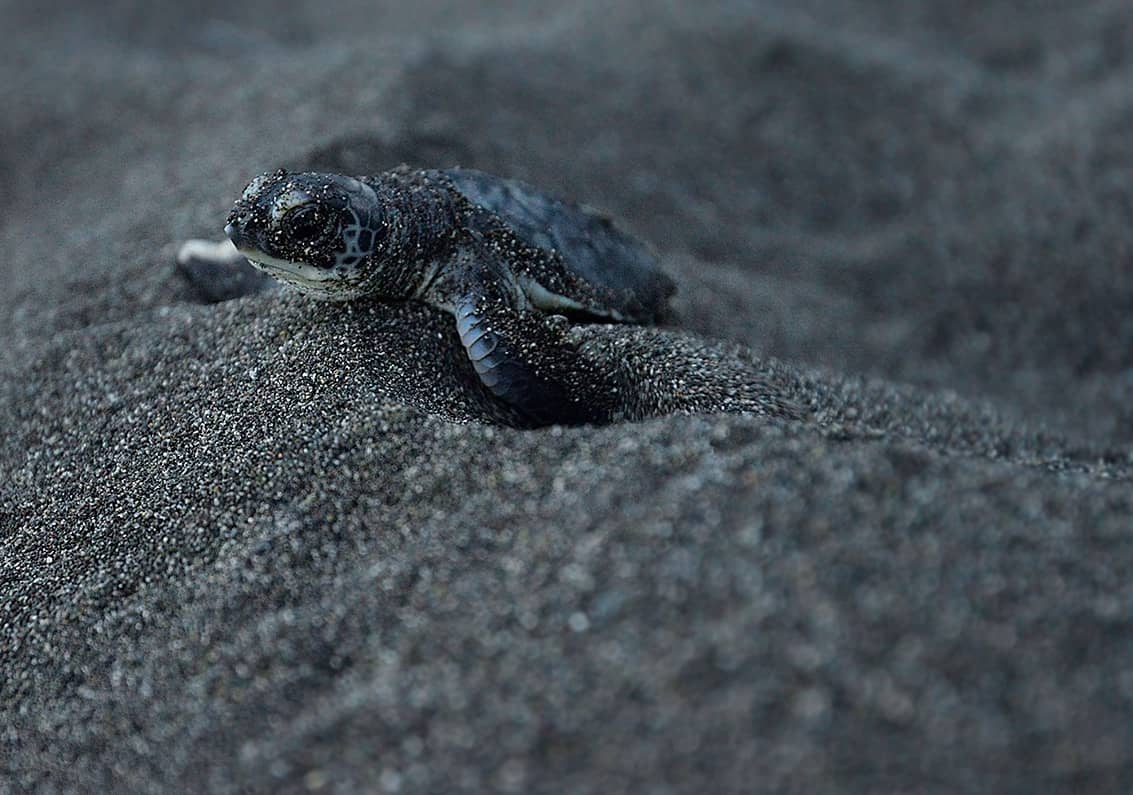
Melisa Campo took her son to observe the release of newborn turtles in captivity in Panama, while, not far from that beach, delegates from more than 180 countries discuss new protection measures for endangered species.
“I came to bring the children to see the release of turtles so that they can learn about the issue, since they are the future generations,” Campo said as he and his 10-year-old son watched the first steps of some 200 turtle hatchlings on the sand of Chame beach.
Campo, a neighbor of the area, hopes that her son and the other children “learn about the care and protection of a species that is in danger of extinction”.
Turtles are one of the main topics of the conference on international trade in endangered species, which runs until November 25 in the Panamanian capital.
Panama City is located 43 kilometers in a straight line along the sea from this white sand beach, where thousands of olive ridley turtles (Lepidochelys olivacea) come to lay their eggs every year.
The COP19 of the Convention on International Trade in Endangered Species of Wild Fauna and Flora (CITES) is being attended by delegates from more than 180 countries and conservation experts, who are debating 52 proposals to modify levels of protection, including for some turtles.
Many threats
The village of Punta Chame, which has no more than 500 inhabitants, is on a thin peninsula in the Pacific Ocean, from which the skyscrapers of Panama City are visible.
At night, the lights of the buildings and highways of the modern capital dazzle those who walk along this tropical beach, where the thermometers rarely fall below 25 degrees Celsius.
The fight against the trafficking of turtle meat and eggs in Punta Chame is carried out, almost single-handedly, by Jorge Padilla, from the NGO Fundación Tortuguías, who walks the beach day and night to scare away people who put the survival of these animals at risk.
“The threats to sea turtles, both in the Pacific and in the Caribbean, are many, to tell the truth”, says said Padilla, in charge of a nursery on Chame beach where hundreds of turtle hatchlings are born daily between July and February.
This 25-year-old tour guide and some volunteers from the village collect the eggs recently laid by the turtles and then bury them in an orderly fashion in a trellised hatchery on the same beach, a little further from the shore.
After 45 days, the turtles hatch. An hour or two later, Padilla takes them out of the hatchery on a tray, releases them on the sand and they go into the sea for the first time. The females will return to lay their eggs on this same beach in 18 to 20 years.
They are not aphrodisiacs
In the village it is an open secret that there are neighbors who sell turtle eggs – similar to ping-pong balls – that they collect on the beaches, an illegal activity in Panama.
They offer the eggs house to house for 75 cents or a dollar, says Padilla, who indicates that they are in high demand due to the popular belief that their consumption increases men’s sexual performance.
“Eggs don’t do you any good, they’re not aphrodisiacs,” Padilla says, however. “Normally people say, especially men, that by eating turtle eggs they are going to have greater sexual pleasure,” but it’s not true, he adds.
Melisa Campo prefers not to talk about egg trafficking in her town, but admits that “there are people who come to the beach to steal turtle eggs for illegal commercialization.
Turtle eggs and hatchlings are also preyed upon by animals, such as stray dogs and harpy eagles.
Padilla chases away abandoned dogs, but not eagles, because eagles are natural predators of turtles, which is part of the ecological balance.





