

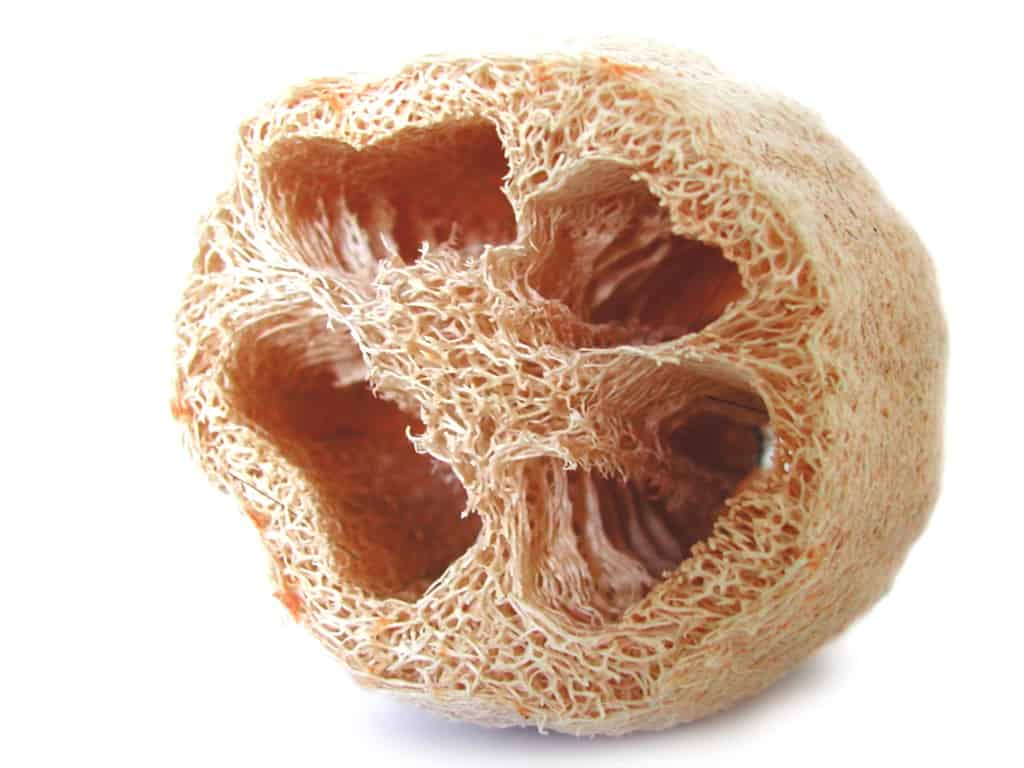
I was introduced to the Luffa gourd while living in Guanacaste, Costa Rica, where it grows on every telephone pole in the province.
Guanacaste has a dry tropical forest ecosystem with at least six months of hot, dry weather (November – May) followed by a wet season (June – November) which provides the ideal climate for Luffa gourds.
They aren’t consumed as a vegetable in Guanacaste; rather, they are used as a scrubbing sponge in the shower, hence the common English names of “Dishrag gourd.”
The fruit has a thin skin and pericarp and will dry out quickly in the hot tropical sun, exposing the fibrous network of xylem vessels. The dried skin can be easily removed and the seeds shaken out, and with a few deft carvings with a knife, you can have an incredibly satisfying and exfoliating sponge for your shower.
A cottage industry in the dry tropical regions of Central America is to cut out the matrix of xylem vessels and sew them into a cloth backing for a value-added sponge. I buy these by the dozens, especially those cut out to look like a rubber ducky.
The luffa (often written as “Loofah”) is native to Asia, but was extensively grown in Egypt. The name name luffa was taken by European botanists in the 17th century from the Egyptian Arabic name لوف lūf.
In 1706, the botanist Joseph Pitton de Tournefort introduced the formal genus name “Luffa,” in the cucumber family.
How the plant was introduced into Guanacaste from Egypt or Southeast Asia is unknown, but was likely due to human intervention. The dried fruit will float, but it seems unlikely they floated across the oceans to the dry tropical forest.
In Southeast Asia, Nepal and India, the immature fruit of L. acutangula (< 5 cm) are eaten as a vegetable, either steamed or stir-fried. I have personally never eaten — or for that matter even thought of eating — the immature fruit, as in Guanacaste it has almost toxic levels of Cucurbitacin.
Cucurbitacin is an exceedingly bitter triterpenoid compound which is a deterrent to herbivory and is common among members of the Cucurbitaceae family, including squash, pumpkins, and cucumbers. It must be effective, as I have never seen any critter with either fur, wings or bug eyes that ever damaged a Luffa gourd! The Luffa seeds are also exceedingly bitter.
The immature fruit eaten in Southeast Asia are likely cultivars or landraces selected with low levels of Cucurbitacin. In contrast, the wild types used as a sponge in Costa Rica have high levels of Cucurbitacin, but when dried, the xylem matrix has no bitterness or smell.
In regions of the dry tropical forest in Central America, Luffa grows wild, and when you want a sponge, you simply yank a dried fruit off a telephone pole.
There is interest in commercialization of this plant, and Professor Todd Wehner at North Carolina State University has initiated a Loofa breeding program. His laboratory is evaluating germplasm for desirable characteristics including fruit length and fiber color.
— Jim Nienhuis is a Professor at the University of Wisconsin-Madison Department of Horticulture.





