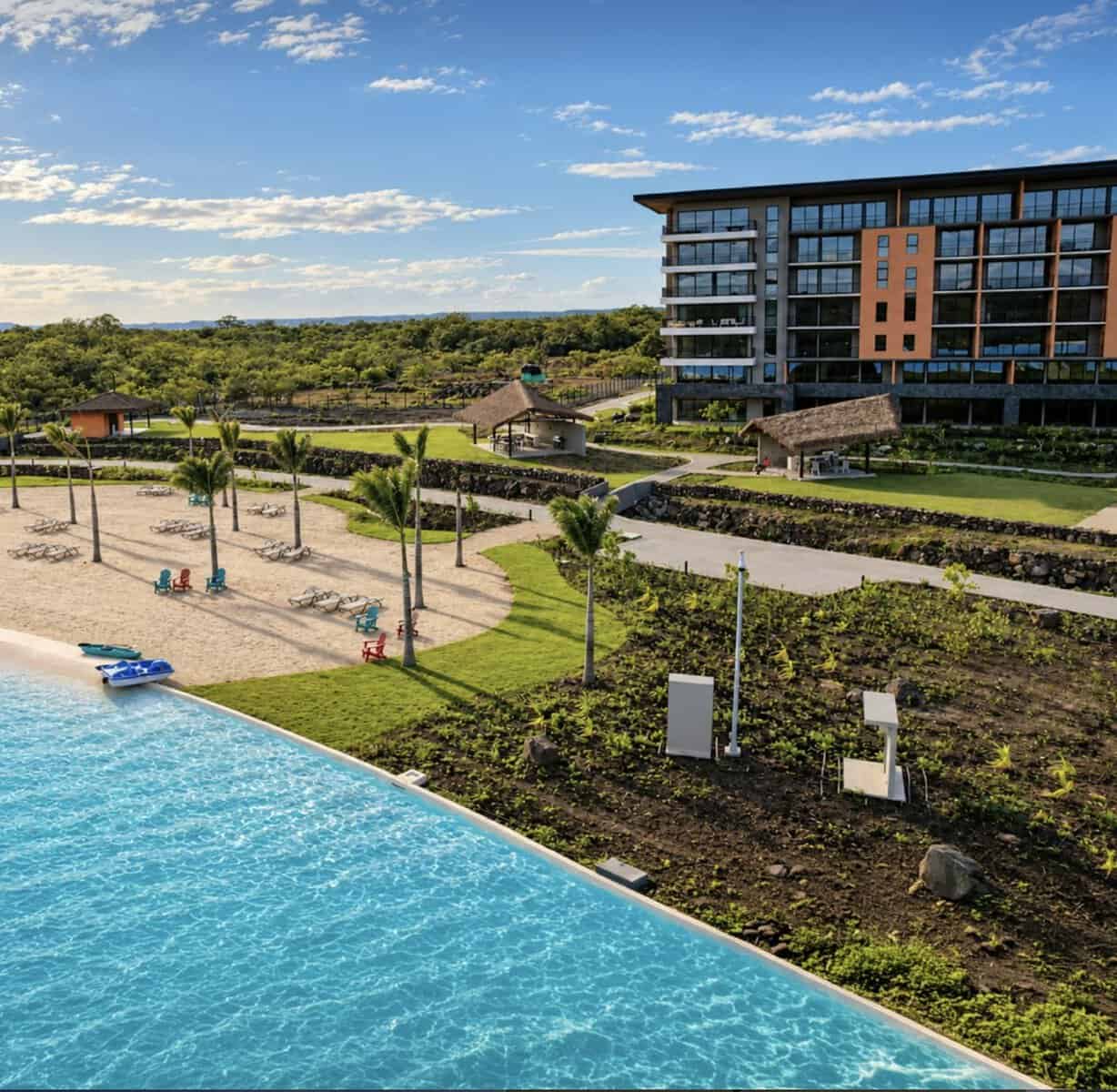
Costa Rica’s first artificial beach is finished, and the water that fills it is pumped from the ground in one of the driest corners of the country. Ciudad Nya, a mixed-use development about five minutes from the Liberia Airport, has completed a 3.5-hectare (8.6-acre) lagoon built with Crystal Lagoons technology. Its builders describe it as the first lagoon of its kind in the country. It has seven white-sand beaches, a central island with docks, a 1.6-kilometer (1-mile) perimeter trail and a maximum depth of 2.8 meters (9.2 feet).
The lagoon arrives as Guanacaste heads into what the National Meteorological Institute (IMN) expects to be a severe El Niño dry season. That timing makes the developer’s water claims more important than they would be in an ordinary year. Enrique Barrientos, general manager of Ciudad Nya, said the project has five wells of its own. Three of them hold water concessions and supply the lagoon. He said the plan is to fill the lagoon once and then replace water lost to evaporation through rainfall and a filtration system.
In a statement issued when construction ended, the company said the lagoon operates as a closed circuit and only needs topping up to replace evaporation, part of which is offset by rain during the wet season. It said the water comes from wells concessioned and approved by the Water Directorate of the Ministry of Environment and Energy (MINAE). It also said the lagoon complies with Health Ministry water-quality rules and holds a sanitary operating permit.
Crystal Lagoons, the Chilean company behind the technology, says its lagoons use up to 30 times less water than a golf course of comparable size. Barrientos made a similar comparison and also said a golf course is part of Ciudad Nya’s plans.
Neither the company’s statement nor its manager’s public comments have specified how much water the lagoon holds or how much it loses to evaporation in Guanacaste’s heat. They have also not said how much the wells are authorized to extract, or what role the two wells without concessions play on the property.
Those figures matter because the rain the system relies on may not arrive. The IMN’s seasonal outlook for October through December forecasts an 80% rainfall deficit in the North Pacific, an early end to the rainy season, and average temperatures 1.5 to 2 degrees Celsius (2.7 to 3.6 degrees Fahrenheit) above normal along the Pacific slope.
The institute said sea surface temperatures in the Niño 3.4 region reached anomalies near 2.5 degrees Celsius (4.5 degrees Fahrenheit) in August. That is higher than during the strong El Niño events of 1997 and 2015.
The national El Niño contingency strategy for 2026-2027, prepared by the National Emergency Commission (CNE) with other institutions, says the Water and Sewer Institute (AyA) expects drinking-water shortages in rural communities of the Chorotega region. It also anticipates reduced recharge of strategic coastal aquifers in systems in Liberia, Carrillo, Santa Cruz, Nicoya and other cantons.
Pressure on Guanacaste’s groundwater predates this El Niño. The National University’s Observatory of Tourism and Migration in the Chorotega Region found that in 2024, 22 community water systems in the province lacked the technical capacity to approve new connections. Seventeen of them were clustered around the tourism districts of Sardinal, Tamarindo, Tempate and Cabo Velas.
Barrientos said the project’s approach concentrates development around an inland lagoon instead of bringing the same kind of construction to the coast, which he said would carry a heavier environmental cost. He acknowledged that a broader strategy to preserve natural areas, restore rivers and protect wildlife is still being developed.
The lagoon is primarily a private amenity for residents. Barrientos said the company plans to open part of it to outside visitors for a fee similar to a hotel day pass, a plan he described as still at an early stage. He said the goal is not to compete with Guanacaste’s free public beaches but to offer an alternative.
The company has contracted battery-powered surfboards for the lagoon and bans petroleum-powered equipment in the water, Barrientos said. Sand for the beaches was brought from the Rincón de la Vieja volcano area, according to the company. The 900-hectare (2,224-acre) property was originally slated for a Discovery-branded theme park announced in 2017. The brand later withdrew, and investors repositioned the land in 2022 as a planned city with housing, offices, retail and entertainment.
The first residential building, the 91-unit Miravalles tower, cost close to $25 million and is about 80% sold, according to the company. Two- and three-bedroom apartments are priced from $380,000 to $560,000. Ciudad Nya also built a 29.2-megawatt solar park under a 20-year power purchase agreement with the Costa Rican Electricity Institute (ICE).
When the project broke ground in 2022, its developers said the first phase would create 600 direct jobs. Barrientos said about 60 people have been hired so far in construction and administration, and that the company has no direct hiring target. He said further growth will depend on market demand.
The coming months will test the lagoon’s water use. Guanacaste’s dry season is expected to arrive early, and the rain the system depends on is forecast to fall at a fraction of its usual rate.