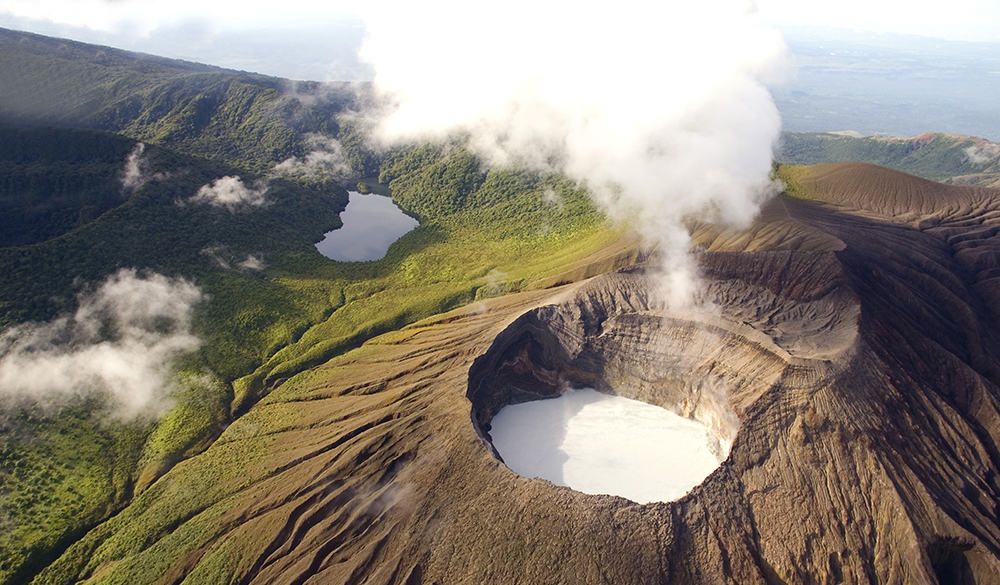
Costa Rica has raised the alert level for communities around Rincón de la Vieja Volcano after scientists detected increased volcanic activity, marking a further escalation just hours after OVSICORI warned that stronger eruptions could occur. The National Emergency Commission (CNE), placed five districts under a yellow alert today, Dos Ríos and Aguas Claras in Upala, and Mayorga, Cañas Dulces and Curubandé in Liberia. The same areas had previously been under a green alert.
The decision follows an increase in eruptions, volcanic gases and earthquake activity at Rincón de la Vieja, which has been unusually active since July. Activity picked up again during the final days of September. The change does not mean scientists believe a major eruption is imminent. OVSICORI continues to keep Rincón de la Vieja at Volcanic Activity Level 3, or Precaution.
The CNE alert and OVSICORI activity level measure different things: the yellow alert increases preparedness in communities around the volcano, while the scientific activity level describes what monitoring instruments are detecting at the volcano itself. As we reported earlier today, OVSICORI has detected several changes happening at the same time, including increased earthquakes, unusual volcanic tremor, movement near the summit and changes in volcanic gases.
Between September 26 and 28, scientists recorded 123 small earthquakes caused by rock breaking south of the crater in the Las Pailas area, along with six smaller earthquakes closer to and beneath the crater. Monitoring equipment also detected a rapid rise of about 13 millimeters, or roughly half an inch, around the summit during September, although scientists noted considerable uncertainty in that measurement.
Gas measurements have also changed. Sulfur dioxide emissions have remained above the volcano’s normal background level since mid-June, while the composition of gases suggests sulfur dioxide is reaching the surface more efficiently than before. A European satellite detected a cloud containing about 22 metric tons of sulfur dioxide moving west from the volcano on September 29.
OVSICORI recorded six eruptions between September 25 and September 30, most of them small releases of steam and volcanic gases. Scientists also detected 172 low-energy acoustic pulses associated with small releases. Only one of the six eruptions reached what the observatory considers moderate strength.
The observatory said the combination of geophysical and gas measurements means eruptions may continue and that some could be stronger than those recorded so far. The CNE has been increasing preparations in communities near the volcano. Emergency officials said residents have received training on evacuation routes, emergency plans, shelters and safe areas, while warning signs have been installed along rivers on the volcano’s northern side.
Those rivers remain one of the main concerns. Eruptions at Rincón de la Vieja can send lahars, fast-moving mixtures of water, mud, rocks and volcanic material, down river channels far from the crater. Authorities are asking people to stay away from rivers carrying volcanic material and not to drink, touch or give that water to livestock. If ash falls in populated areas, residents are advised to limit exposure and cover their nose and mouth.
The yellow alert represents the clearest official response yet to the latest increase in activity. Scientists will continue watching the volcano through seismic and acoustic stations, gas instruments, ground-movement equipment, cameras and field observations.