

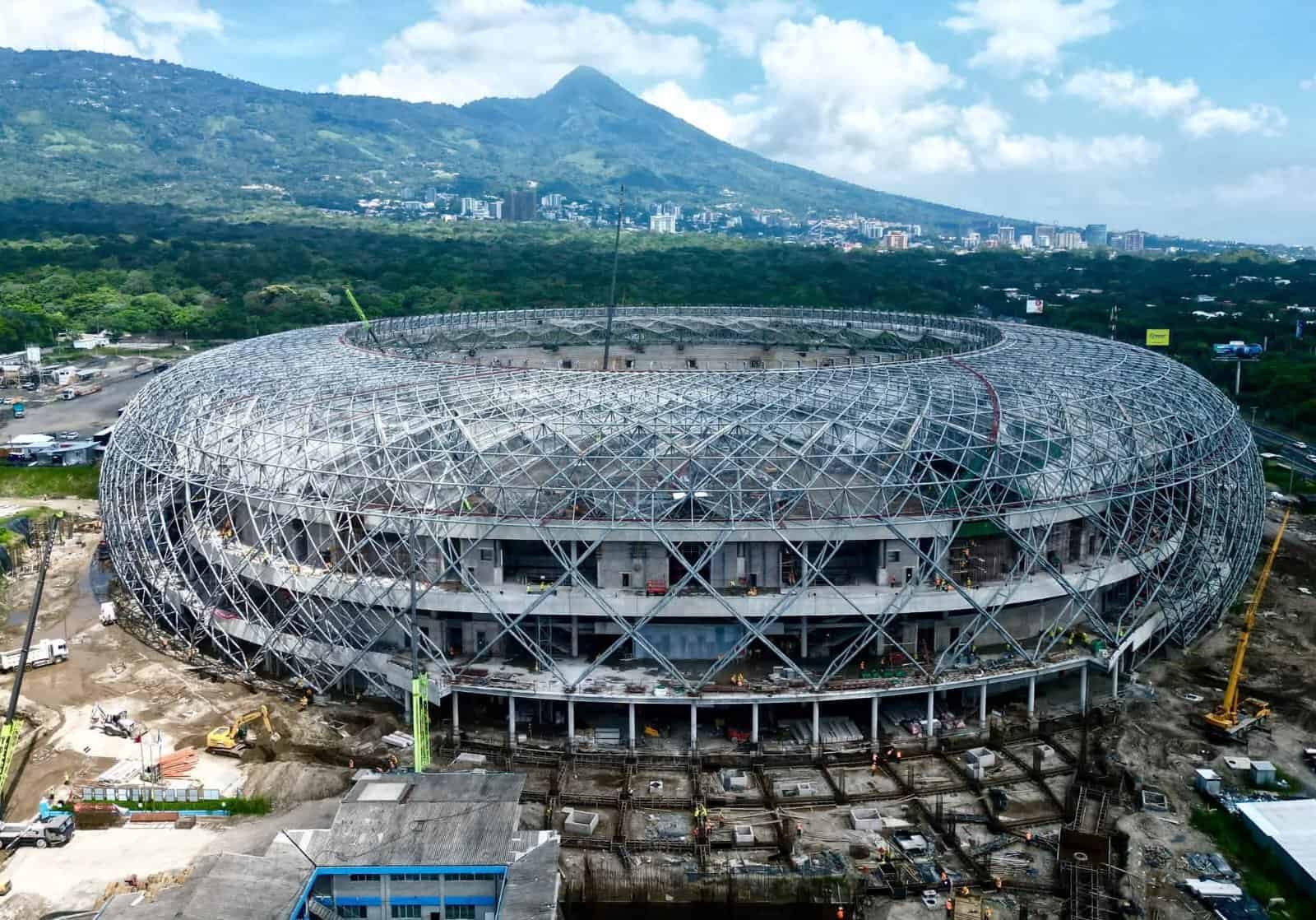
El Salvador’s new National Stadium is three-quarters built, President Nayib Bukele announced Thursday, and when it opens next year its 50,000 seats will make it the largest stadium in Central America. Bukele posted aerial video of the site on his official X account on Oct. 8, putting progress at 75% and saying the venue will be the biggest and most modern in the region.
The post came hours after El Salvador’s National Sports Institute (INDES) released its own photos of the stadium with a message that it was getting closer. The stadium is rising in Antiguo Cuscatlán, on the western edge of San Salvador, on the grounds of the former Captain General Gerardo Barrios Military School.
It is being financed and built by China under a cooperation agreement Bukele announced on Dec. 31, 2021, with China State Construction Engineering Corporation as the contractor. Chinese Ambassador Zhang Yanhui said in a local television interview Thursday that all 50,000 seats are due to arrive at the Pacific port of Acajutla this weekend. Installation would begin in the coming weeks, he said, and will require a temporary increase in the workforce.
About 300 Chinese workers and more than 600 Salvadorans are currently on the project, according to the ambassador. He said another 300 to 400 Chinese workers could join by the end of October, along with additional local hires.The contract sets July 2027 as the delivery date, but Zhang said both governments are working to finish sooner.
He cited April or May 2027 as possible targets and said the stadium could be usable as early as February while finishing work continues, though he stressed that no final decision has been made. No official inauguration date has been announced. Work still pending includes electrical systems, lighting, fire protection and interior fit-out, the ambassador said.
The design is a soccer-only oval bowl with two tiers of stands, a middle ring of corporate boxes and a continuous lightweight dome that serves as both roof and facade. Its curved forms are meant to evoke raindrops, and the undulating wall at the main entrance is meant to suggest ocean waves.
Project plans include VIP areas, press facilities, spaces for people with disabilities and an on-site medical area. Capacity could later be expanded to about 60,000, and the surrounding complex is set to include outdoor courts for basketball, futsal and beach soccer. Beyond national team matches, the government plans to use the venue for concerts, fairs, festivals and other mass events. At the groundbreaking on Nov. 30, 2023, Bukele said the project would take three years and cost $100 million, with parking for 1,400 vehicles.
At 50,000 seats, the new stadium will be far larger than its neighbors. Costa Rica’s Estadio Nacional in La Sabana holds about 35,000, Honduras’ Estadio Nacional Chelato Uclés roughly 34,000, Panama’s Estadio Rommel Fernández close to 32,000 and Guatemala’s Estadio Doroteo Guamuch Flores about 26,000.
The project follows a familiar pattern in the region. Costa Rica’s own National Stadium was also built and donated by China, opening in 2011 after San José switched diplomatic recognition from Taiwan to Beijing in 2007. El Salvador made the same switch in 2018, and the stadium deal was reached during Bukele’s official visit to China in 2019.
The stadium is one of several large public works under way during Bukele’s government, which has drawn regional attention for its security model and, more recently, its economic reforms. Once complete, it will become the home of El Salvador’s national team and the largest venue in Central America for major international matches and touring events.





