
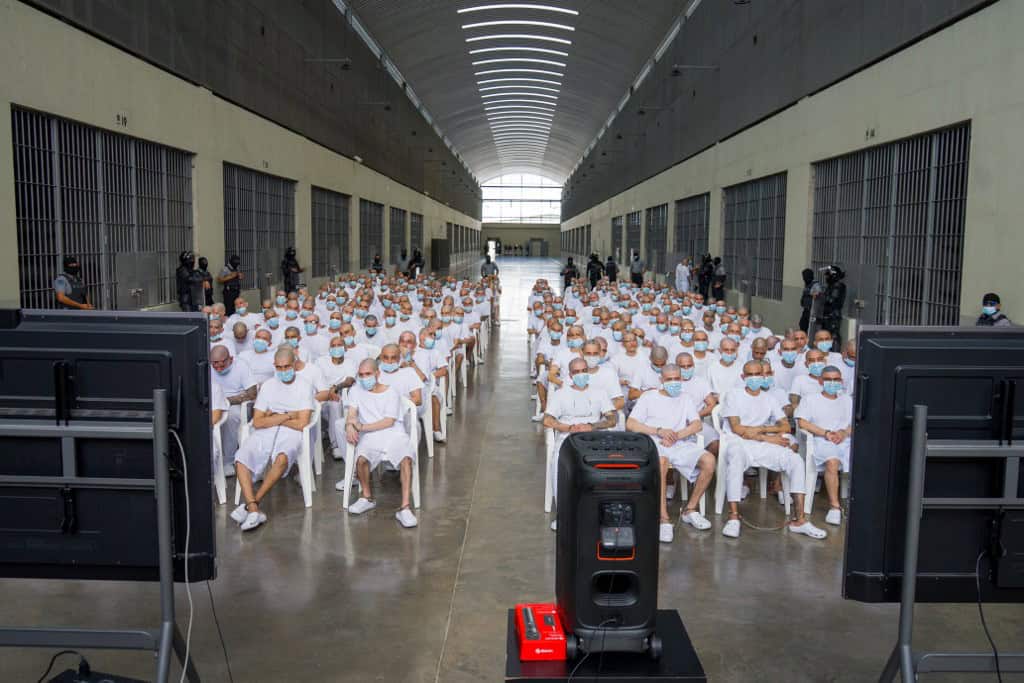
Shackled hand and foot, visibly aged, the MS-13 leaders on trial in El Salvador are now only a shadow of the violent gang members who once helped turn the country into one of the most dangerous in the world. They are 22 members of the “historic ranfla,” the leadership structure of MS-13, made up of veterans of the criminal organization dismantled by the government of Nayib Bukele.
Most are imprisoned in the Terrorism Confinement Center, known as Cecot, the symbol of Bukele’s anti-gang war, which has been maintained since 2022 under a state of emergency that has jailed some 92,000 people without judicial warrants.
The leaders head the group of 486 gang members who have been undergoing one of the government’s mass trials for the past two weeks. These proceedings have been criticized by human rights groups, which fear innocent people could be convicted because criminal responsibility is not being individualized.
What Is the Trial Seeking?
Bukele justifies the collective trials on the grounds of “command responsibility,” comparing them to the Nuremberg trials against Nazi leaders. The indictment covers some 29,000 murders and thousands of other crimes. But several of these leaders are already serving sentences that amount to life in prison.
Even so, criminologist Ricardo Sosa calls it “an act of exhuming the truth,” because “before, filing a complaint was a death sentence.” Miguel Montenegro, of the nongovernmental Human Rights Commission, sees it as a “media” strategy to show an “attitude of combat against the gangs” and justify the state of emergency.
It is a “politics of spectacle,” says Ingrid Escobar, of the NGO Socorro Jurídico, noting that the “ranfleros” have been imprisoned since long before Bukele’s government and that the trial obscures the situation of some “30,000 innocent people” behind bars who could be convicted.
Who Are the Top Leaders?
In three small rooms, with shaved heads and wearing white T-shirts and shorts, the defendants listened over loudspeaker to testimony from a gang member, that was observed during a hearing at Cecot. Among them stands out Borromeo Henríquez, alias “Diablito de Hollywood,” 47, the top leader, who has been serving an 87-year sentence since 1998 for 497 murders.
Henríquez founded the “national ranfla” with others after being deported to El Salvador from the United States, where he had emigrated in the 1990s. It was in Los Angeles that MS-13 and its enemies in Barrio 18 emerged.
Unlike most gang members, he does not have his face tattooed, and he wears glasses. In 2012, he even delivered a peace proposal to then-OAS Secretary General José Miguel Insulza. Also on trial with him are Carlos Tiberio Ramírez, alias “Snider de Pasadena,” 49, and Dionisio Arístides Umanzor, alias “El Sirra de Teclas,” 47.
Ramírez, imprisoned since 2001, is serving 94 years for 500 murders. Umanzor, arrested in 1999, is serving a 67-year sentence for 106 killings. Also being tried in absentia is Élmer Canales, known as “Crook de Hollywood,” who is imprisoned in the United States. An investigation by the digital outlet El Faro alleges that Bukele released him from prison in 2021 as part of a “pact” with the gangs that later broke down.
How Powerful Were They?
The gangs came to control 80% of Salvadoran territory, according to the government. The “ranfla” had so much power that it directed the gang even from prison, and several leaders took part in talks that led to temporary truces and revealed their closeness to politicians.
Bukele, who has been in power since 2019 and holds sweeping authority, denies having made deals with the gangs involving prison benefits in exchange for reduced homicide rates and support to help him reach power.
Former President Mauricio Funes, who died in 2025, was sentenced in 2023 to 14 years in prison for negotiating with gang members. MS-13, considered a terrorist organization by the United States, sought to build “a system of power alternative to the state,” Sosa said.
How Did MS-13 Operate?
It had a pyramid-style command structure and a recruitment system based on beatings. Beginning in 2008, “killing” became a requirement for joining, another scholar of violence in El Salvador said. Below the leadership were other lower-ranking bosses, and the gang was divided into cells known as “clicas.”
On Tuesday, during the trial, prosecutors released audio recordings that revealed the system of “open valves,” instructions from gang leaders to kill rivals, carry out internal purges, attack state agents, and plan crimes. According to authorities, some 63,000 MS-13 members are imprisoned.
The mass trial does not yet have a date for its conclusion.