

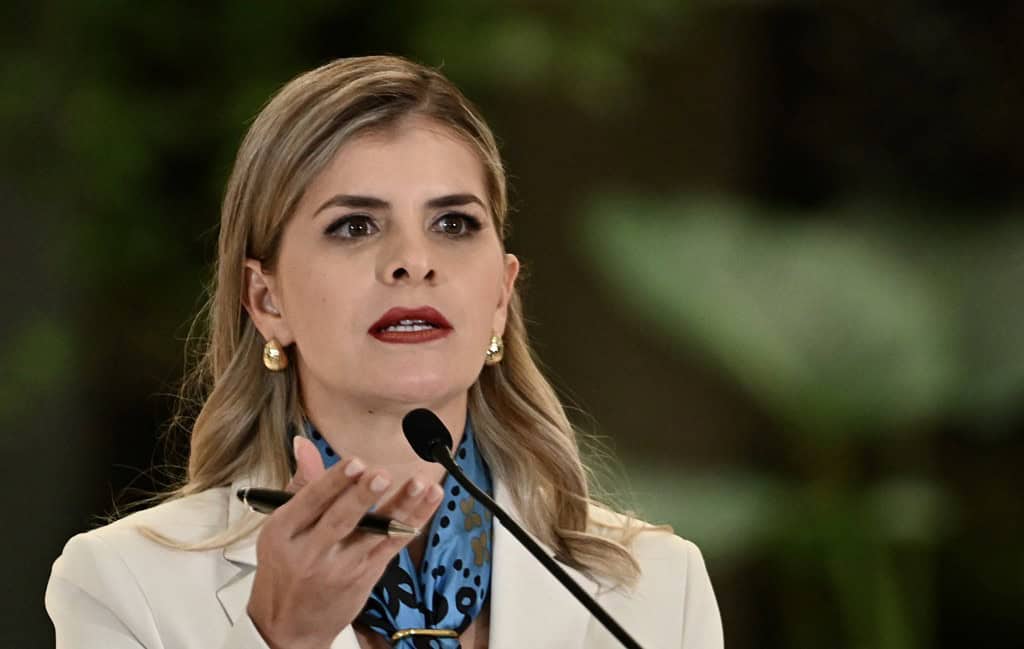
President Laura Fernández unleashed a barrage of personal attacks on Costa Rica’s top judicial officials on Wednesday, calling the country’s attorney general a “national disgrace” and mocking a Supreme Court magistrate’s complaint about the tone of a recent White House-style summit, just 48 hours after she had publicly praised the same meeting as a “working table” with “willingness for dialogue.”
The reversal, delivered during Fernández’s first weekly press conference since taking office on May 8, marks the clearest signal yet that her young administration intends to govern through open confrontation with the judicial branch, continuing the combative posture established by her predecessor and political mentor, former president Rodrigo Chaves Robles.
“I was stunned, frankly I can’t find another word, stunned by Monday’s meeting,” Fernández said of the May 18 encounter at Casa Presidencial with Supreme Court president Orlando Aguirre Gómez, Third Chamber magistrate Patricia Solano Castro, and Attorney General Carlo Díaz Sánchez. “It seems they live in Narnia, in a fable from the cartoons we used to watch, where impunity doesn’t matter much and judicial backlog doesn’t either.”
Her sharpest words were reserved for Díaz, the attorney general whom Chaves spent much of his administration trying to push out of office. Asked about Díaz’s comment that the president behaved more cordially behind closed doors than in front of the cameras, Fernández replied: “Did you think that because I’m a woman, or because I’m young, or because I’m not Rodrigo Chaves, I would stop raising my voice and pointing you out as a national disgrace for what you’ve done to this country day after day? Forgive me, sir.”
When the topic turned to magistrate Solano, who had told reporters on Tuesday that the Casa Presidencial meeting felt “hostile” and that attendees had their cell phones confiscated and her handbag searched on arrival, Fernández responded with sarcasm. “What did she want, that I bring her roses? That I bring her a serenade? We just buried a Fuerza Pública officer last week, shot in the back. People need to have some shame. What kind of meeting did they think they were going to have with me? The little Maria cookie and a cup of tea? No, sir.”
Fernández also accused Solano of breaking a confidentiality agreement around what the president emphasized was a “pri-va-te meeting,” drawing out the syllables for effect. When she delivered the “national disgrace” line about Díaz, members of her cabinet applauded, including her minister of the presidency, Rodrigo Chaves Robles. Vice President Francisco Gamboa Soto did not join in, according to footage of the press conference.
The shift in tone is striking because it followed a meeting Fernández herself had described in conciliatory terms on Monday. After two and a half hours behind closed doors, she announced agreement on three of the five points on her agenda, including a commitment that the Judicial Inspection Tribunal would investigate sentencing-execution judges, that the courts would strengthen anti-corruption policy, and that the Judicial Investigation Agency and prosecutors would coordinate with the security ministry. She even acknowledged that “I’ll take from my own bag whatever we can improve and correct.”
Costa Rican analysts say the about-face fits a pattern. Fernández won the February 2026 election promising to “consolidate the political rupture movement begun in 2022,” a reference to Chaves’s combative four-year term. Chaves personally led a march through San José in March 2025 demanding Díaz’s resignation, with Fernández marching alongside him. In the days before the May 8 transition, Chaves publicly urged his successor “not to ease up” on pressure against the judiciary.
The two leaders share the same political vehicle, the Sovereign People’s Party, and now share a cabinet table: Fernández named Chaves her minister of the presidency, a position that places him at the center of executive decision-making despite Costa Rica’s constitutional ban on consecutive presidential re-election.
What separates them, observers note, is style rather than substance. Where Chaves favored frontal insults and street mobilizations, Fernández so far prefers irony, sarcasm, and media-ready one-liners. The strategic direction, however, is identical: cast the judicial branch as the government’s principal adversary and treat each clash with magistrates and prosecutors as a demonstration of executive strength.
Fernández herself appeared to anticipate the comparison. Addressing Díaz directly, she told him: “Learn to know me and get used to how this working relationship is going to be.”
The broader stakes extend beyond the personalities involved. The Fernández government has signaled it intends to introduce constitutional and legal reforms to the judicial system in June, and threats to withhold budget transfers to the Poder Judicial have already surfaced. For foreign investors, our expat and tourism communities that depend on Costa Rica’s reputation for institutional stability, the trajectory of the executive-judicial relationship has become one of the most important variables to watch.





