

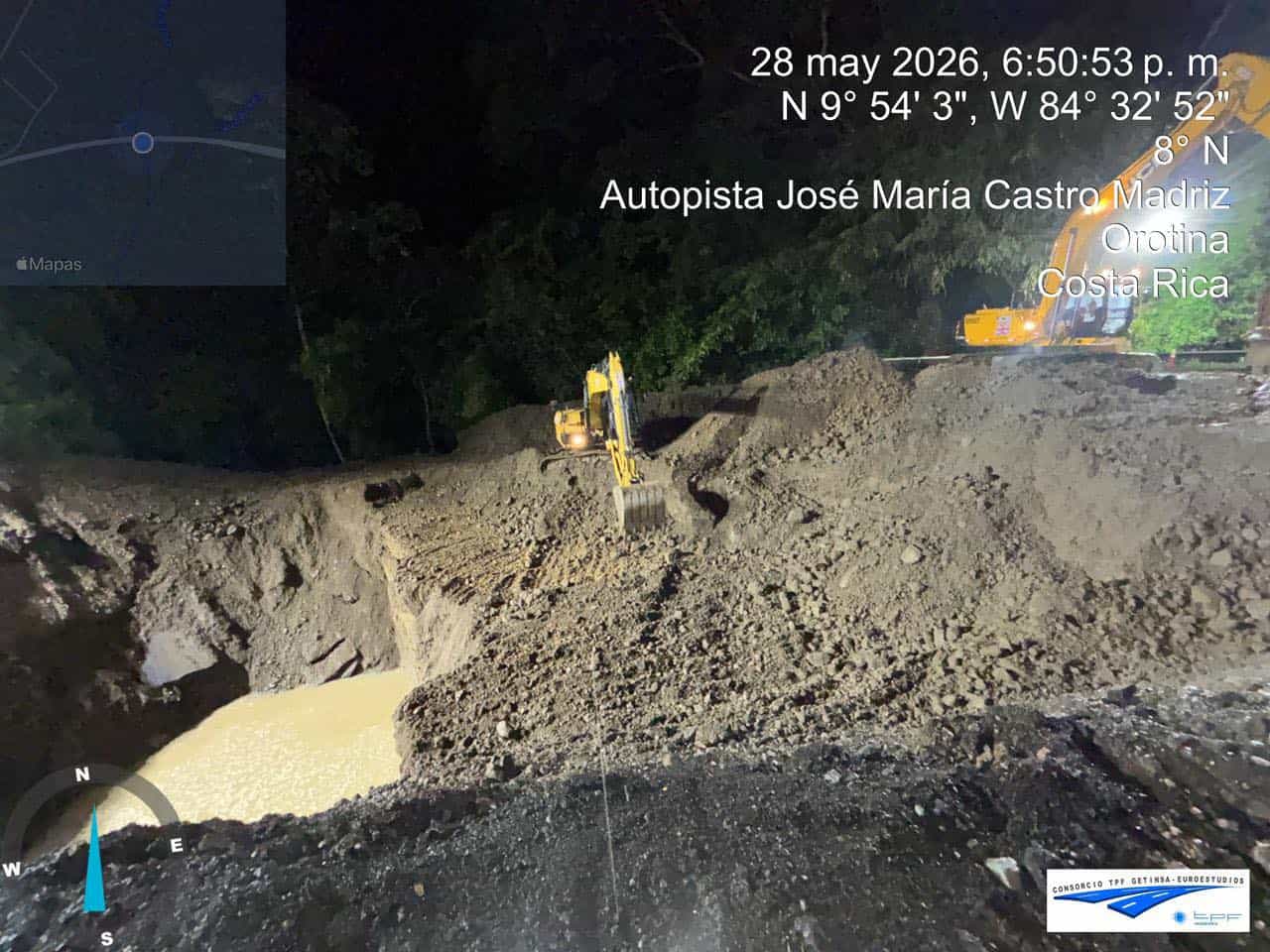
Those heading between San José and the Central Pacific will need to keep planning around delays on Route 27, where the permanent repair of the sinkhole at kilometer 56 still has no estimated completion date.
The damaged section, near Orotina, remains open only under a temporary traffic plan. Light vehicles can pass through one alternating lane, with traffic controlled in both directions. Heavy vehicles must continue using alternate routes established by the Ministry of Public Works and Transport.
The problem began May 27, when heavy rain and a water surge overwhelmed a culvert under the highway. The failure caused the roadbed to collapse and opened a large sinkhole across the roadway. Authorities moved quickly to restore limited traffic, but the full repair has become more complicated than first expected.
The concessionaire first indicated that the permanent fix could take about two weeks. That timeline is no longer in place. Work crews have had to stabilize the area, drain water that built up beside the road, remove mud and accumulated material, and prepare the site for the replacement of the damaged culvert.
A temporary Bailey bridge was also considered as a way to improve traffic flow during repairs, but that option was ruled out. The affected area had to be expanded to allow crews to reach the needed depth and move in specialized machinery. Available modular bridge structures in our country also did not fit the required span for the work zone.
Therefore, when going this way keep in mind that Route 27 is open, but it is not back to normal. The alternating lane can keep cars and other light vehicles moving, but bottlenecks remain likely, especially during peak travel periods, weekends, and rainy afternoons. Anyone heading to Jacó, Herradura, Los Sueños, Puntarenas, Caldera, or other Central Pacific destinations should build extra time into the trip.
The repair is also hampered due to weather delays. Recent rains slowed work, and more rain could again affect progress. Costa Rica is in the rainy season, and the area around Orotina has already seen conditions strong enough to cause major drainage failure on one of the country’s most important travel corridors.
The incident has renewed attention on the condition of Route 27, a highway that carries everyone from tourists and commuters to freight traffic between the Central Valley and the Pacific coast. For most, it is often the fastest route from San José and Juan Santamaría International Airport to many beach destinations. For freight, it is also a key connection toward Caldera, one of Costa Rica’s main Pacific ports.
Until the permanent work is complete, traffic authorities are asking drivers to slow down near the area, obey temporary signs, and follow the instructions of crews and Traffic Police. The current setup remains a temporary solution designed to keep light vehicles moving while the damaged section is rebuilt.
No injuries were reported in the original collapse. The next major milestone will be the replacement of the culvert and the full recovery of the roadbed, but no public date has been set for when normal traffic will return.





