I’ve been interested in wildlife my entire life. If younger me knew what I was up to these days, playing with camera traps in Costa Rica, he’d be quite pleased. Something I had to wrap my head around as a young guy interested in wild creatures was that many of the species I was quite fond of were killing and eating many of the other species I was quite fond of. Predation is a fact of life in the animal kingdom.
As a young dude, I developed two ways of soothing my sad feelings when the Discovery Channel showed me the indelicate manner that a pride of lions used to dispatch a wildebeest. First, I told myself that’s how it’s always been. Predators have been consuming their prey for ages and me feeling a certain way about it really had no impact at all. Second, I leaned into the fact that the lions needed to kill to eat and I tried to imagine the happy baby lion munching on a drumstick more than the baby wildebeest wondering where its mom went.
The current version of me, a bearded professional camera trapper in Costa Rica, has the opportunity to record predators taking their prey with my own camera equipment and rather than feeling sad about it, I generally feel privileged to have recorded such an interesting interaction between species. Each of my cameras only monitors a few square meters of forest, so I’ve found recording predation to be quite difficult.
One of the very few predator-prey interactions I can reliably record is a predator eating a fish. Two of the main reasons I record this type of predation more than any other is that one, a vast number of species are interested in eating fish and, two, I do a lot of work in an area with a prolonged dry season.
Guanacaste, on Costa Rica’s northern Pacific coast, experiences almost no rain between January and May. That means that large bodies of water shrink down to small puddles and all of the fish become concentrated and easy to catch. Every year I find the last remaining water holes on the properties I monitor and place a camera trap at the water’s edge and every year I record a whole host of species scarfing down fish.
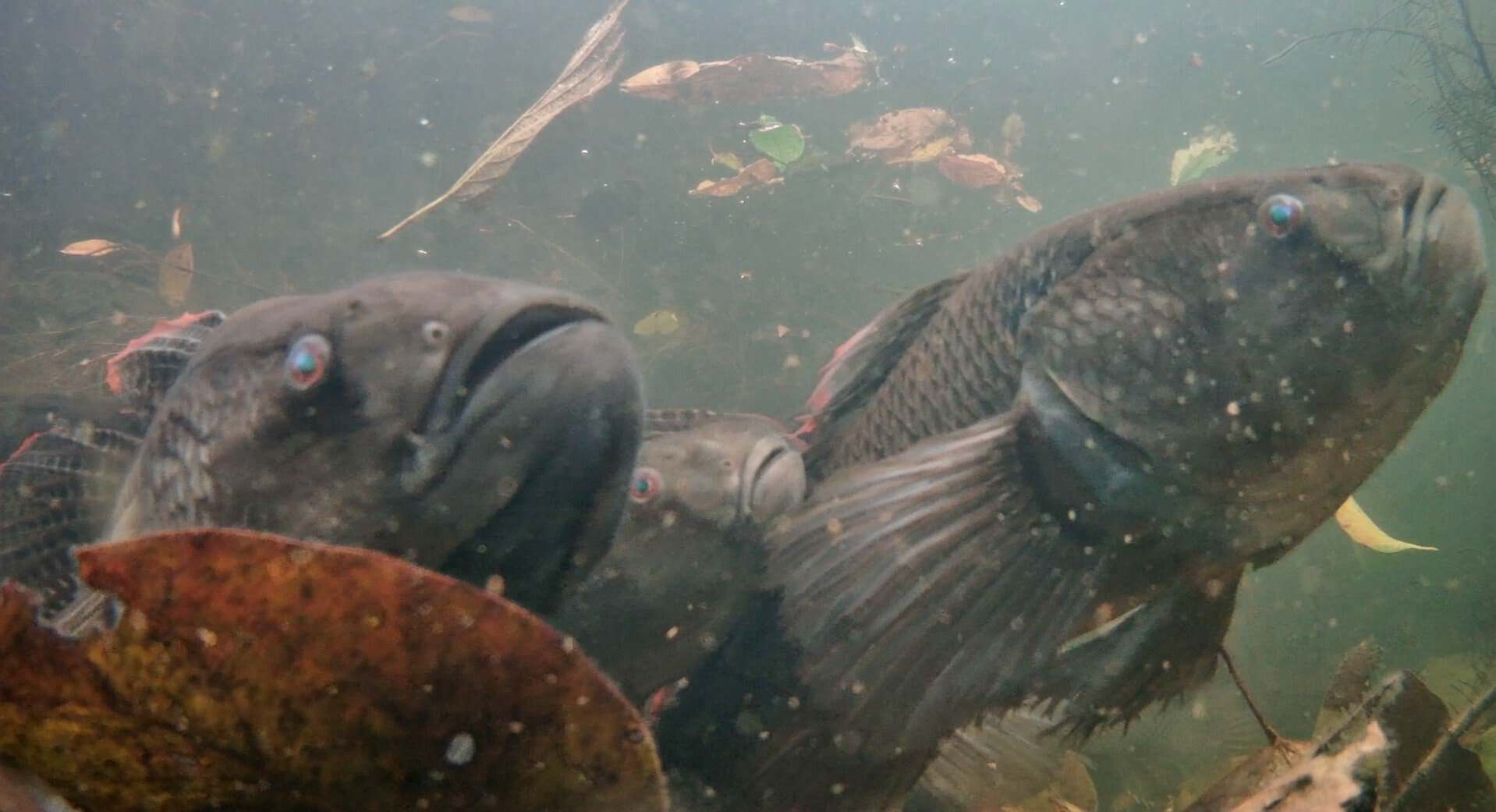
During this year’s dry season, I was camera trapping in a property along the Pacific coast. In a drying streambed that eventually emptied into an estuary, I found a series of waterholes that housed the remaining fish from the stream. Usually, the fish I find in these puddles are minnow-sized, but for whatever reason, this year, these puddles were teeming with foot-long fish. In an attempt to figure out what species they were, I sunk my Go-pro into the water and recorded a few videos.
I eventually discovered that these fish were called Pacific fat sleepers (Dormitator latifrons), a species of fish that lives in brackish water. I read as much as I could find about them and their life history and I reviewed the Go-pro videos that I had recorded. I found them to be quite interesting and beautiful fish, which made this next part a little more difficult than it otherwise would have been.
For the next two months, every time I visited the area I walked into the site of a massacre. Each visit showed fewer fish living in an ever-decreasing amount of water and piles of fish bones strewn about the streambed. The perpetrators of the carnage were recorded by my camera traps. The two most frequent fish-eaters were the northern raccoon and common black hawk. The hawks hunted during the day, and the raccoons came at night, but it wasn’t just them. Somewhat surprisingly, a female ocelot and a species of large snake called a blacktail cribo also joined the fray.
By the time it was all said and done, I had recorded a bunch of neat videos of a variety of creatures munching fish. While the videos were undoubtedly cool, I found I was a little melancholy watching the fish I had spent time recording and learning about getting chomped. Let’s see how you feel about it. I’ll start out the video below with a clip I took of the Pacific fat sleepers when I first found them, and then I’ll show you their fate.
About the Author
Vincent Losasso, founder of Guanacaste Wildlife Monitoring, is a biologist who works with camera traps throughout Costa Rica.