

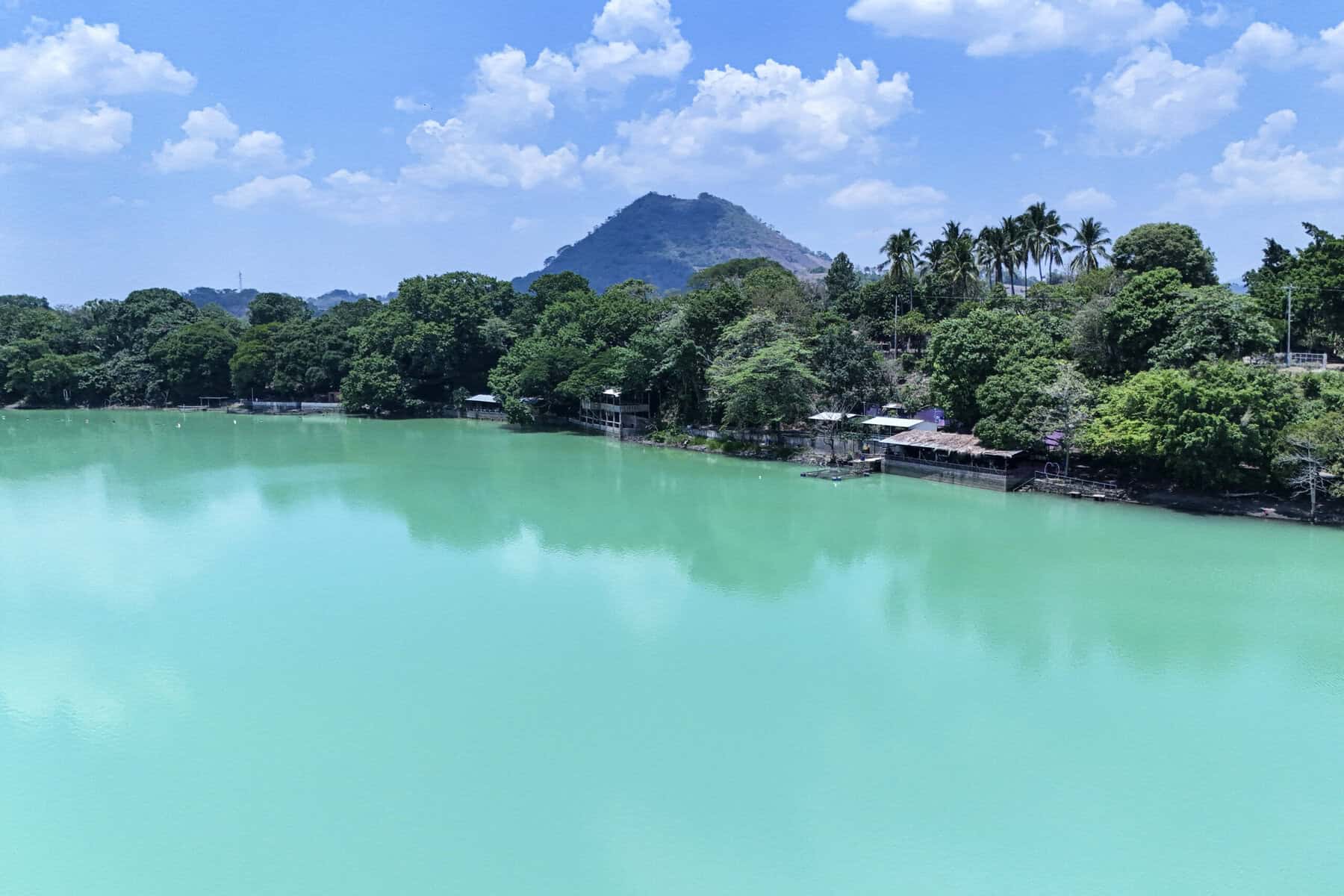
One of El Salvador’s most popular volcanic lakes has taken on a striking new look, and travelers are taking notice. The Laguna de Apastepeque, in the central department of San Vicente, has shifted to a vivid turquoise hue in recent days, drawing a surge of domestic and regional visitors eager to see the unusual phenomenon for themselves.
It’s about an hour and a half east of San Salvador and managed as a recreational park by the Salvadoran Institute of Tourism (ISTU), the lagoon sits in a wide volcanic crater known as a maar, measuring 44 meters deep according to recent sonar mapping by researchers at the University of El Salvador (UES). The park has long been a weekend favorite for its beach area, swimming pools, cabins, trails, and docks for boating and sport fishing, but the turquoise water has elevated it from local getaway to must-see destination almost overnight.
El Salvador’s Ministry of Environment and Natural Resources (MARN) has attributed the color shift to a bloom of cyanobacteria — microorganisms commonly known as blue-green algae — favored by high solar radiation, cloudless skies, and the lake’s alkaline conditions. Édgar Marinero Orantes, director of the UES Environmental Research Center, said that the turquoise tone is produced by the way sunlight interacts with the bloom, and noted that despite the popular name, the microorganisms are not technically algae.
No public health alert has been issued for Apastepeque, and operators say the lake remains open for boating, fishing, and recreation as usual. The ministry did warn in 2025 of possible skin irritation linked to cyanobacteria at another Salvadoran lake, and the U.S. Centers for Disease Control and Prevention notes that such blooms can occasionally produce toxins. Visitors planning to swim may want to check directly with park staff about current conditions on the day of their visit.
For lakeside businesses, the unusual coloring has been a welcome boost. “People have been startled to see that it really is turquoise — they come to see it and take photos,” said Linda Alfaro, 49, who runs a restaurant on the shore. A lifelong resident, Alfaro said the lake has occasionally turned brown, yellow, or slightly green over the years, but never the current shade. Kevin Flores, a 33-year-old boatman, said boat traffic has picked up noticeably as curious day-trippers arrive from San Salvador and surrounding departments.
Travelers heading to the lagoon will find it in the area of Calderas, in the municipality of Apastepeque, roughly 70 kilometers east of the capital and a short drive from the colonial town of San Vicente, with its historic churches and views of the San Vicente volcano. The park offers picnic areas, lookout points, and small boats for hire. Officials say monitoring will continue to determine how long the turquoise coloration will last — meaning the window to catch it may be short.





