

Four opposition factions in Costa Rica’s Asamblea Legislativa have closed ranks against the executive branch’s bid to reopen metallic open-pit mining in Crucitas, ratifying their joint commitment to uphold the country’s 2010 ban and pursue alternative responses to the environmental and security crisis gripping the northern zone.
The bloc — formed by Liberación Nacional (PLN), Frente Amplio (FA), Unidad Social Cristiana (PUSC), and Coalición Agenda Ciudadana (CAC) — controls 26 votes between them. The four caucus chiefs formalized their alliance on May 1 alongside the Directorio Legislativo elections, signing a commitment to maintain the prohibition on open-pit mining and to explore alternative routes for addressing the ecological, security, and social fallout in the Cutris district of San Carlos, near the Nicaraguan border.
Their stance puts the bloc in direct conflict with the administration of President Laura Fernández, whose government argues that legalizing and regulating open-pit extraction is the only viable way to dismantle the illegal mining networks entrenched in Crucitas. Officials from the ruling Pueblo Soberano (PPSO) faction have publicly stated they see no alternative to mining.
The executive’s proposal, filed under expediente 24.717, would authorize exploration and exploitation in Cutris and create a public auction system through which the Ministry of Environment and Energy (MINAE) would grant mining concessions. After the Plenario advanced the bill in mid-May despite opposition requests to postpone discussion, the four factions responded by filing 644 substantive motions — a procedural maneuver that has effectively frozen the project in the Asamblea.
Frente Amplio legislator Edgardo Araya said the bill seeks to “legalize theft and legalize destruction,” while PLN representatives argue better solutions exist for the crisis in the northern zone. The opposition has also pointed to alternative legislative tracks, including expediente 24.675, which proposes a sustainable development pole in the Huetar Norte region centered on ecological restoration, ecotourism, and community enterprise, and expediente 25.426, which would create a Bono Verde Soberano Crucitas to finance ecological restoration through green sovereign bonds.
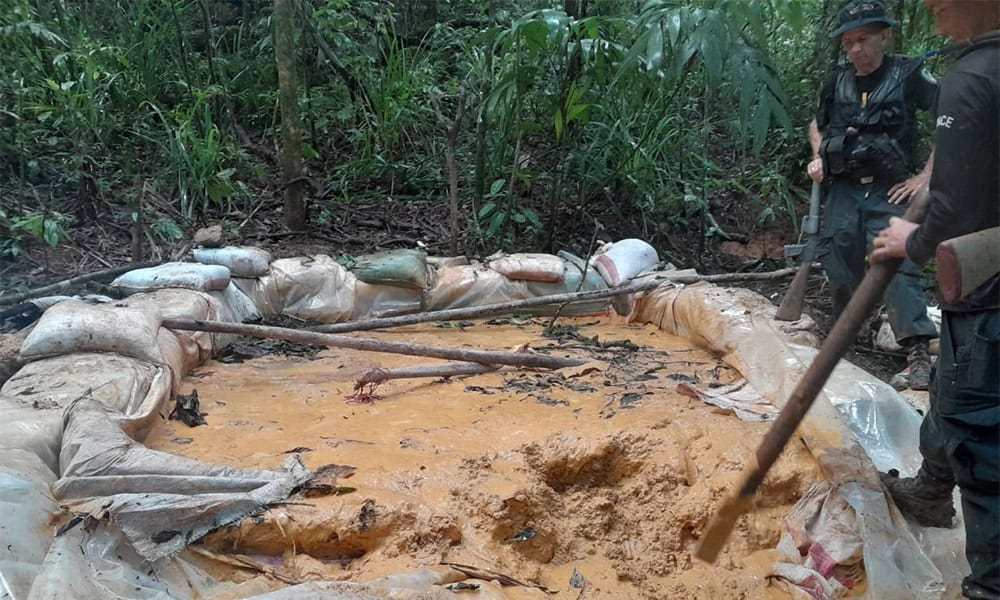
Crucitas has been Costa Rica’s most contentious environmental dispute for more than a decade. The 2010 constitutional ban on open-pit metallic mining followed years of litigation over the now-defunct Industrias Infinito gold concession. In the absence of legal extraction, illegal mining — known locally as coligallero activity — has expanded sharply, drawing in foreign criminal networks and producing mercury and cyanide contamination in waterways that feed the San Juan River basin.
President Fernández has invited opposition legislators to visit Crucitas in June. The 644 motions are scheduled to be debated and voted on in the Comisión de Ambiente, which is being reconstituted in the coming weeks.





