

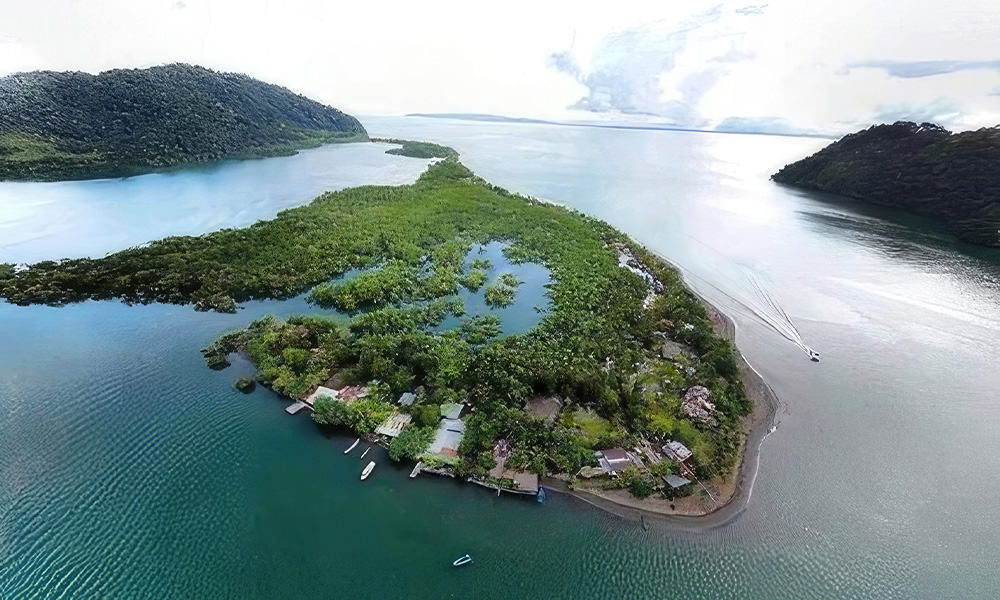
A long-awaited project to bring piped drinking water to Isla Caballo has hit another delay after crews uncovered ceramic pieces, shells and fossil material that may have archaeological significance. The materials appeared during vegetation-clearing work connected to the aqueduct project on the small island in the Gulf of Nicoya. Machinery that had recently been brought to the island has since been removed while authorities determine what was found.
The Costa Rican Institute of Aqueducts and Sewers (AyA), says the aqueduct project remains active. However, the National Environmental Technical Secretariat, or SETENA, has required an archaeological study before the project can move forward with its environmental approval. AyA President Lourdes Sáurez said the materials include pieces of ceramics, shells and blocks containing fossils. At this stage, officials cannot determine their age or whether they have historical or archaeological importance.
That distinction here is important. The material has not yet been formally classified as an archaeological discovery. A specialist must first examine the site and determine whether any of the objects require protection or further investigation. AyA has begun the process of hiring an archaeological consultant. The National Museum has not yet become directly involved and is expected to wait for the specialist’s findings before deciding whether any material must be protected or removed.
The additional study is expected to delay the project by approximately three to four months, although that estimate could change depending on what archaeologists find. If the material is determined to be historically significant, authorities could require protected areas around parts of the site or changes to the route and design of the aqueduct.
For Isla Caballo residents, the setback adds more time to a wait that has already lasted decades.The island, located in the Gulf of Nicoya off Puntarenas, has never had a conventional piped drinking-water system serving its community. Residents have depended on water transported by boat, rainwater collection and other temporary systems.
A Constitutional Court ruling in 2015 ordered AyA to provide a solution to the island’s water problem. Water has been transported to residents regularly since then, while universities and other organizations have also helped install rainwater collection systems at community facilities. Plans announced in 2025 envisioned connecting Isla Caballo to the mainland through a submarine pipeline stretching as much as five kilometers from the Lepanto area. The project also includes distribution pipes, pumping infrastructure and water storage on the island.
The total planned investment now exceeds ₡3.4 billion.The first phase is valued at approximately ₡198 million and includes pipes and a 150-cubic-meter storage tank. A second phase of roughly ₡3.294 billion would complete the pipeline network, pumping stations and additional storage infrastructure.
Under the current schedule, AyA expects to issue the formal order to begin the main construction work during the first half of 2028, with completion projected between late 2029 and early 2030. Those dates assume the archaeological review does not force major redesigns.Until then, AyA says it will continue transporting drinking water to Isla Caballo.
For those of us in Costa Rica, the latest obstacle presents an unusual conflict between two public interests: protecting possible evidence of Costa Rica’s past while trying to provide one of its isolated communities with a basic service it has lacked for generations.





