

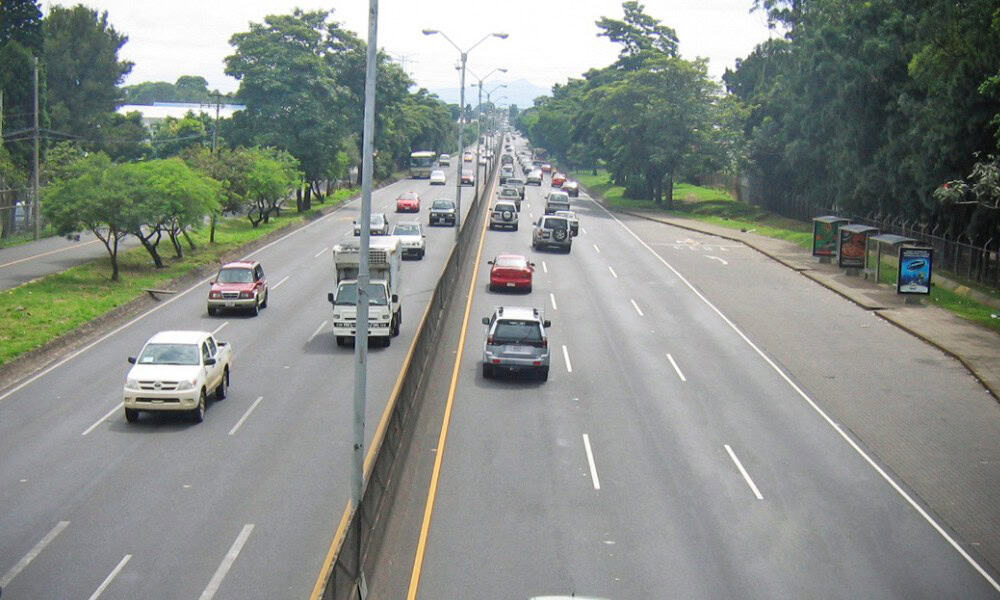
Drivers on the widened highway between San José and San Ramón would be watched by cameras and radar sensors at least every 1.5 kilometers (0.9 miles), according to documents for the long-delayed expansion of Route 1. The system would track vehicle speeds, traffic volume, congestion and crashes along the corridor around the clock, including at night and in fog or heavy rain. If built as specified, the route would be the first in Costa Rica covered end to end by video surveillance.
The Ministry of Public Works and Transport (MOPT) has not said whether the equipment will be used to issue automated speeding tickets. The requirements are part of the tender MOPT published on Oct. 21 for widening roughly 55.6 kilometers (34.5 miles) of Route 1 between La Sabana in San José and San Ramón in Alajuela. The project is financed by a $770 million loan from the Central American Bank for Economic Integration and the OPEC Fund.
Under the tender, contractors must install dome-style cameras that pan, tilt and zoom, record in color and see at least 1.5 kilometers. The cameras also need infrared or thermal night vision and must keep working in fog, cloud cover and low light. Coverage has to reach the entire roadway with no blind spots. Contractors would have to prove that with a three-dimensional coverage map and add cameras wherever gaps appear.
The units would sit on 15-meter (49-foot) poles inside the highway right of way. Where grid power is not available, they would run on solar panels. The radar sensors would count vehicles, measure their speed and classify them by type. They would also record vehicle length, the average gap between cars, how much of the road is occupied and where traffic jams begin to form.
A separate set of cameras would send automatic alerts for crashes, stalled vehicles, wrong-way drivers, congestion and people on foot in restricted areas. Those alerts would go to a traffic control center planned at the Los Arcos toll plaza in Belén. Operators there would monitor the corridor and the new Río Segundo connector, coordinating with the Road Safety Council (Cosevi) and the Traffic Police. The tender requires a protocol to activate the response to a major crash within five minutes.
Drivers would see the information on LED message boards similar to those on Route 27. The boards would warn of crashes, breakdowns, lane closures, roadwork, rain and fog, and could show travel times or suggest alternate routes when traffic stops. The package also includes a weather station recording rain, wind, temperature and visibility. It adds emergency call posts linked to the control center and scales that weigh trucks while they are moving.
The same technology would make barrier-free tolls possible. The tender includes requirements for electronic vehicle identification and automatic license plate recognition, and contractors must leave conduits, foundations and equipment space for future toll gantries. Toll stations must also be designed so their islands and booths can later be removed to leave a continuous roadway. That switch depends on legislation that does not yet exist.
Public Works Minister Efraím Zeledón has said MOPT is preparing a bill to allow toll payment without barriers. One option would charge tolls through digital marchamo technology linked to the vehicle, similar to a Quickpass tag. A separate bill to the same effect, filed in March by lawmaker Alexander Barrantes Chacón remains in committee.
The highway is planned to have four main toll stations at Los Arcos, El Coyol, Grecia and the Río Segundo connector. Zeledón has put the full one-way trip for a light vehicle at about ₡1,523, roughly $3.34, while cautioning that the figure is approximate. Construction is expected to begin in the second half of 2027 in seven sections. Each section would open as it is completed, with the full project due within six years.
Automated speed enforcement has a troubled history in Costa Rica. A first attempt at camera-issued fines in 2011 stalled over notification problems, a lack of funding and a Constitutional Court ruling, and a separate private proposal to bring the cameras back on high-crash routes, submitted in 2023, is still under study.
Speeding remains the leading cause of road deaths and officers fined 2,254 drivers for speeding in the first half of 2026, a period in which 330 people died on Costa Rica’s roads. Whether the San Ramón cameras end up writing tickets will depend on decisions MOPT has yet to announce. For now, the tender presents them as a way to spot crashes and congestion faster on one of our busiest commuter corridors.