

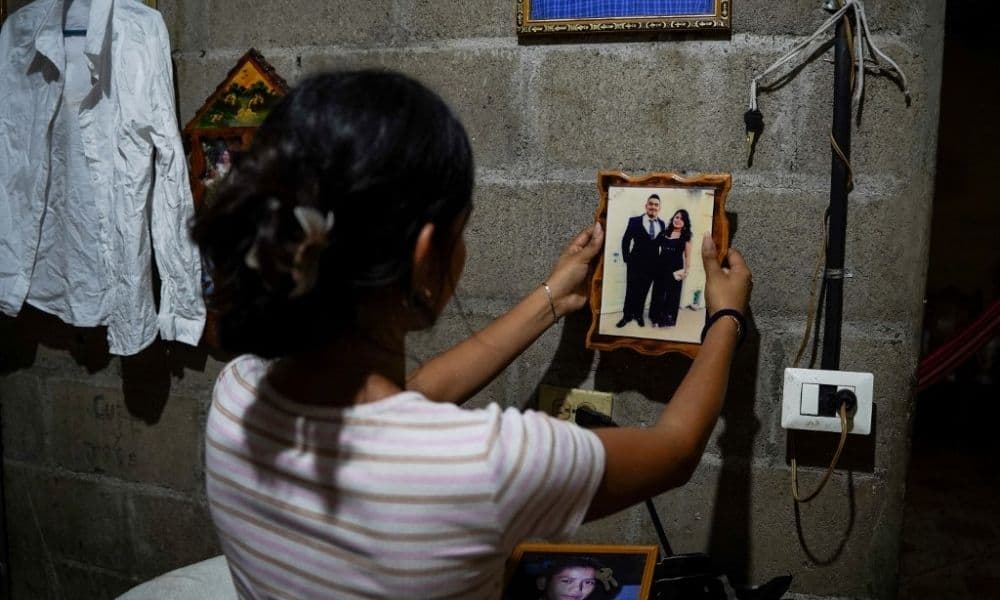
Chicks chirp anxiously when Jade arrives to feed them. Since her father was detained in El Salvador’s anti-gang war, she has had to work on her grandmother’s farm and endure classmates saying her “dad” is a criminal. President Nayib Bukele’s crackdown pushed violence down to historic lows by jailing around 91,000 people, but it has also left thousands of children in poverty, stigmatized, or traumatized after being separated from their parents, many of whom human rights groups say are innocent.
After José Urquía was arrested in August 2023, Jade, 16, and her 13-year-old brother were placed in the care of their grandmother, Sara Rivas, in El Rosario, 50 km east of San Salvador. They survive on a modest remittance sent by their mother, who had emigrated to the United States, and on income from the small farm that Jade helps keep running after school.
“It hurts when they tell me, God knows what kind of gang member he is (…) People always bring it up, telling me my dad is a delinquent,” she tells AFP. “My dad is innocent,” she insists. According to the well-known NGO Cristosal, about 62,000 children under 15 may have suffered some form of abandonment as a result of Bukele’s hardline policies, including the state of emergency in force since 2022, which allows arrests without a judicial warrant.
Silent crisis
Jade’s conviction that her father (a fictitious name) is innocent goes beyond affection. When he was captured, Urquía, 37, had no criminal record, according to an official certificate issued in September 2024, which Rivas shows AFP inside her modest home in El Rosario. Authorities told the family, she says, that he suffers from kidney failure.
Urquía was detained upon arriving deported from the United States, accused of belonging to “illicit associations.” The family believes the reason was tattoos on his hands and chest bearing his children’s names. Cristosal and other NGOs denounce arbitrary detentions and torture under the state of emergency. The government rejects the allegations, but acknowledges that about 8,000 people have been released for lack of evidence.
The stigma weighs so heavily on Jade that she plans to change schools when she starts secondary education. “I’d rather go to a new one with people who don’t know me and start from zero,” she says, flipping through photos of her dad. Some children separated from their father or mother, or both, drop out of school to work after being left in the care of poor relatives, Cristosal says.
The NGO denounces a lack of state attention for these children, who embody a “silent crisis.” The “impact will be seen in the decades to come,” it warns. Asked, the government agency responsible for children, Conapina, said it provides “psychological and emotional” support to prisoners’ children and helps the families caring for them start small businesses.
According to Conapina, in some cases parents who belonged to gangs were “the main people responsible for the violation of their children’s rights.”
They took my childhood away
The lives of twins Carmen and Manuel (fictitious names) were upended in June 2022 when police detained their father, José Ángel Ruiz, a 36-year-old bread distributor. “It’s horrible because it wasn’t abandonment that he chose, it’s that they took him from our arms,” says Carmen, 17, in her precarious home in Zacatecoluca, 60 km east of San Salvador.
Since then, the teens, who say Ruiz also had no criminal record, have helped support their three siblings: she cleans houses with her mother and bathes pets; he works as a construction laborer. “I had to grow up too fast. They took my childhood away,” Carmen says. Despite everything, she finished high school with honors and trusts that her father will be freed.
But for some, that possibility does not exist. Cristosal says that between 2022 and 2024, nearly 180 minors experienced the death of a father or mother while they were imprisoned. The NGO Socorro Jurídico reports 470 deaths in prison under the state of emergency.





