

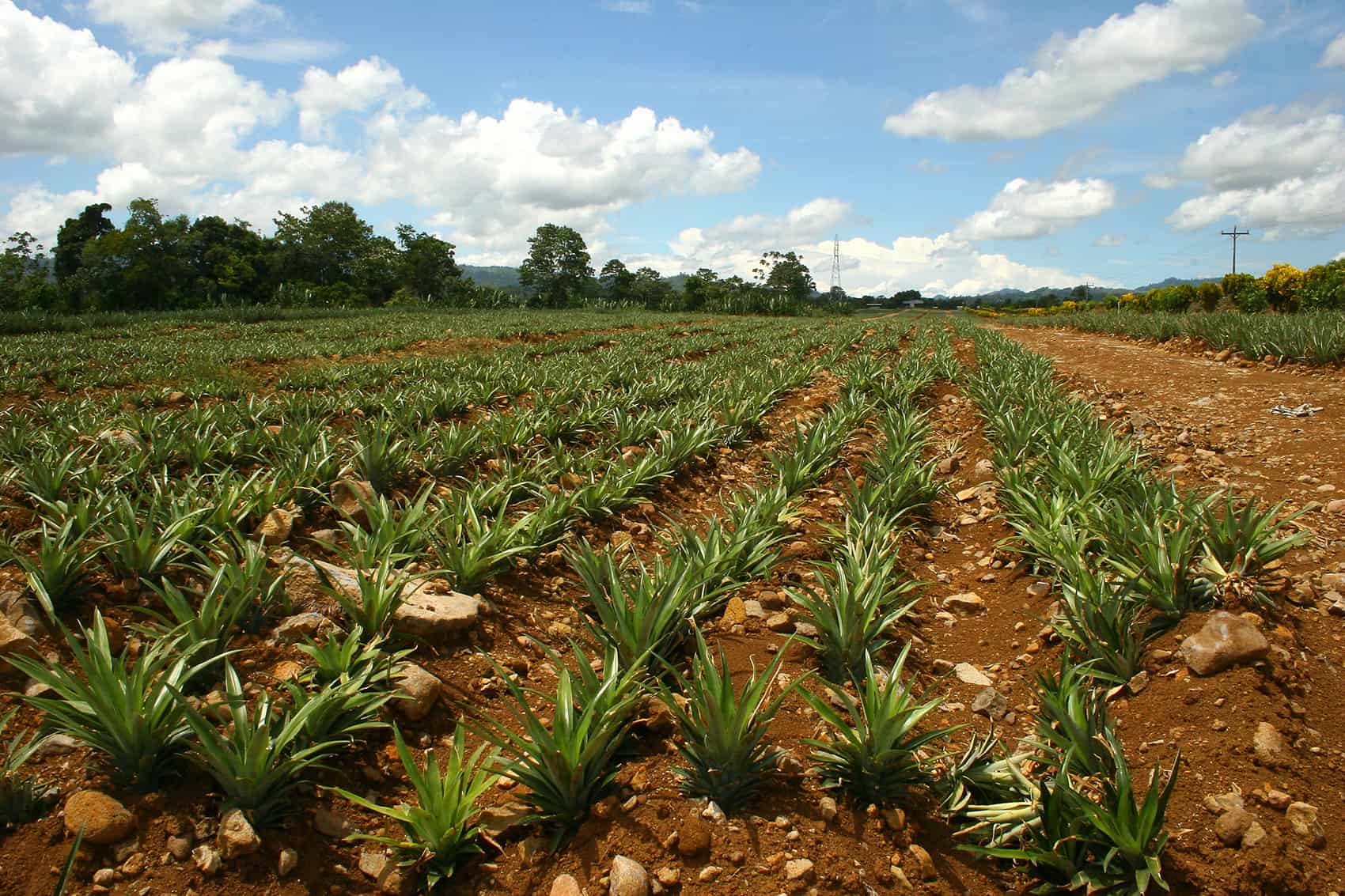
Edgardo Araya, a legislator for the Broad Front Party from Alajuela, and a number of community representatives from pineapple-producing zones, on Monday urged the executive branch to pass a decree that would place a moratorium on pineapple production for five years. They argued that pineapple producers have not been held accountable for the environmental impact of their activities.
Community leaders from Río Jiménez de Guácimo, Upala and Los Chiles asserted that the massive pineapple producers are not only responsible for significant environmental degradation in rivers and aquifers, as well as harming wildlife, but that they have also had a negative impact on the economy of their communities.
The decree proposal, named “Moratoria Nacional a la Expansion del Monocultivo Intensivo y Extensivo de la Piña,” calls for a moratorium on the expansion of single-crop pineapple plantations throughout the country for five years, or until certain requirements are met.
Sofia Barquero, Mr. Araya’s assistant, told The Tico Times that the moratorium would specifically prohibit new permits for “intensive and extensive” pineapple plantations. She added that it would not affect small or “organic” plantations, nor would it affect large plantations that have already been permitted.
Pineapple is one of Costa Rica’s most lucrative export industries, currently generating about $800 million a year. Industry growth began its upward climb in the year 2000. In the next decade, Costa Rican pineapple production increased by almost 300 percent. Pineapple plantations cover about 45,000 hectares of countryside, according to the Agriculture and Livestock Ministry (MAG), although some skeptics question the transparency of those figures. The sweet fruit is now Costa Rica’s top agricultural export, with key markets in the United States and Europe.
According to the proposal, during the five-year period the Environment Ministry and MAG, as well as local governments, would be responsible for making sure all environmental regulations are followed, and with the support of local universities and community representatives, establish committees to oversee implementation of the new law.
The argument is that even though the massive expansion of pineapple production has resulted in jobs for local residents and Nicaraguan immigrants, it also has had three negative impacts. First, it has taken land away from smaller, local farmers who now have nowhere to plant their crops. Second, pineapple production is not generating any income for the local communities – only profits for the large corporations who own these plantations. Third, they allege that these companies pay very low wages and do not provide the social benefits normally guaranteed to Costa Rican workers.
Petrona Oporta Corea, a community leader from Upala, told The Tico Times that large-scale single-crop pineapple plantations are displacing the small farmers who traditionally planted corn and beans.
“For many years Upala was the primary producer of beans in the northern part of the country, and it seems that not even half of the normal crop will be produced next year, because many of the farming cooperatives have gone bankrupt, like Pueblo Nuevo,” she said.
Oporta went on to explain that because local, traditional farmers don’t have land upon which to plant their crops, some rent land along the Nicaraguan border where they can’t insure their crops against natural disasters or bad weather. They have to absorb the cost of these kinds of losses themselves. Others simply plant within Nicaragua, but have their product confiscated when they try to bring it back into Costa Rica.
She summed up the situation by saying that “this is how small farmers and local cooperatives are destroyed.”
Legislator Araya also proposed a $1 tariff per box of pineapples exported, as a means of raising funds for local municipalities to help protect the environment.
Recommended: Costa Rica will go all-in on pineapple exports. But is that a good thing?





