

President Luis Guillermo Solís’ administration found itself once again playing defense with the media after the Ministry of Science, Technology and Telecommunications (MICITT) released a “draft” version of a bill that would give the government authority to shutter radio and television stations for broadcasting “lies” or offending public morality.
The proposed legislation reforming a 61-year-old radio and TV law rankled media outlets and advocates who decried it as an affront to Costa Rica’s tradition of free speech. They also claimed the bill allowed the government to wield a “sword of Damocles” over the media.
The outcry over the bill’s language forced the government to backpedal: it announced Tuesday morning that the bill’s punishments for media infractions would be removed.
The bill’s critics were especially outraged by provisions in the bill that they said could get a radio or television station closed if it broadcast two “lies” or offended “moral standards” twice in a given year.
Lies and moral slights were listed as “serious offenses” under Article 68 of the original bill. Two serious offenses would have constituted a “very serious offense,” which under Article 74 of the original bll, could have resulted in a media outlet having its broadcast license revoked.
In an editorial that aired Monday evening, Ignacio Santos, director of news for Channel 7, said the bill went “against our nation’s strong tradition in defense of the freedom of expression.”
The news director painted an Orwellian picture of what would happen if the bill passed as it was: “Imagine that a group of politically appointed officials are charged with deciding what is a lie or [what offends] moral standards?”
The daily La Nación called the bill a “gag law” and said in an editorial that the sanctions could muzzle the media “to the detriment of freedom of expression and the open environment that exists in Costa Rica to share opinions.”
President Luis Guillermo Solís has been mute on the bill and his administration has worked to distance him from the fallout.
On the heels of the outcry, Casa Presidencial released a letter dated March 27 and signed by Solís inviting Edison Lanza, Special Rapporteur for Freedom of Expression for the Organization of American States, to participate in the drafting of the media reform bill.
The media may have been worried about the bill as a sword of Damocles, but it was MICITT Minister Gisela Kopper who had to fall on her sword.
During the weekly press conference at Casa Presidencial on Tuesday, Kopper, Vice Minister of Telecommunications Allan Ruíz, and presidential legal advisor Marvin Carvajal were the only government representatives present. Neither President Solís nor either of his vice presidents attended the press conference, and no business was discussed outside the media reform bill controversy.
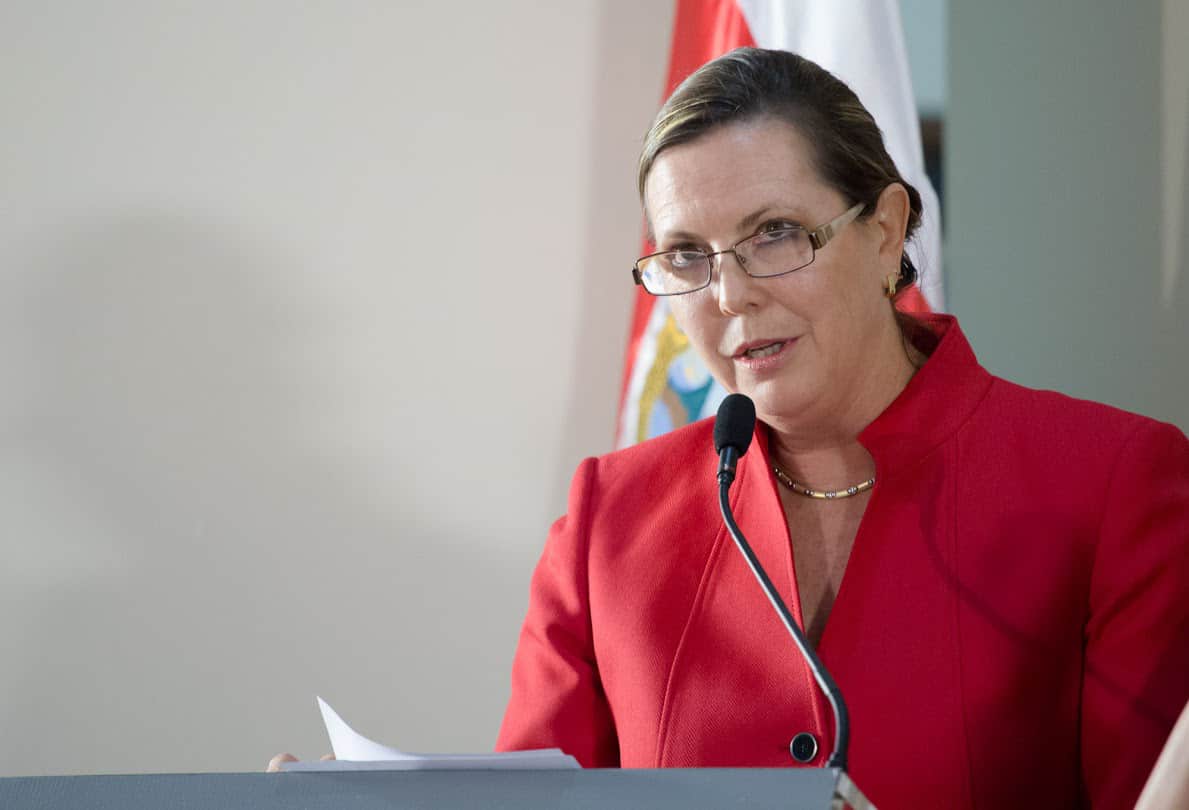
“The administration rejects sanctioning the media for content,” the embattled Kopper said at Casa Presidencial. “These sanctions are not shared by and are not the wishes of the [Solís] administration,” she said, reading from prepared remarks.
When it came time for questions from the media, MICITT leaders found themselves in the baffling position of having to explain how and why provisions that the government said it opposed had made it into its own draft bill.
Vice Minister Ruíz said that the sanctions were taken from the existing 1954 legislation and that they were included as part of the debate on what the reform should look like.
Kopper and Ruíz would not specify the author or authors of the bill, repeating that the draft legislation was written between 23 lawyers and staffers at MICITT.
When asked who bore the blame for the political fallout over the bill, Kopper said she would take responsibility.
She might have to take her mea culpa to the Legislative Assembly, where some lawmakers Tuesday called for her to testify on the law’s sanctions.
Alejandro Delgado, president of Free Expression and Press Institute (IPLEX), said that the current radio law was obsolete but needed to be reformed in a way that reinforces, not weakens, press freedom.
“We’re very concerned about the text that has been circulating,” he said, adding that the bill was an example of indirect censorship.
Delgado told The Tico Times that citing the 1954 law as the reason for including sanctions in the reform bill was a poor excuse. The IPLEX president added that even if the bill was a draft, it was reasonable to assume that it was close to the ministry’s final version.
“It would be like saying I’m opposed to rape but I’m going to put forward a bill allowing it so we can discuss it. It’s absurd,” Delgado said.
The controversy over the media law reform came on the heels of another throw down with Costa Rican media on March 4, when President Solís lashed out at the press for allegedly twisting and underplaying his government’s accomplishments.
At the time, Solís penned a bitter op-ed in the daily La Nación in which he complained about daily harassment from the press. “The use of alarmist or openly false headlines, of highlighted bad news and very well concealed good news has become the rule,” he wrote.
Delgado admitted that there had been instances when the media stepped out of line.
“Yes, there are examples of excesses by the media, it’s true,” he said, “But I would rather have these excesses than a press that was quiet and gagged.”





