

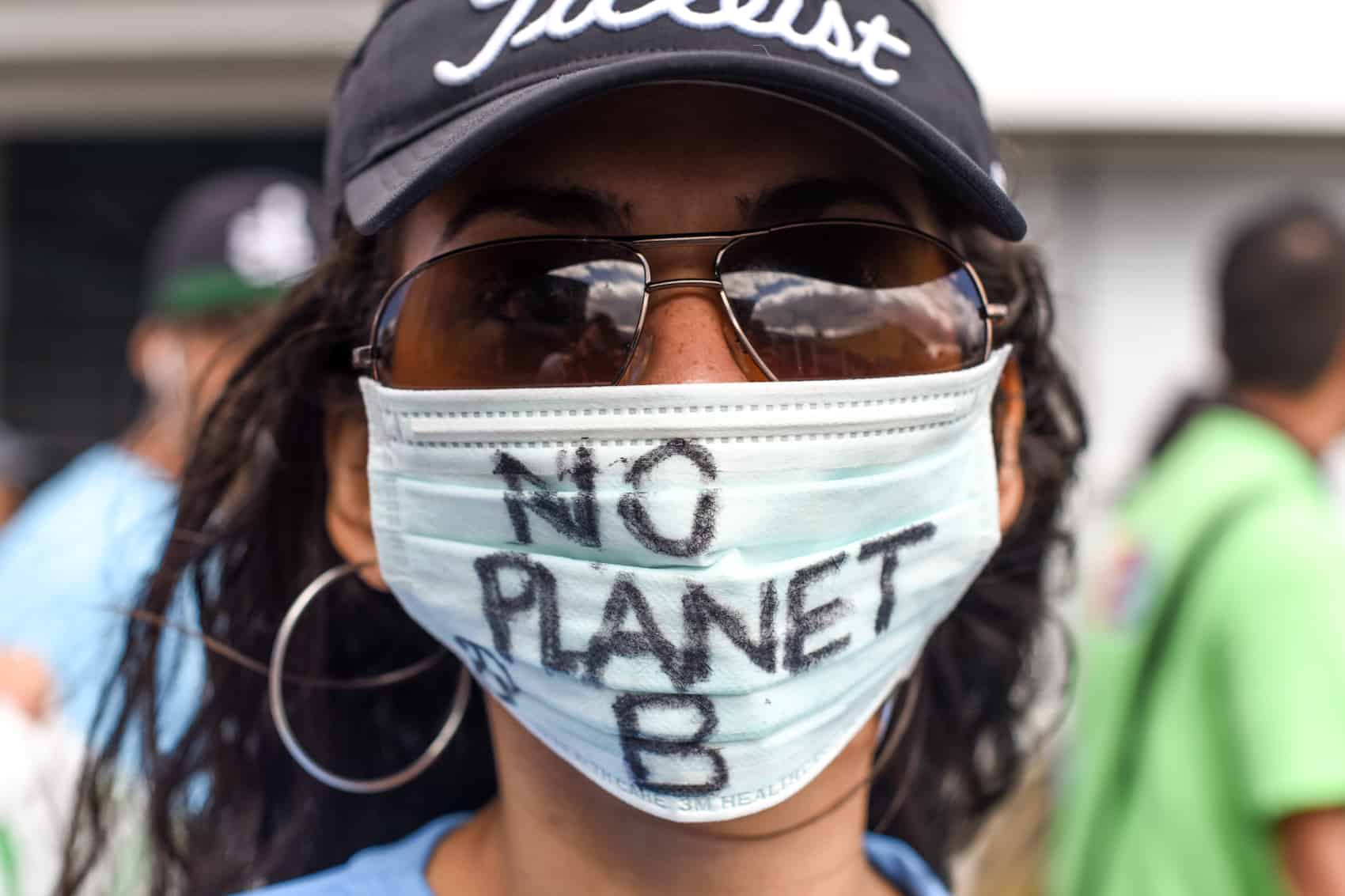
Costa Rica is touted worldwide to tourists and potential residents as a tropical paradise. But the dream is in danger. For a country that relies heavily on its natural endowments, the forces of global climate change present a clear and present danger. Not today, perhaps, or even next year, but the changes are moving inexorably.
According to many experts, within our children’s lifetime the jungle-strewn beauty here and around the equatorial regions could degenerate into desert or rough scrubland – paradise literally razed to the ground as global warming causes the tropics to head for the poles.
While some deny the urgency, others take action. A gathering of concerned people, nongovernmental organizations and private-sector representatives recently met in San José to discuss the situation and suggest future actions. This is especially relevant in light of the government’s intention to become the world’s first nation to completely offset its carbon emissions by 2021 (see separate story in the news section).
The initiative, called “Tierra Viva (Animate Earth): A Sustainable Future for Costa Rica and the Region,” invited British ecologist Stephan Harding to conduct talks on the pioneering concept of Gaia Theory. Harding, who holds a doctorate from Oxford University, coordinates the Master of Science program in holistic science at world-class educational center Schumacher College in England, and has collaborated for many years with Gaia Theory’s originator, atmospheric chemist James Lovelock.
Challenging orthodox scientific doctrine that the Earth is a dead lump of matter to be exploited at will, Gaia Theory shows that Earth is a living organism that intimately depends on the living beings that play a vital part in creating its rocks, atmosphere and oceans. Without plant or animal life, there would be no continents, breathable air or water; and without “them,” there would be no “us.” By self-regulating many long-term cycles and connections to keep conditions viable on the Earth’s surface, Gaia as a fully integrated system lets living organisms thrive.
For skeptics who find it hard to accept Earth as alive and capable of such interaction to keep our planet habitable, Harding swiftly turns on the “hard science” button to support the theory with quantitatively verifiable evidence. Though the science of Gaia is complex, Harding’s talent lies in his ability to impart complicated concepts in a way that is understandable to laypeople.
Using a much-simplified temperature-regulating cycle, one Gaia Theory model goes like this:
Clouds are vital, reflecting the sun’s heat to keep the planet cool. To form, clouds have to be “seeded” with “condensation nuclei” such as sulfur particles, so water droplets can condense around them. Minute marine plankton in temperate climes called (tongue-twistingly) coccolithophores form huge sulfur-spewing “blooms,” releasing mega amounts of sulfur-rich dimethyl sulfide gas when surface sea temperatures are warmed.
Dense white clouds form that cool the Earth. Coccolithophore populations decrease in cooler waters, producing less sulfur, and hence fewer clouds, which reheats the earth as the sun shines onto the dark ocean. Thus, the neat self-regulating cycle continues around and around like a giant natural thermostat.
Oversimplification aside, this cycle, like many others presented in Gaia Theory, is accepted as irrefutable scientific data, yet most conventional scientists refuse to embrace the animistic Gaia viewpoint of Earth as a living being.
Harding explains, “I prefer an animistic interpretation of Gaia in which the whole planet and all its life forms are living, experiencing subjects rather than dead mechanical objects.”
Though the planet has veered between ice ages and warm eras and suffered devastation from meteor hits, these events spanned many thousands of years, allowing for adaptation and recovery. Mankind’s impact on this delicate balance is disturbing the biosphere so profoundly that the self-regulating system could tip into unrecoverable overheating at a rate far faster than predicted by mainstream climate science.
“Earth is a complex dynamic system in which biodiversity plays a vital role,” Harding says. “We can’t say for sure if the effects we have caused are irreversible, but if we do nothing, the worst-case scenarios could well become a dreadful reality.”
Harding makes no bones about the crisis.
“We cannot carry on with ‘business as usual,’” he warns. “The deal is non-negotiable. Earth cannot sustain our increasingly high levels of consumption.”
However, Gaia, the Earth, will undoubtedly continue, in some form or other, reinventing herself ecologically into a hotter configuration much more vulnerable to man’s destructive behavior. If the worst comes to pass, areas suitable for human existence will be reduced to the polar regions as equatorial and subtropical regions of the Earth become desert because of global heating.
A five-day residential course on Gaia Theory recently held at Poás Volcano Lodge in cloud-wrapped Vara Blanca, north of San José, drew participants from Mexico to Ecuador. Delving deeper into the complexities of Gaia Theory with Harding’s classes, they followed a course style similar to that of Schumacher College, where staff and students share daily tasks such as cooking and housekeeping outside class.
An outcome of the course and Harding’s visit is the formation of the association Grupo Tierra Viva (Animate Earth Group) with the intention of creating a sister Schumacher College in Costa Rica. Poás Volcano Lodge owner Michael Cannon and Tropical Science Center director Enrique Ramírez, a course participant, have pledged physical space to conduct residential short courses in holistic approaches to economics, science, design and development issues, while University for International Cooperation academic director Miguel Vallejo has offered the university’s virtual campus for opensource courses aimed at regional students.
“Costa Rica is an ideal place for a Schumacher College,” Harding says. “It has no army, a tradition of peace and has tried to preserve its biodiversity. It’s not perfect, but it’s good, with many well-trained teachers and experts to help at the college.”
In the meantime, Gaia proponents urge a change in attitude and consumer habits. Ultimately, by consuming less and strengthening local community, we must tread lightly on Earth and be responsible for her well-being.





