

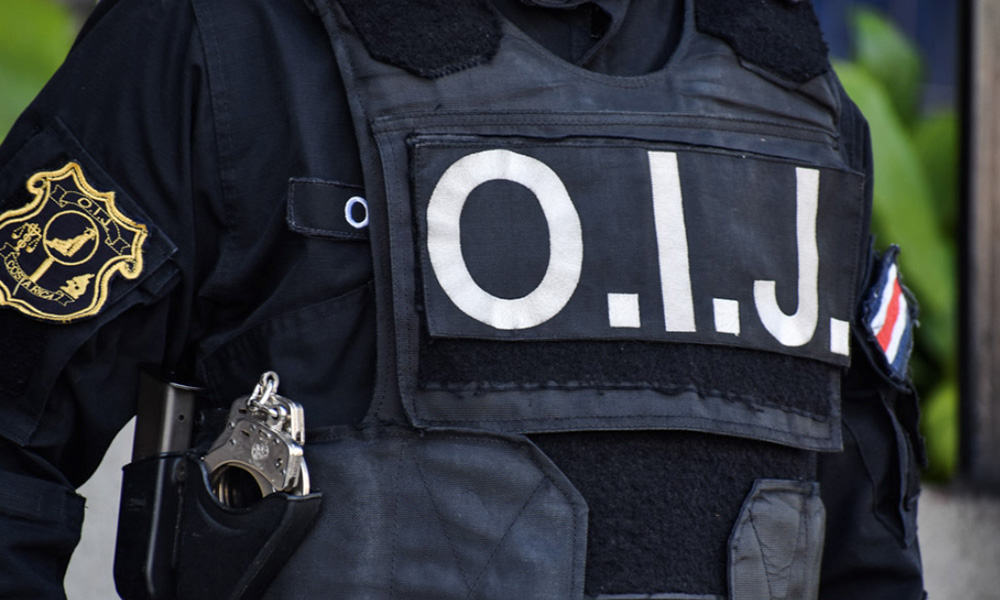
Costa Rica’s Judicial Investigation Agency, known as the OIJ, opened a preliminary investigation into a detonation that interrupted President Laura Fernández’s visit to Crucitas, the northern mining zone at the center of the country’s illegal gold extraction crisis.
Fiscal General Carlo Díaz confirmed Monday that the case is now under review after PLN lawmaker Eder Hernández asked prosecutors to investigate what happened during Friday’s presidential tour. Díaz said he forwarded the request to interim OIJ director Michael Soto, who told him the matter was already being handled.
The incident occurred during Fernández’s visit to Crucitas, in Cutris de San Carlos, where she was accompanied by ministers, security officials and about 30 lawmakers. The tour was meant to show officials the scale of illegal gold mining in the area and the environmental damage left behind.
A loud detonation was heard shortly after 8 a.m. as the official group was in the area. Security officers immediately activated emergency protocols and evacuated the president from the site. No injuries were reported, though lawmaker María Isabel Camareno was taken out by ambulance after suffering a nervous crisis.
Authorities have not yet confirmed the origin of the blast or whether it was caused by explosives, a firearm, or another source. Security Minister Gerald Campos said Friday that officers were sweeping the area and that a group of people had reportedly been seen about 200 meters away. He said the perimeter was secured after the evacuation.
The incident has raised questions about security planning for the visit, especially because Crucitas has long been considered a high-risk zone. Hernández asked prosecutors to examine not only who caused the detonation, but also whether security officials failed in their duties by allowing the presidential group to be exposed.
El Observador reported that the OIJ had alerted the Dirección de Inteligencia y Seguridad, Costa Rica’s intelligence agency, and the Ministry of Public Security about confidential information received before the tour regarding possible actions against the government group.
Díaz said the investigation remains in its early stage and that prosecutors will wait for more information before giving further details. He also said the Public Ministry has a broad understanding of what is happening in Crucitas and acknowledged that organized crime is involved in the illegal gold trade there.
According to Díaz, people tied to drug trafficking have diversified into illegal gold extraction. He said the detonation reflected a broader pattern in which criminal groups are increasingly willing to challenge state authority.
Fernández, speaking after the evacuation, said the situation in Crucitas had gotten out of control. She pointed to environmental destruction, water contamination, open pits, trash and the danger faced by police officers assigned to the area.
The president also said she did not believe the detonation was necessarily an attempt on her life. She suggested it may have been caused by illegal miners using explosives in the forest to open holes for gold extraction. Even so, she said the fact that a detonation occurred during a visit by the president, lawmakers and a large security operation showed how serious conditions have become.
Crucitas has become one of Costa Rica’s most difficult security and environmental problems. Authorities say illegal miners use mercury and cyanide to separate gold, while police face an area where criminal groups, armed actors and informal mining networks operate near the Nicaraguan border.
The government has been pressing lawmakers to move forward with legislation aimed at changing how the country deals with Crucitas. Fernández has argued that illegal mining should be treated as organized crime and that the state needs stronger legal tools to confront the groups extracting gold from the area.
The Friday incident also came the same day authorities arrested a man in San Carlos over an alleged death threat against Fernández. Reuters reported that the arrest was connected to a suspected threat against the president, while officials said no attack against her had occurred during the Crucitas tour.
For now, the OIJ investigation is expected to focus on the detonation itself, the security response and whether the presidential delegation was exposed to a preventable risk during one of the most sensitive tours of Fernández’s early administration.





