

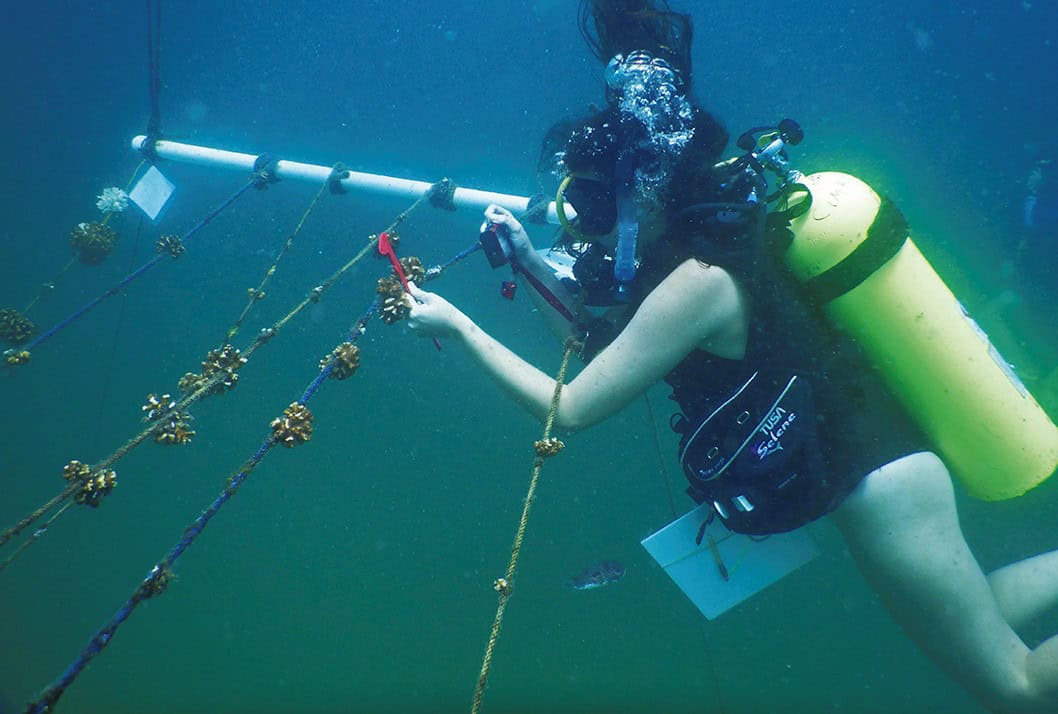
Scientists in Costa Rica have moved 2,700 corals into deeper water in the Gulf of Nicoya to shield them from ocean heat driven by El Niño. Warming Pacific waters are raising the risk of bleaching on the reefs. The corals belong to the restoration project run by the State Distance University (UNED) at Isla Tortuga, off the southern tip of the Nicoya Peninsula. Researchers relocated them from about 5 meters (16 feet) down to 13 meters (43 feet), where the water stays cooler than near the surface.
UNED researcher Yeison Lizano Rojas, who leads the Isla Tortuga project, said El Niño is already putting Costa Rica’s corals under heat stress. The university warned that if high temperatures persist, that stress can lead to bleaching and, eventually, to the death of the corals. Bleaching happens when heat breaks down the partnership between corals and the microscopic algae that live in their tissue. Those algae, known as zooxanthellae, supply most of the coral’s food and energy.
Under prolonged stress, the coral expels them, loses its color and weakens. A bleached coral is not necessarily a dead one. According to UNED, some corals recover once water temperatures return to normal, which is why the team is trying to buy them time in deeper, cooler water. The team has also paused the routine work of the nursery.
Coral gardening, fragmentation and the installation of new structures are on hold, while monitoring of bleaching, water temperature, salinity and other conditions has been stepped up. Lizano said extreme heat is one of the main challenges facing marine conservation. He stressed that restoration and scientific monitoring are what allow reefs to become more resilient.
The threat reaches well beyond Costa Rica. In June, the U.S. National Oceanic and Atmospheric Administration warned that El Niño could trigger a fifth global coral bleaching event, with the eastern Pacific at greatest risk. NOAA said El Niño could raise Pacific sea surface temperatures by more than 2 degrees Celsius (3.6 degrees Fahrenheit), and put the chance of mass bleaching in the region between June and September at 60% to 90%.
The two most recent global bleaching events, in 2023 and 2025, affected 84% of the world’s reef area, according to NOAA. The Isla Tortuga project began in mid-2024 as a partnership between UNED’s Puntarenas campus, the National Learning Institute (INA) and tour operator Bay Island Cruises, which provides boats and logistics.
By June 2025, the team had planted its 2,000th coral and installed 43 nursery structures, and UNED reported that the cultivated corals were growing up to four times faster than corals in the wild.The relocation comes in a week of contrasting news for Costa Rica’s reefs. Days earlier, researchers raised coral larvae in Costa Rica for the first time. On land, El Niño has also been linked to the rainfall deficit that has left Guanacaste drying out this year.
Healthy reefs feed and shelter fish, protect coastlines and support the diving, snorkeling and fishing that coastal communities around the Gulf of Nicoya rely on. UNED warned that losing them would ripple through the marine species that depend on reefs for food, shelter and reproduction, and through the fishing and tourism built around them.





