
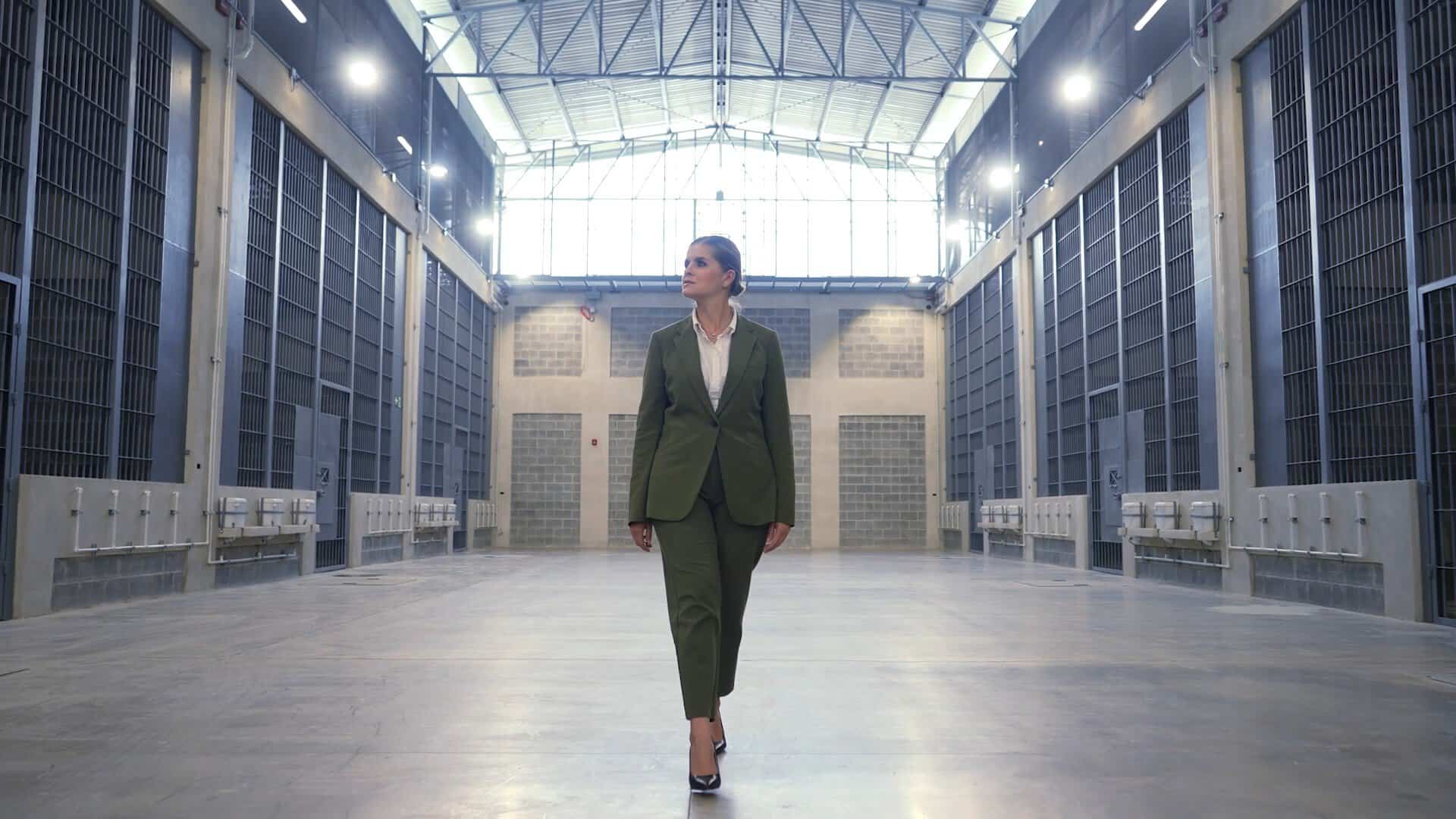
President Laura Fernández is scheduled to inaugurate Costa Rica’s new maximum-security prison at 12:30 p.m. Wednesday, but the facility will not receive inmates today. Justice and Peace Minister Gabriel Aguilar has said the first transfers to the Centro de Alta Contención y Crimen Organizado (CACCO), will take place at the end of this month.
The prison sits inside the La Reforma penitentiary complex in San Rafael de Alajuela, about 25 kilometers (15.5 miles) from San José. According to the Justice Ministry, it can hold about 5,100 inmates in five housing modules, with 31,048 square meters (about 334,000 square feet) of construction on a 90,846-square-meter (22.4-acre) property.
Costa Rica built the facility from plans donated by El Salvador, and its design draws on its Centro de Confinamiento del Terrorismo, or CECOT, the mega-prison at the heart of President Nayib Bukele’s crackdown on gangs. CECOT was designed for about 40,000 people, roughly eight times Costa Rica’s new maximum-security prison.
Fernández has presented CACCO as the centerpiece of her government’s strategy against organized crime. In announcing the ceremony, she said her administration’s mission was to return peace to law-abiding people and that it would not rest until it did so.
The president said invitations went to Ombudsman Angie Cruickshank, Supreme Court magistrates, OIJ Director Michael Soto and Attorney General Carlo Díaz. She also invited Colombian President Abelardo de la Espriella, whose attendance had not been confirmed as of this morning.
The Justice Ministry has said one of the five units holds 1,020 people in cells built for 60 inmates each, fitted with triple bunks. The modules have their own guard posts, controlled access points, internal walkways, bathrooms, showers and separate sun yards.
Inmates will wear orange uniforms and will not be allowed to receive clothing from outside. Aguilar has said the garments, which have no pockets, elastic or drawstrings and are sewn with security stitching, are meant to make searches easier, prevent the concealment of phones, drugs or weapons, and help identify inmates in any escape attempt.
Women held at the Vilma Curling Rivera prison, better known here as Buen Pastor, sewed the uniforms with technical support from the National Learning Institute (INA), according to the ministry.
Daily life inside will be overseen by the General Regulation of the High-Containment Circuit, which started in August 2025. The ministry has said high containment adds restrictions designed to stop people tied to criminal organizations from coordinating activity from behind bars.
According to a constitutional challenge filed against the decree, the regulation limits inmates to one 10-minute phone call a week, bars access to radio and television and restricts intimate visits to once every two months. The regulation also prohibits visits by minors. Inmates may see their children only by video call, with narrow exceptions that require a social-work assessment and a specific authorization from the circuit’s management.
The government says CACCO will hold inmates it considers especially dangerous, including people linked to organized crime, drug trafficking and contract killings. Aguilar has said inmates already held under the high-containment regime at existing prisons will be the first to move. Officials have given different figures for the first phase.
In July, Aguilar said the first 2,500 inmates would be transferred once the building had been received and inspected. The government has since given a preliminary estimate of about 2,100 inmates for the first stage. Placement is supposed to follow technical criteria. The Ombudsman’s Office has pointed to Circular 1-2026 of the National Institute of Criminology, which sets the criteria for assigning inmates to high-containment spaces, and has said such placements cannot depend on the will or impulse of a political authority.
That question became a flashpoint two weeks ago, after the ministry published a video of Aguilar inspecting the 26 de Julio prison in Puntarenas. In it, he told several inmates they would be sent first to high containment and then to CACCO. The Ombudsman’s Office condemned the minister’s conduct and said the unilateral transfer orders violated the principle of legality and due process.
The Attorney General’s Office has since opened an investigation into Aguilar for alleged abuse of authority related to an inmate’s transfer to CACCO. Aguilar has not been charged and in an Oct. 10 statement, he denied that inmates were assaulted or mistreated during a separate operation at La Reforma.
Whether CACCO’s restrictions comply with Costa Rican law has not been decided. The Constitutional Chamber (Sala IV) admitted an unconstitutionality action against several articles of the decree in 2025. That challenge was filed by a Mexican inmate convicted of drug trafficking, who argues that the limits on visits, calls and education violate the Constitution and international human rights treaties.
The regulation stays in force while the court weighs the case, because admitting a challenge does not suspend the rule being challenged. Separately, judges have asked the chamber to rule on whether several of the decree’s articles are constitutional.
On Oct. 1, University of Costa Rica professor Ricardo Zeledón Zeledón filed an amparo, a petition asking the Constitutional Chamber to protect fundamental rights from a specific government action. His petition asks the court to stop the inauguration and any transfers and to order the building demolished. It also questions the project’s financing and the international cooperation behind it.
Court spokesman Alejandro Lizano outlined the request yesterday, when the case remained at the admissibility stage. The filing does not by itself suspend today’s ceremony. The National Mechanism for the Prevention of Torture, which operates within the Ombudsman’s Office, went further on Oct. 1. After the Puntarenas video, it said CACCO should not begin operating because minimum guarantees and standards were not being met.
The Justice Ministry estimated the project’s total investment at $34.5 million when lawmakers approved its financing in 2025. The procurement record on the government’s SICOP purchasing system puts the cost at more than $33 million. The Legislative Assembly approved the first 40% of the funding in a midyear budget in September 2025, by a vote of 41 to 0. The government covered the remaining 60%, about $23 million, in the 2026 national budget.
Construction began in January during a visit by Bukele to Costa Rica. Then-President Rodrigo Chaves, now minister of the Presidency and Finance, promised the prison would be finished in 195 days, a deadline that passed on July 27. The ministry reported the work 95% complete on Sept. 21.
CACCO is the first new prison since CAI Terrazas opened in 2021, and it will be its largest. The opening is already affecting the rest of the system. The Justice Ministry suspended special visits, volunteer groups and attorney visits today at the prisons of the Western Complex in Alajuela and is rescheduling intimate visits and parcel deliveries planned for the day. The ministry asked inmates, their families and partner organizations for understanding.
The inauguration comes as Costa Rica’s prison population sits at a record high and as the government argues that criminal organizations must be cut off from running operations from inside existing prisons. How CACCO’s rules are applied to each person sent there, and how the Constitutional Chamber rules on them, will decide whether the country’s largest prison becomes a security model or its next major legal battle.