

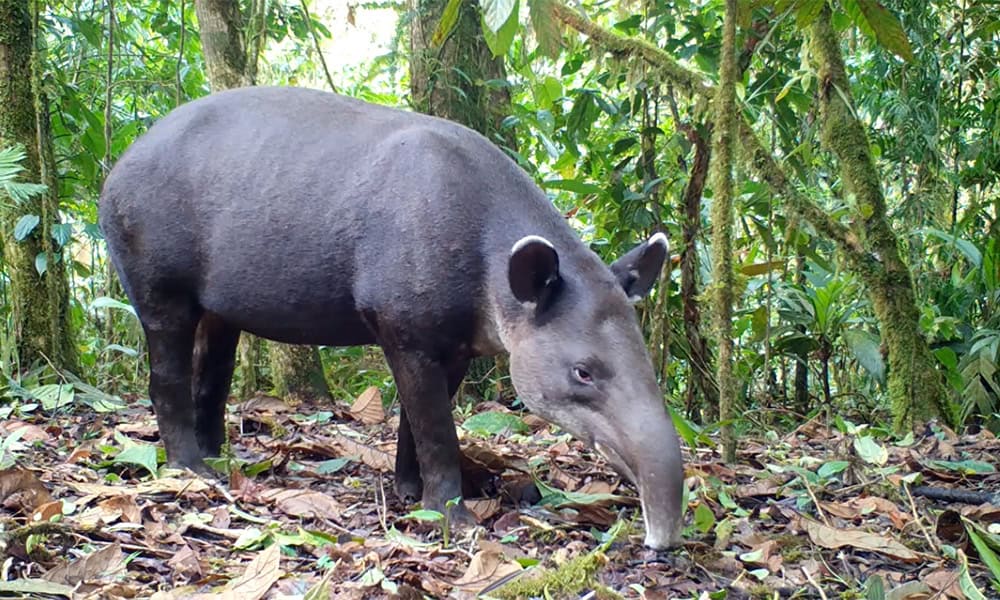
A rare wildlife encounter in northern Costa Rica has captured the attention of conservationists after a family of three endangered tapirs was filmed walking together through patches of forest in Pital de San Carlos. The sighting is particularly unusual because the animals were traveling as a family group in broad daylight, offering a glimpse of one of Central America’s largest and most elusive mammals.
The encounter took place on October 23 during a field visit by specialists from the Foundation for the Development of the Central Volcanic Mountain Range (FUNDECOR). The organization’s environmental services team recorded a male, a female and a young tapir moving through the landscape, an observation that conservationists say highlights the importance of maintaining connections between forest habitats.
The footage was made public this week, drawing attention to a species that plays an important role in Costa Rica’s ecosystems but is rarely observed in family groups.
Dylana Álvarez Masís, a forest management specialist with FUNDECOR, described the encounter as highly unusual, particularly because the three animals were seen together outside dense forest cover. Known locally as dantas, Baird’s tapirs (Tapirus bairdii) are the largest native land mammals in Central America. Despite their size, they are often difficult to spot in the wild because they generally move through dense vegetation and tend to avoid human activity.
The animals have large, rounded bodies, short legs and distinctive elongated snouts that help them gather leaves, fruit and other vegetation. Adults can weigh several hundred pounds, making them considerably larger than most other mammals found in Costa Rica’s forests.
Tapirs are generally solitary animals, although mothers remain with their young for an extended period. Their reproductive cycle is also unusually slow. Pregnancy lasts approximately 13 months, and calves typically stay close to their mothers for at least a year. These characteristics make the sighting in San Carlos particularly interesting. Observing a male, female and young animal together provides an uncommon opportunity to document their behavior in a natural setting.
Beyond their appearance, tapirs perform an essential ecological function. They are sometimes called the gardeners of the forest because they eat fruit and disperse seeds over considerable distances as they move through their habitats. Some seeds pass through the animals’ digestive systems and are deposited in different parts of the forest, helping native trees and plants establish themselves in new areas.
Their movement through dense vegetation can also create small openings that allow sunlight to reach the forest floor, contributing to natural regeneration. For this reason, protecting tapirs can also help protect the wider ecosystems that depend on healthy forests.
However, the species faces significant threats throughout Central America. Baird’s tapir is classified as endangered by the International Union for Conservation of Nature (IUCN), with habitat destruction, forest fragmentation and hunting among the main factors contributing to its declining population.
In Costa Rica, tapirs can still be found in protected areas such as Corcovado National Park and other large forest ecosystems. But their survival also depends on what happens outside national parks, particularly in regions where agricultural land, roads and human settlements divide natural habitats.
The Pital de San Carlos sighting illustrates why these connections matter. The animals were observed moving between separate patches of forest rather than remaining within one continuous wooded area. Conservation specialists refer to the ability of animals to move between these habitats as ecological connectivity. Maintaining these connections allows wildlife to find food, reach suitable breeding areas and move between populations.
When forests become isolated, animals may have difficulty moving safely between them. Roads, fences, agricultural expansion and other forms of development can create barriers, increasing the risk of wildlife becoming trapped in smaller areas of suitable habitat. FUNDECOR says observations such as the one recorded in Pital demonstrate the importance of strengthening conservation programs that maintain functioning connections between forests.
The organization works with landowners and communities on sustainable forest management and environmental services programs designed to protect natural resources while supporting local economic activities. Costa Rica’s Payment for Environmental Services program is one mechanism used to encourage landowners to maintain forest cover rather than clearing land for other purposes.
These efforts can be especially important in agricultural regions, where patches of privately owned forest sometimes provide the only connections between larger protected ecosystems. The presence of the young tapir also gives researchers an opportunity to learn more about how the species uses the landscape. However, a single sighting cannot establish that the local tapir population is increasing or that the animals face fewer threats than before.
Determining whether a population is recovering requires repeated observations and scientific monitoring over time. Camera traps, field surveys and other monitoring tools have become increasingly important for studying Costa Rica’s elusive wildlife, allowing scientists to identify where animals are moving and which habitats remain connected.
For residents and visitors, encounters with tapirs are a reminder of the remarkable wildlife that continues to inhabit Costa Rica’s northern region, even in places where forests are surrounded by farms and human settlements. The animals are generally shy, and anyone fortunate enough to encounter one in the wild should maintain a safe distance and avoid approaching or feeding it.
For conservationists, the unusual footage from Pital is more than an interesting wildlife moment. It shows why maintaining forest connections remains essential for protecting endangered species whose survival depends on having enough space to move, feed and reproduce.
And for three tapirs quietly making their way through the forests of San Carlos, those connections may help determine whether future generations can continue traveling through the same landscape.





