

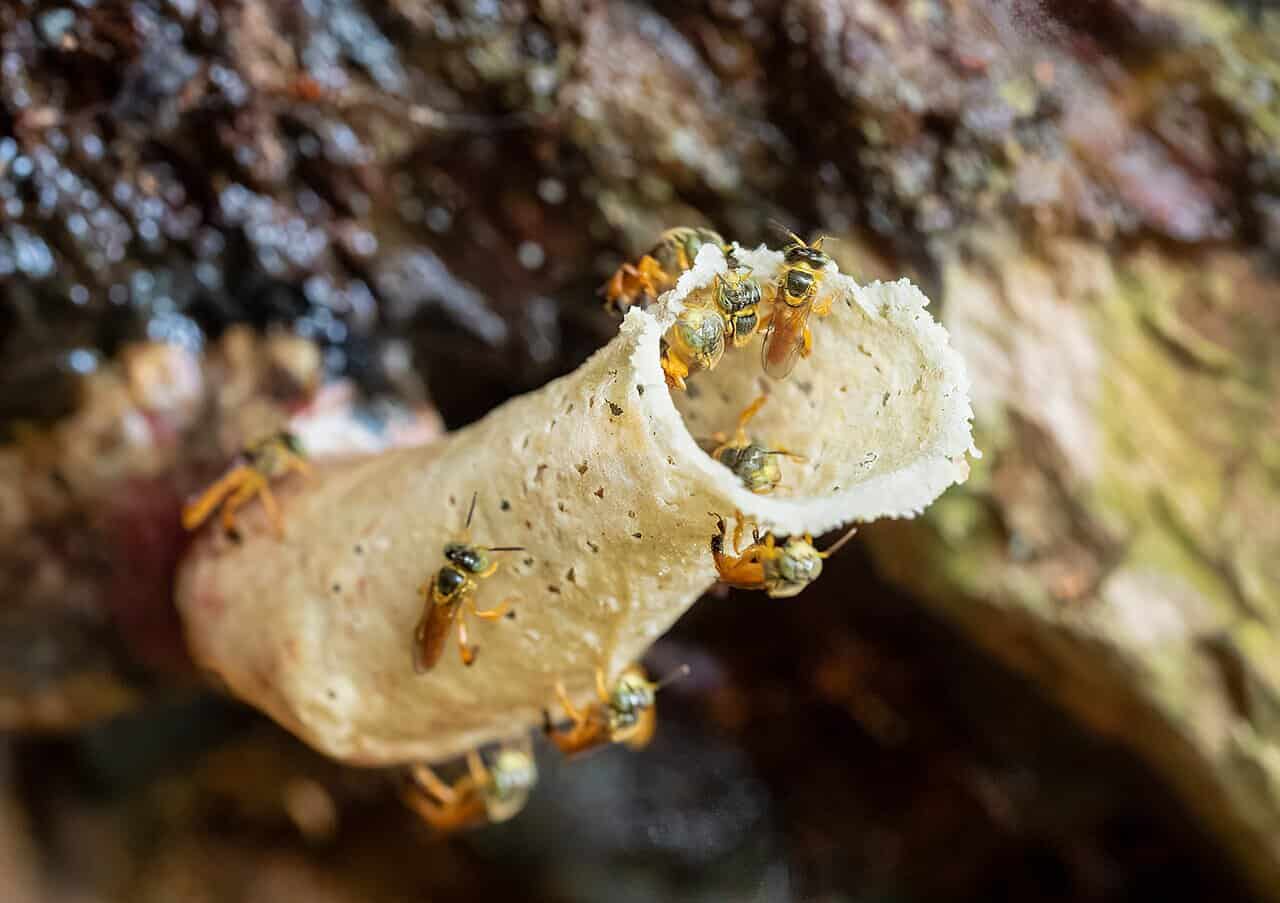
Costa Rica’s tiny native bees have become the center of a legal battle that could affect beekeepers, honey producers and efforts to protect some of the country’s most important pollinators. The Constitutional Chamber of the Supreme Court (Sala IV), has agreed to review a challenge against government regulations that limit the commercial use of native stingless bees. The case raises questions about whether the rules are protecting biodiversity or making it unnecessarily difficult for people who have raised these insects for generations.
Costa Rica is home to 58 recorded species of native stingless bees, but regulations introduced in November 2025 allow commercial production without additional scientific studies for only two species. Anyone hoping to commercially produce honey, wax or other products from the remaining species must first provide scientific evidence showing that doing so will not threaten their survival.
The legal challenge was accepted last week following a complaint filed by Yandry Johanna Alvarado Castro. The lawsuit questions several provisions of the Executive Decree which regulates facilities where stingless bees are raised and managed. Unlike the familiar European honeybee, Costa Rica’s native stingless bees lack a functional stinger. Many are much smaller, and some live in colonies inside hollow trees, fallen logs and other natural cavities.
Two of the best-known species are the mariola (Tetragonisca angustula) and soncuano (Scaptotrigona pectoralis). Both are included among the species permitted for commercial production under the regulations. Their honey is produced in relatively small quantities and has long been valued by Costa Rican families, particularly in rural communities where raising native bees has been passed down through generations.
The practice is known as meliponiculture, a type of beekeeping that focuses on stingless bees rather than the imported honeybees commonly used in large-scale commercial honey production. But these insects do much more than produce honey. They pollinate native plants and agricultural crops, helping forests regenerate and supporting the reproduction of vegetation throughout the country.
That ecological importance is one reason the government introduced the regulations. Officials say the rules are intended to protect native bee populations, prevent overexploitation and preserve genetic diversity. However, beekeepers and researchers have questioned whether some of the restrictions are supported by sufficient scientific evidence.
One of the most controversial measures limits commercial operations to 30 colonies and noncommercial operations to just five. The legal challenge argues that these limits fail to consider differences between species, regional environmental conditions and the availability of food sources.
A beekeeper working in the humid forests of Limón, for example, may face very different conditions from someone maintaining colonies in the dry forests of Guanacaste. Critics argue that applying identical limits to both operations may not make sense without additional research.
The regulations also require beekeepers to maintain minimum distances between their colonies and agricultural operations using pesticides. Depending on the size of the bee species, those distances range from 500 meters (1,640 feet) to 3.5 kilometers (2.2 miles). Even greater distances are required in some circumstances, including where aerial spraying takes place.
Although the intention is to protect bees from potentially dangerous chemicals, the lawsuit questions how those distances were established and whether they are practical for small farmers and rural families. Researchers at the National University’s Tropical Bee Research Center (CINAT) have also raised concerns about the scientific basis for the restrictions.
Of the 58 native stingless-bee species recorded in Costa Rica, researchers have documented 20 species being maintained in managed colonies. That is considerably more than the two species covered by the regulation’s simpler commercial approval process. Specialists agree that native bees need protection but have warned that more information is required before deciding how many colonies should be allowed or which species are appropriate for commercial production.
For traditional beekeepers, the rules could have financial consequences. Some families maintain several species and depend on the sale of small quantities of honey and other products to supplement their income. Others raise bees primarily to preserve traditional knowledge and maintain healthy populations of pollinators on their properties.
The National Chamber of Stingless Beekeepers has previously called for additional species to be included in the regulations, particularly the jicote gato (Melipona beecheii) and jicote barcino (Melipona costarricensis). The organization and other critics argue that overly restrictive rules could discourage beekeepers from registering their operations and push some producers into the informal market.
Another concern involves potential penalties. The lawsuit challenges provisions that refer violations to Costa Rica’s Wildlife Conservation Law, arguing that beekeepers could face legal uncertainty over activities involving insects that naturally move between managed colonies and the surrounding environment. The case now moves forward in the Constitutional Chamber, where judges will examine whether the disputed rules comply with Costa Rica’s Constitution and environmental protections.
The court has given the Attorney General’s Office and the ministries of Environment and Energy and the Presidency 15 days to respond to the legal challenge. Importantly, accepting the case does not mean the judges have ruled against the regulations. The existing requirements remain in effect while the court considers the arguments.
Beekeepers also face a registration deadline in November 2026, when the 12-month period established under the regulations is scheduled to expire. The dispute comes at a time when Costa Rica is already confronting broader concerns about the survival of native bees. Earlier this year, the Constitutional Chamber ordered authorities to enforce a nationwide ban on insecticides containing fipronil after a separate case involving damage to bee colonies in Lepanto, Puntarenas.
The complainants in that case reported losing at least 24 native bee colonies and serious damage to hundreds of additional hives. The ruling highlighted the risks that agricultural chemicals can pose to pollinators and reinforced the importance of protecting native insects that play an essential role in Costa Rica’s ecosystems.
For now, the latest legal dispute presents a difficult question for authorities: how to protect native bees without placing unnecessary burdens on the people who raise and care for them. With dozens of native species, a long tradition of small-scale beekeeping and an economy closely connected to agriculture and conservation, Costa Rica has considerable interest in finding the right balance.
The Supreme Court’s eventual ruling could help determine how the country manages its native bees for years to come, affecting not only honey producers but also the forests and farms that depend on these small but valuable pollinators.





