

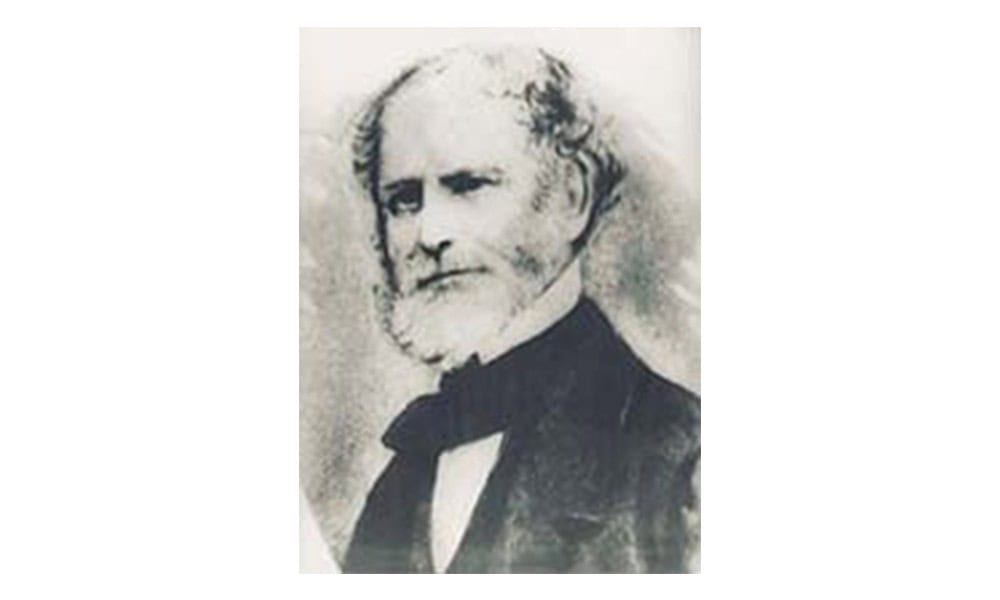
When devout Christian Capt. William Le Lacheur first arrived in the Pacific port city of Puntarenas in the mid-19th century, he was horrified at what he described as “the lowest form of the Roman faith” practiced in the nominally Roman Catholic country. He stated that “superstition took precedence over true religion,” and soon came to the conclusion that the best way to defeat these superstitions was to introduce Protestant Bibles to Costa Ricans.
Le Lacheur, who was born into a farming family on the English Channel island of Guernsey, asked his minister in 1844 to assist him in obtaining Protestant Bibles for the people of Costa Rica. To this end, the Reverend William Wild wrote a letter of recommendation to the British and Foreign Bible Society’s headquarters, which stated: “Capt. Le Lacheur is a member of my church … he is about to return to Costa Rica … I know of no man in this kingdom of Great Britain to whom you may with more confidence entrust Spanish Bibles.”
The captain sailed into Puntarenas on the schooner Lavina on Jan. 26, 1845, bringing with him the first consignment of about 300 Bibles. In all, he managed to obtain a total of 3,500 Bibles, which he sold at cost to introduce the Protestant faith in Costa Rica. As a sea captain and merchant, Le Lacheur entered the Azores fruit trade in 1830.
He formed Le Lacheur & Co. with two ships, the Minerva and the Dart. As his business prospered, he continued to add to his fleet and to seek out new markets. In 1841, he took on a much larger vessel capable of longer journeys, a bark named Monarch. He sailed to Mazatlán on Mexico’s Pacific coast, where he learned of the difficulty coffee growers in Costa Rica were having in finding markets for their products. Seeing a business opportunity, Le Lacheur immediately set sail for Costa Rica.
In 1842, he became acquainted with the Montealegres, a Costa Rican coffee-growing family. Having studied engineering in England, the Montealegres’ son spoke English, which was fortunate for Le Lacheur, who spoke no Spanish. At the time, local coffee growers used middlemen to ship their coffee via Valparaíso, Chile. Through the Montealegres, Le Lacheur & Co. was able to establish an agreement to provide regular direct service to London for the country’s entire coffee crop.
Laden with its first cargo of more than 5,000 bags of Costa Rican coffee, the Monarch set sail from Puntarenas and docked in London four months later on Oct. 19, 1843. The venture proved a great success, and to accommodate the increased demand for coffee in London, Le Lacheur & Co. had to increase the size of its fleet. In 1860, Le Lacheur installed his son, John, as his permanent representative in Costa Rica.
Having established regular voyages between Costa Rica and London, Le Lacheur arranged for wealthy Costa Ricans to send their sons to be educated in England, contributing further to the success of the Costa Rican economy. Through this arrangement, the game of soccer was introduced to Costa Rica.
When U.S. filibuster William Walker, the self-appointed president of Nicaragua, attempted to invade and conquer Costa Rica, Le Lacheur put his ships at the disposal of the country’s military commanders. They transported troops up the coast from Puntarenas to the northwestern Guanacaste province – a long, arduous journey on foot – so that they might reach their destination fit and ready to fight.
The filibusters were defeated at the Battle of Rivas on April 11, 1856. The Boletín Oficial newspaper stated, “The distinguished Capt. Le Lacheur deserves not only the recognition of the government, but of all Costa Ricans.” Costa Rican bank notes and postage stamps featured Le Lacheur’s ships during the 19th and 20th centuries.
Le Lacheur retired from the sea in 1857 at the age of 55. He became a national hero in Costa Rica, credited with having helped boost it from one of the poorest countries in Central America to one of the wealthiest.
After a long illness, Le Lacheur died in his home in London in 1863 at the age of 60. In 1864, his son, John, built the first Protestant church in Costa Rica and dedicated it to his father’s memory, transporting prefabricated iron to the country and assembling the church in the capital city of San José. Although he named it the Church of the Good Shepherd, it soon became known as “the iron church” because of its construction.
The Church of the Good Shepherd was rebuilt with more traditional materials in 1937 on Avenida 4, between Calles 3 and 5, and a plaque inscribed “by whose exertions public Protestant worship was established in this republic” was erected to the memory of William Le Lacheur.





