
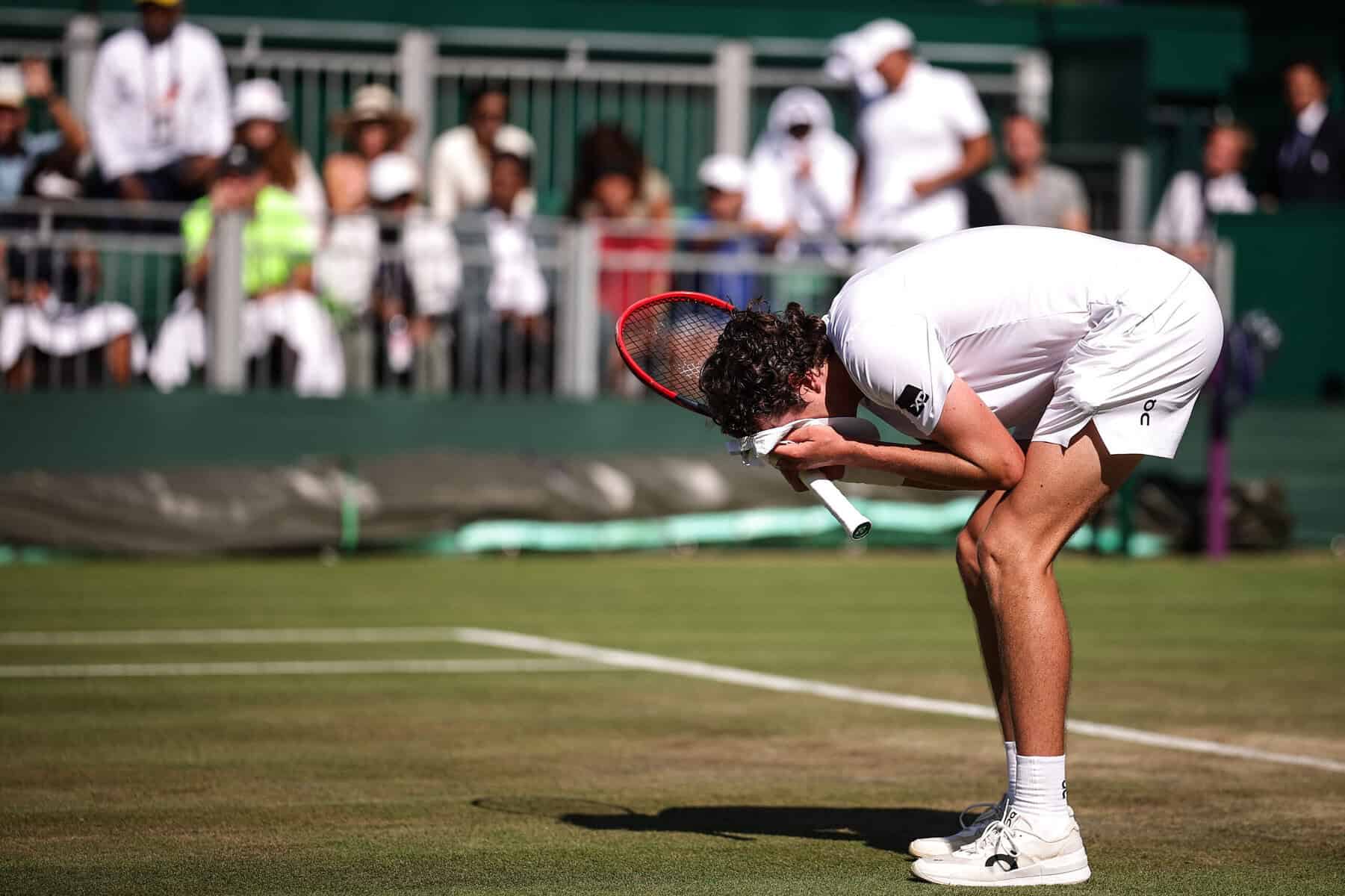
João Fonseca’s Wimbledon run ended Friday with a flat but revealing third-round defeat, as Russian qualifier Roman Safiullin beat the Brazilian teenager 6-3, 6-3, 6-3 to reach the last 16. Fonseca, the 24th seed and one of the most watched young players in men’s tennis, arrived on Court Two with momentum and a loud Brazilian following behind him. He left with a reminder that grass-court progress rarely moves in a straight line.
The 19-year-old had looked sharp earlier in the tournament, including a straight-sets win over Jesper de Jong that sent him into the third round at Wimbledon for the second year in a row. But Safiullin never allowed him to build the same rhythm Friday. The Russian controlled the match from the baseline, protected his service games, and kept Fonseca from turning the crowd’s energy into a real push.
The scoreline was blunt. Fonseca failed to win more than three games in any set, and the match never developed into the kind of emotional comeback that has already become part of his young reputation.
For Brazil, the loss pauses one of the tournament’s strongest Latin American storylines. Fonseca has become the face of a new wave of Brazilian tennis interest, drawing unusually loud support for a player still early in his career. That attention has followed him across the tour, sometimes giving his matches the feel of a football crowd more than a tennis crowd.
That passion is part of his appeal. It is also part of the weight he now carries. Fonseca’s talent is not in question. His forehand, court presence, and willingness to attack have made him one of the sport’s clearest teenage prospects. But Friday showed the gap between promise and consistency, especially on grass, where points can disappear quickly and small lapses become full sets.
Safiullin’s win also had its own comeback story. The former Wimbledon quarterfinalist entered the tournament outside the top 100 after a difficult injury period and had to come through qualifying before facing Fonseca. He became emotional after the victory, which put him into a fourth-round match against Novak Djokovic.
For Fonseca, the defeat does not erase a solid Wimbledon. He won two matches, protected his seed early, and again showed he can compete on a surface that usually punishes young players still learning movement and timing. But the next step is clear. Fonseca is no longer being judged only as a promising teenager. He is being watched as the player many Brazilian fans believe can carry their country back into the center of men’s tennis.
That is a heavier assignment than a third-round match at Wimbledon. Friday showed he is still learning how to carry it.