

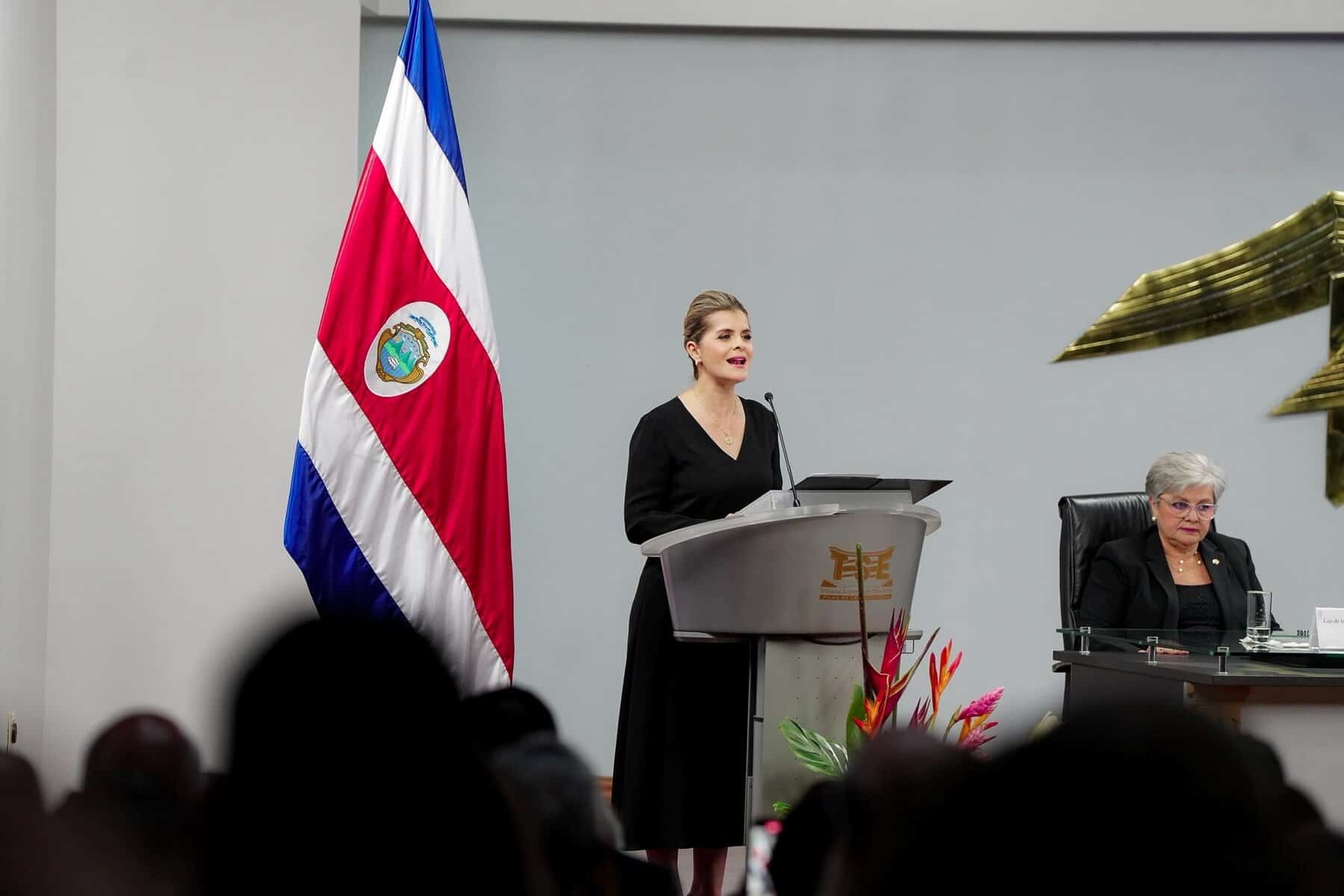
President Laura Fernández said yesterday that she has received information about roughly nine alleged plans to attack her, including one she described as involving a sniper, and that the reports have been passed to prosecutors for investigation. She made the statements at a press conference following a meeting of the National Security Council at Casa Presidencial, adding that she had not spoken about the matter publicly before because she considered the information sensitive and confidential.
According to Fernández, the roughly nine threats are directed at her physical safety and, in some cases, extend to members of her cabinet and her family. She said the intelligence behind them came for the most part from police and prison sources, and that the files had already been referred to the Ministerio Público, our prosecutorial authority. She said she intends to request a written account of how far those investigations have advanced. No supporting evidence for any of the alleged plots has been made public, and none of the claims has been independently confirmed.
Fernández presented the disclosures as part of a wider push on security policy, and she used the same appearance to criticize the leadership of the Judicial Branch, whose senior figures did not attend the council meeting. She described their absence as a “tantrum” and a slight against Costa Ricans, said she could formally denounce them, and indicated she wants the council to convene at least once every two months. She said the meeting had also covered the progress of security legislation and the effectiveness of the courts.
The president spoke without offering documentation, names, or details that would allow the alleged plots to be assessed by anyone outside the government. She said the protocols governing her own protection and that of her ministers were already known, and that the aim now was to confirm what prosecutors had done with the cases already referred to them.
The claims arrive against a backdrop of earlier, similarly unproven security scares surrounding the presidency. Fernández took office in May, succeeding her political mentor, Rodrigo Chaves, whose government announced in January that it had uncovered an alleged plot against the then-president; authorities never produced concrete evidence in that instance.
In June, Fernández was evacuated during an explosion while touring an area of illegal mining in the country’s interior, and in the days before that the government said it had received information about an alleged plan said to be taking shape inside a prison. As with those episodes, the accounts released yestarday rest at this stage on the government’s own characterization rather than on any publicly verifiable proof.
For now, the matter sits with the Ministerio Público, and any determination about whether the reported threats amount to credible plots will depend on the outcome of that review. Fernández, for her part, signaled that she does not intend to alter her public schedule, saying she would continue in the role regardless of who might wish her harm.





