

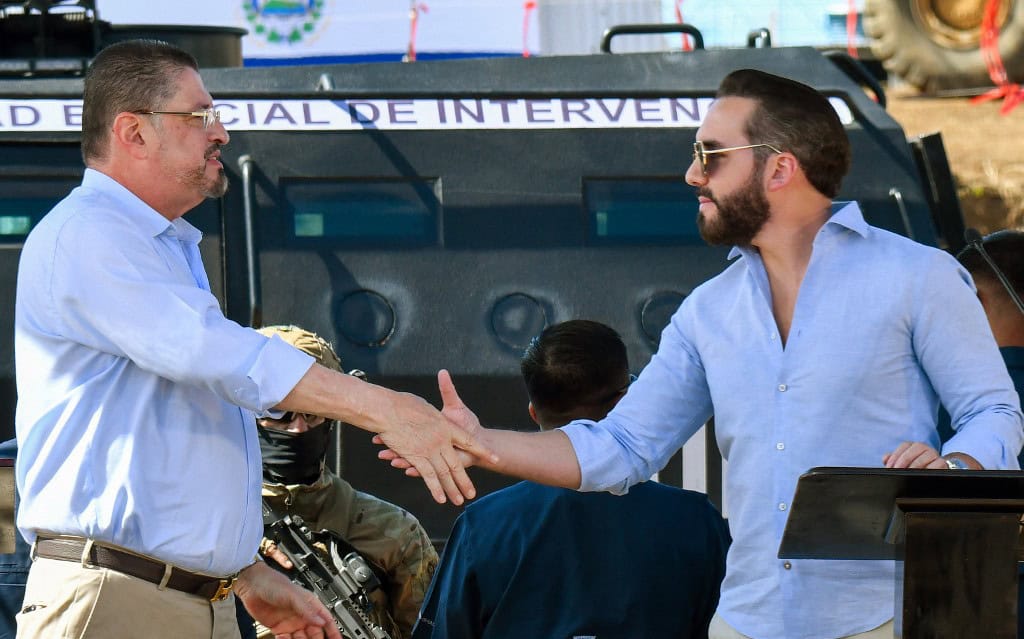
El Salvador’s President Nayib Bukele joined Costa Rican President Rodrigo Chaves on Wednesday to lay the first stone for a new maximum-security prison in Alajuela, modeled after El Salvador’s controversial Terrorism Confinement Center (CECOT). The event has intensified debates in Costa Rica’s presidential campaign, with opposition leaders claiming it boosts the ruling party’s hard-line stance on crime ahead of the February 1 elections.
The facility, named the Center for High Containment of Organized Crime (CACCO), will hold up to 5,100 inmates and cost $35 million to build. It aims to house high-risk prisoners linked to drug trafficking and organized crime, expanding Costa Rica’s prison capacity by about 40%. Construction is set to finish in under 200 days, with El Salvador providing technical support in design and security protocols.
“Everything we did at CECOT will be done in its Costa Rican version,” Bukele stated during the ceremony, held 20 kilometers from San José. He urged Chaves to confront rising crime “with the strength of the state,” warning that insecurity “will keep growing like a cancer if it isn’t stopped.” Bukele added that success requires unified support across government branches, drawing from his own experience where control over legislature and judiciary enabled sweeping reforms.
Chaves echoed Bukele’s call for tougher measures, announcing plans to propose legislation against organized crime based on El Salvador’s laws. He dismissed a recent electoral tribunal ruling that urged foreign leaders to avoid campaign interference, calling it “an aberration.” The tribunal had reviewed complaints about Bukele’s visit but allowed it to proceed, while reminding him to steer clear of domestic politics.
The visit comes as polls show ruling party candidate Laura Fernández leading with promises to complete the prison and declare states of emergency in high-crime areas. Fernández, a former Chaves minister, argues these steps are essential to reverse Costa Rica’s spike in violence, which has eroded its reputation as one of Latin America’s safest nations. Homicide rates hit record highs in recent years, driven by drug cartels using the country as a transit hub.
Critics, however, warn that adopting Bukele’s approach risks undermining Costa Rica’s democratic traditions and human rights standards. Humanitarian organizations report that El Salvador’s strategy, launched under a prolonged state of emergency since 2022, has led to over 90,000 arrests, many arbitrary, along with allegations of torture and deaths in custody. “This is a step backward for a country seen as a human rights model,” said opposition figure Claudia Dobles, who described the project as an expansion of existing facilities rather than a true mega-prison.
Bukele’s anti-gang offensive, which suspended constitutional rights like warrants for arrests, has slashed El Salvador’s homicide rate to historic lows and boosted his popularity. Yet it has drawn international scrutiny for eroding checks and balances, including indefinite reelection approved by his-controlled congress—a mechanism unavailable in Costa Rica.
Chaves, known for his confrontational style, has clashed with the judiciary, accusing it of blocking his agenda. He received Bukele with Costa Rica’s highest honor, praising the Salvadoran leader’s crackdown. “In a democracy, it’s necessary to grant enough power to those who govern,” Chaves said, emphasizing accountability through results.
The CACCO will feature five modules for isolation, focusing on preventing inmates from directing crimes from behind bars. Officials have kept some details confidential, but the project aligns with Costa Rica’s efforts to modernize its overcrowded system, currently 30% over capacity.
As the election nears, crime remains a top voter concern. Fernández aims for a first-round win and a legislative majority to push constitutional reforms, particularly in the judiciary. Bukele advised that “with a parliamentary majority, we were able to make all the changes we needed.”
The opposition accuses Chaves of using the visit to rally support for Fernández, who leads over 20 contenders. They argue the timing violates electoral neutrality, though the tribunal rejected halting the event. Costa Rica’s shift toward stricter security reflects broader regional trends, with leaders in Ecuador, Honduras, and Peru eyeing Bukele’s methods. Yet rights groups stress the human cost, including thousands of innocent detentions in El Salvador.
Construction on CACCO begins immediately, with officials promising adaptations to fit Costa Rica’s legal framework. Whether it delivers on security without compromising rights will test our country’s balance between order and democracy.





