
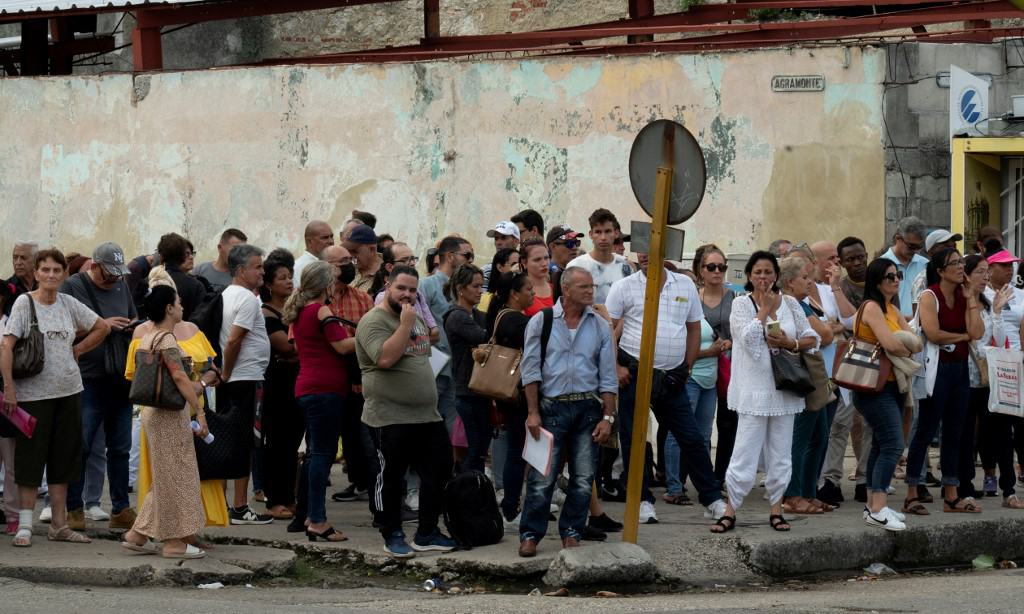
Elsa resisted leaving Cuba, until opportunities closed for her and she decided to join the Cuban exodus in 2023, which in two years reached record levels. An unprecedented bleed, since the beginning of the Revolution in 1959, motivated by the serious economic crisis on the island.
In the midst of galloping inflation, as well as the collapse of agricultural production and slow recovery of tourism in her country, the 30-year-old left in August, disillusioned by the rapid deterioration of the economic situation.
“It was very difficult to resolve and satisfy basic needs, there was nothing, the issue of blackouts was unbearable and that of food, the price of the dollar” kept rising, she says from Miami, where she arrived in November.
Like many of her compatriots, Elsa flew to Managua and from there traveled a risky 3,000 km journey to reach the US border.
The US Customs and Border Protection Office announced on Saturday that in 2023 it registered more than 153,000 irregular entries of Cubans into its country. Another 67,000 flew directly to US territory thanks to the program known as Parole, implemented a year ago by the Joe Biden administration.
Coupled with the more than 313,000 who entered without papers in 2022, this “represents the largest number of Cuban migrants ever recorded in two consecutive years since the beginning of the post-revolutionary Cuban exodus in 1959,” says Jorge Duany, director of the Cuban Research Institute at Florida International University.
In two years, at least 533,000 Cubans arrived in the United States, a figure equivalent to 4.8% of the 11.1 million inhabitants. This, without counting entries with other types of visas for which no official figures are available.
A substantial loss
This wave of migration is only preceded by that of Mariel, in the 1980s when 130,000 Cubans left, followed by the “rafters” in 1994 with 35,000 and the flight for political reasons between 1960 and 1963 of 300,000 at the beginning of the revolution.
In these two years “many young people with high educational and occupational levels” have left, which “represents a substantial loss of human resources” for Cuba, which has one of the most aging populations in the region, adds Duany.
Latin America and Europe are also the destination for tens of thousands of Cubans, however, there is no global official figure.
For example, 36,574 Cubans sought refuge in Mexico between 2022 and 2023, while at least 22,000 entered Uruguay and hundreds arrived in Chile, according to official figures from these three countries.
Radibel Peña, a 28-year-old carpenter flew in April from Havana to Georgetown, Guyana, which does not require a visa for Cubans. He then traveled through Brazil and went to Bolivia, from where he illegally entered Chile in May.
“Here there is everything. Working decently, one lives well,” he said in Valparaíso, in the center of Chile, where he works in construction still without immigration documents.
Intolerance
The massive departure began in November 2021, when Nicaragua, an ally of Cuba, eliminated the visa requirement for Cubans. An escape valve for the island mired in its worst economic crisis in three decades.
In 2023, an unusual traffic of subleased flights loaded with Cuban migrants to Managua also skyrocketed, a phenomenon that led Washington to sanction these airlines in November.
In Europe, Spain is one of the favorite destinations for islanders, especially after the approval in 2022 of the so-called grandchildren’s law, which allows descendants of Spaniards to obtain nationality.
Marco Antonio Nápoles Álvarez, a 24-year-old waiter from the province of Holguín, plans to travel to Madrid in March with his sister, after obtaining his Spanish passport.
“We plan to settle there to see if it goes well for us,” he says when leaving the embassy with the Spanish passport in hand. Meanwhile, Raúl Bonachea, a 35-year-old playwright, stayed in Madrid in September with an artistic residence visa.
“It was the opportunity I had to leave,” he says, complaining that on the island he had to have up to six jobs to cover basic expenses and disappointed by the “intolerance” in his country governed by the Cuban Communist Party (PCC, only).
He says his play “Iphigenia”, a classic that he reinterpreted with the theme of migration, was censored.