
I’m leaning into being a grumpy old man here, but when I was a kid and I got in trouble my punishment was that I wasn’t allowed outside. I had to sit inside and be bored. These days, I have to all but force my kids to leave the comfort of our little house and go outside.
Last week, I was using the subtle art of persuasion to get my older son to go outside and play with his younger brother by repeating “Go outside and play” over and over again. After the 10th or so “Go outside and play” he finally relented and informed me that he was going to join his little brother in the trampoline.
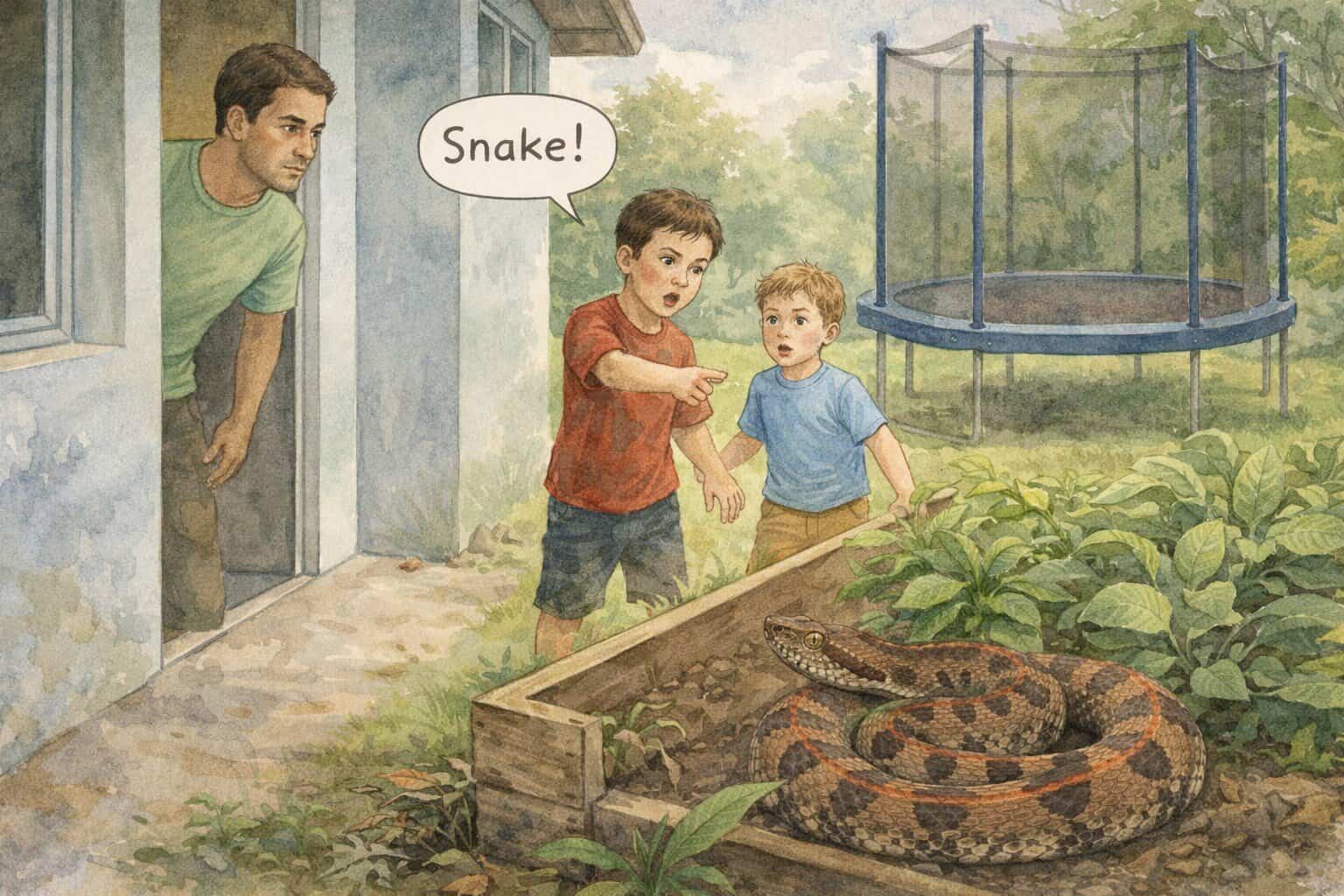
I had the interior of the house all to myself for approximately 30 seconds until he returned through the front door. Before I could start on a new round of “Go outside and plays” he cut me off with a single word, ‘Snake!’. I followed him into the yard, and he pointed to a skinny little snake all coiled up next to one of my wife’s garden beds. I knew what it was immediately, a dry forest hognosed pit viper.
The dry forest hognosed pit viper (Porthidium ophryomegas) is commonly known as the toboba chinga in Spanish. Though it has a brown, checkered pattern like a few other species of snake, I was able to identify it immediately because of the thin orange stripe visible down the length of the spine.
Though beautiful, it isn’t one of my favorite snakes to find in the yard because they are venomous. They’re a mostly terrestrial, mostly nocturnal snake that hunt via the ‘wait for the food to come to me’ method. When a small mammal, reptile, or amphibian gets too close to a well-camouflaged snake, they swiftly strike their prey. Generally, they bite and then quickly release their meal, letting their venom do its work.
These snakes are ovoviviparous which is a very fun word to say. Ovoviviparous species produce eggs that develop and hatch inside of the body, meaning the females give birth to live young. Sometime during the rainy season, the female gives birth to up to 15 six-inch little snakes.
The literature says there are few reports of dry forest hognosed pit vipers biting humans in Costa Rica, and the limited information available about the bites says that the effects of the venom are localized and relatively mild. Mild as a bite may be, I really can’t have a pit viper in the yard between the spinach patch and the trampoline with two little boys running around, so a snake removal was necessary.
My official stance on handling snakes is do not handle snakes. If you find a snake in an area where you don’t want a snake, call your local fire department. They are trained to come and help you out. I happen to have experience handling snakes and the proper tools to do so safely, so I relocated this young snake from the garden to a local forest. This is something that you shouldn’t do and, if my mom asks, I’m telling her I didn’t do it either. My official story is the firemen came and got it.
As I watched the little snake make its way into the forest, I realized that I’ve never written a Tico Times article about this species and I should get a quick cellphone video of it to accompany the article. I hope you enjoyed the article and I hope you enjoy the video below.